How to Grow Brussels Sprouts: Firm Soil, a Long Wait and Sweeter Sprouts After Frost
A practical guide to growing brussels sprouts, a long-season winter brassica that needs firm soil and staking to avoid loose blown sprouts, and tastes better after a frost.
When to sow & harvest
A rough guide for a temperate climate - shift it to your own zone and last-frost date. Greenhouse growing stretches both windows earlier and later.
Brussels sprouts are a proper winter crop, and growing your own can convert people who thought they hated them. The reason is simple: home-grown sprouts picked after a frost, cooked fresh, are sweet and nutty, nothing like the grey, bitter, overcooked ones that gave the vegetable its bad name. There is real satisfaction in walking out to a tall, sturdy stalk in December and twisting off enough sprouts for dinner.
They are not a quick crop, and they are not entirely hands-off. Brussels sprouts sit in the middle of the difficulty scale: the tasks are not hard, but the plants are big, hungry and long-lived, and they demand two things many beginners overlook - firm ground and support. Get those right, keep the pests off, and be patient across a long season, and you will grow sprouts worth eating. This guide covers the whole crop from spring sowing to winter picking.
Why grow brussels sprouts
The best reason is flavour and timing. Sprouts are at their finest in cold weather, and they actually improve after frost, which converts some of their starch to sugar and takes the edge off any bitterness. Home-grown, freshly picked, frost-sweetened sprouts are a genuinely different vegetable from the tired bags in the shops. They stand in the garden through the coldest months, giving you fresh greens when little else is cropping.
They are also generous. A single well-grown plant carries dozens of sprouts up its tall stalk, and you pick over each plant gradually across weeks, so a short row keeps a household going for much of the winter.
The honest trade-off is time and space. Sprouts occupy their ground for a long stretch, from a spring sowing right through to a winter harvest, and they are big plants. If your space is tight or you want fast turnover, that is a real cost. But if you have the room and the patience, few crops give you so much fresh food in the depths of winter.
Choosing a variety
Brussels sprouts are chosen mainly by when they mature, and spreading that across the season is the smart approach.
Early varieties are ready from autumn into early winter. They get you sprouts sooner, which is welcome, though the very best flavour tends to come after frost.
Late and maincrop varieties stand through the depths of winter and are bred to hold firm sprouts on the stalk in cold weather. These are the ones for Christmas and beyond, and generally the sweetest, having had the frost to improve them.
Growing an early and a late variety together stretches your harvest across many months rather than landing it all at once.
You will also see modern F1 hybrid varieties, which are widely recommended because they crop evenly, hold their sprouts tightly and resist "blowing" (going loose and open) better than many older kinds. For a reliable first crop, an F1 variety is a sound choice. Look too for any noted disease resistance if problems like clubroot are common in your soil.
Sowing and starting off
Sprouts have a long season, so they are started in spring, usually raised as young plants and then transplanted.
Sow in spring, either in a seed bed to lift and transplant later, or, more conveniently, in modules a couple of seeds per cell. Sow around a centimetre deep, keep the seed moist, and grow the seedlings on somewhere light. Raising them in modules gives you sturdy, well-rooted young plants that transplant cleanly.
When the young plants are large enough to handle and have a few true leaves, transplant them to their final positions. Space them generously - these become big plants and crowding gives poor, loose sprouts. Water the transplants in well.
Here is the point most beginners miss: brussels sprouts want firm ground. Plant them into soil that is settled and firm, not freshly dug and fluffy, and firm the soil well around each plant after planting, pressing it down around the stem. Loose soil lets the tall plants rock in the wind, which loosens the roots and leads directly to blown, open sprouts instead of tight buttons. Firm planting is not optional here - it is one of the keys to a good crop.
Where to grow
Brussels sprouts are an outdoor crop from start to finish, and they need an open, sunny, sheltered position in firm, fertile soil. They are hardy and positively want the cold, so there is no case for growing the crop under glass.
The only role protected growing plays is raising the young plants early in spring. A sowing in a greenhouse or cold frame gets sturdy seedlings ready to plant out, and that is all. After that, the plants belong outdoors in firm ground for their long life.
Because they are tall and long-standing, choose a spot that is not too exposed to strong wind, or be ready to stake them. And as brassicas, they fit into your brassica rotation, so avoid ground that recently grew cabbages, kale or other family members, which helps limit soil-borne disease.
Day-to-day care
Two jobs matter most with sprouts: keeping them firm and upright, and keeping them fed.
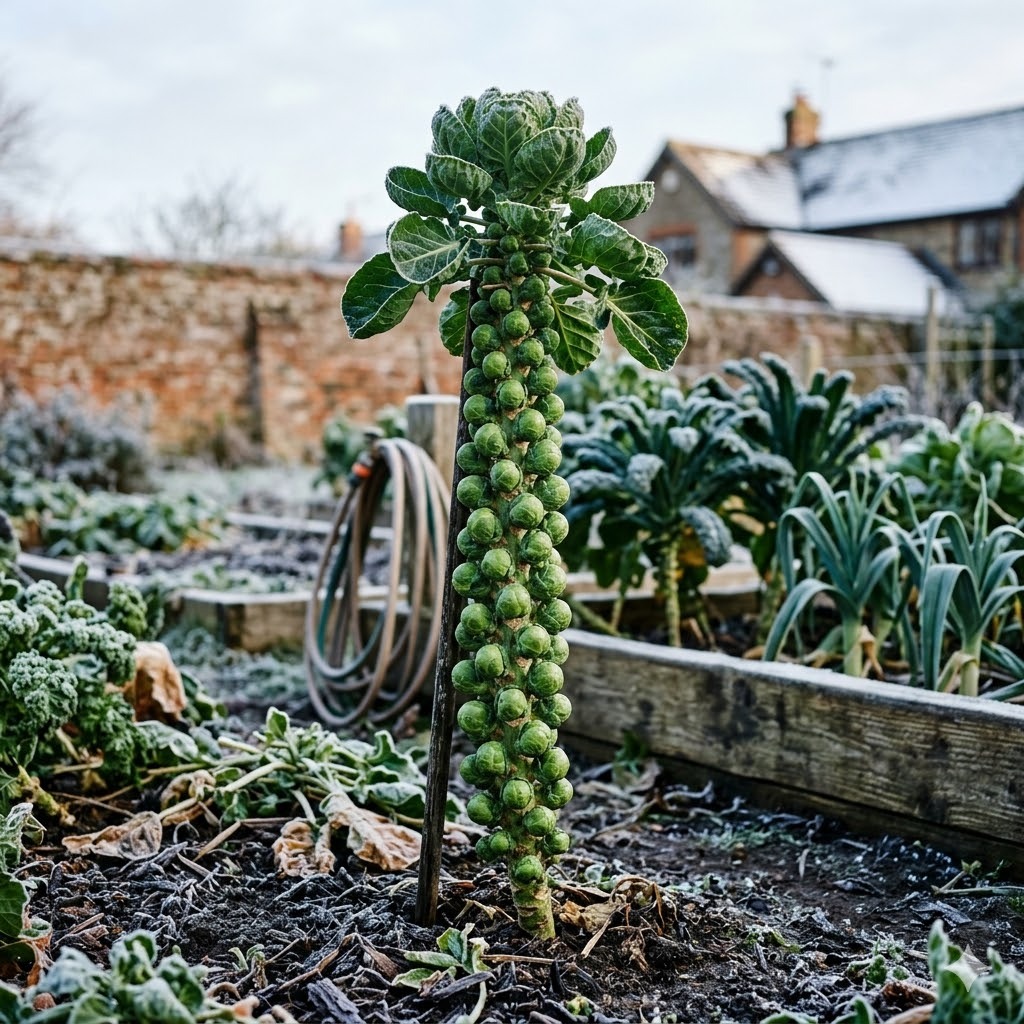
Staking is important, especially for the tall late varieties and on exposed sites. As the plants grow heavy and top-heavy, wind rocks them, loosening the roots and causing blown sprouts. Push a stake in beside each plant and tie it in, and draw a little soil up around the base for extra anchorage. Combined with firm planting, this keeps the plants steady and the sprouts tight.
Feeding matters because sprouts are hungry plants that grow large over a long season. Grow them in soil enriched with plenty of organic matter, and give a feed through the season on poorer ground. Steady, strong growth builds a good crop; starved plants give a poor one.
Water in dry spells, particularly while the plants are establishing and bulking up, since a serious check to growth harms the eventual crop. Keep the bed weeded so the plants are not competing. Some growers remove yellowing lower leaves through autumn to improve airflow and reduce disease, which is a sensible habit.
Common problems and pests
Sprouts share the brassica family's pests, and a couple can wreck an unprotected crop.
Cabbage white butterflies are the classic threat. Their caterpillars strip the leaves and can devastate plants in summer, so netting the crop with fine mesh from early on, before the butterflies start laying, is the reliable defence. It is far easier than picking off caterpillars once they have taken hold.
Pigeons are the winter menace. When other food is scarce, wood pigeons will strip the leaves off brassicas, and sprouts standing through the cold are a prime target. Netting the plants keeps the pigeons off, and this matters right through winter, not just in summer, so keep the crop covered.
Other issues to watch include cabbage root fly, which the young transplants are vulnerable to; whitefly, which cluster under the leaves; and mealy cabbage aphid. In acidic soils, clubroot can be a serious problem, distorting the roots and stunting the plants - liming the soil, improving drainage, good rotation and resistant varieties all help. Blown, loose sprouts, worth repeating, usually trace back not to a pest but to loose soil, rocking plants and over-rich growing, so firm planting and staking are your best insurance.
Harvesting
Patience pays off at harvest. Sprouts are ready from autumn through winter depending on variety, and the flavour is genuinely better once the plants have had a frost or two.
The sprouts mature from the bottom of the stalk upwards, so pick from the bottom up. Start with the lowest sprouts once they are firm, tight and a usable size, snapping or twisting each one off the stem, and work your way up the stalk over the following weeks as the higher sprouts fill out. This gradual, bottom-up picking is what lets a single plant feed you over a long stretch rather than all at once.
Take the lower leaves off as you go if it helps you get at the sprouts. Pick sprouts while they are still tight; once they start to open and loosen they are past their best.
At the very top of the stalk sits the leafy crown, sometimes called the sprout top, which is edible cooked like a cabbage or spring greens, so do not waste it when you finally clear the plant.
Storing and preserving
The simplest way to store sprouts is to leave them on the plant. Standing out in the winter garden, sprouts keep in excellent condition for weeks and improve with cold, so the growing plant is effectively your store. Pick them fresh as you need them right through the season.
Once picked, sprouts keep for a week or so in the fridge, and they hold longer if you leave them on a length of stalk rather than loose. Whole stalks cut and kept somewhere cool will store the sprouts for a good while.
For longer storage, sprouts freeze well, which is handy if you face a glut or want to clear plants before the ground is needed. Trim them, blanch briefly in boiling water, cool quickly in cold water, drain well and freeze. Blanching preserves colour and flavour and stops them going off in the freezer. Frozen sprouts soften on cooking but keep well for months.
Is it worth it?
For anyone with the space and patience, yes. Brussels sprouts ask a lot in one sense - a long season, big hungry plants, firm soil, staking and steady protection from pests and pigeons - but the reward is a generous, long-lasting supply of fresh vegetables through the coldest, leanest months, at their sweetest exactly when you most want warming winter food.
The honest caveats are the space and the two easy-to-miss essentials: plant into firm soil and support the plants, or you will get loose, blown sprouts no matter how well everything else goes. Get those right, net against cabbage whites and pigeons, and wait for the frost to sweeten them. Do that, and home-grown sprouts may well change your mind about a vegetable you thought you disliked.