How to Grow Carrots: Sweet, Crunchy Roots from Your Own Soil
A practical guide to growing carrots outdoors, from choosing the right variety and preparing loose stone-free soil to beating carrot root fly and storing your harvest through winter.
When to sow & harvest
A rough guide for a temperate climate - shift it to your own zone and last-frost date. Greenhouse growing stretches both windows earlier and later.
Why grow carrots
If you have only ever eaten shop carrots, the first home-grown one you pull can be a genuine surprise. Freshly lifted carrots are noticeably sweeter and crunchier than anything you buy, because the natural sugars start converting and the texture starts softening the moment a carrot leaves the ground. Supermarket carrots are often days or weeks old by the time they reach your kitchen. Yours can go from soil to plate in minutes.
Carrots are also one of the most space-efficient crops you can grow. They sit quietly in a narrow band of soil, need very little ongoing attention, and reward you with a long harvest window. You can pull baby carrots in early summer and keep lifting maincrops right through autumn and into winter.
They are not, however, a completely no-effort crop. Carrots are fussy about one thing above all: the soil they grow in. Get that right and the rest is straightforward. Get it wrong and you end up with twisted, forked, stubby roots. So most of the real work happens before you ever sow a seed.
Choosing a variety
Carrots are grouped mostly by shape and by season, and the right choice depends on your soil and when you want to harvest.
Early types such as Nantes and Amsterdam are quick, sweet and slender. Nantes carrots are blunt-tipped and reliable, a great all-rounder for a first attempt. Amsterdam types are even finer and faster, good for early sowings and for pulling young. These are the ones to sow first in spring for summer eating.
Maincrop types like Autumn King are larger, later and built for storage. They take longer to mature but give you big, robust roots that hold well in the ground or in store through winter. If you want carrots to keep, this is the group to grow.
Round or stump-rooted varieties such as the little globe types are worth knowing about if your soil is shallow or stony. Because they never grow a long taproot, they cope far better where a long carrot would hit an obstruction and fork.
Coloured carrots in purple, yellow and white are fun and genuinely tasty, though many of them are best eaten fresh rather than stored. They are a nice way to add variety once you have the basics working.
For a beginner, a good plan is one early variety for quick results and one maincrop for a winter store.
Sowing and starting off
The single most important thing to understand about carrots is that they hate being transplanted. Their taproot is easily damaged or bent when moved, which causes forking and stunting. So you always sow carrots direct, straight into the ground where they are going to grow. Forget modules and seed trays for this crop.
Before you sow, prepare the soil properly. Carrots need loose, deep, stone-free ground. Stones, clods and lumps of fresh manure all force the growing root to divide and twist, giving you those familiar forked and hairy carrots. So dig over the bed, remove stones, break up clumps, and rake it to a fine, crumbly tilth. Do not add fresh manure before sowing - it encourages forking and lush leaf at the expense of the root. If your soil is heavy, shallow or full of stones, the easiest fix is to grow in a deep container or a raised bed filled with a light, sifted, stone-free mix.
Sow thinly. This matters more than it sounds. Scatter or space the seed so plants come up with room around them, because thick sowing means heavy thinning later, and thinning carrots has a real cost (more on that below). Sow into a shallow drill about a centimetre deep, cover lightly, firm gently and water in.
Carrot seed is slow and sometimes patchy to germinate, often taking two to three weeks. Keep the soil consistently moist during this stage. To keep a steady supply rather than a glut, sow small amounts every few weeks from spring through to midsummer.
Greenhouse or garden - where to grow
Carrots are fundamentally an outdoor crop. They are hardy, they like the open ground, and they do not need protected growing to thrive. For almost all of your sowings, the garden bed or a deep outdoor container is exactly right.
A greenhouse or covered space has one useful role with carrots: extending the season at both ends. An early sowing under cover in late winter can give you tender carrots weeks ahead of outdoor crops, and a protected late sowing can push fresh pulling into the colder months. Beyond those bookends, there is no advantage to growing carrots inside, and the space is usually better given to crops that genuinely need the warmth.
So the honest answer is: grow carrots outdoors, and only reach for a greenhouse, cloche or fleece tunnel when you specifically want a very early or very late crop.
Day-to-day care
Once carrots are up and growing, they ask for very little, but two things make the difference between good roots and disappointing ones.
The first is watering. Carrots want steady, even moisture. The problem to avoid is erratic watering - letting the soil dry out hard and then soaking it. That sudden swing makes the roots take up water fast and split. Aim for consistent moisture rather than feast and famine, and mulch lightly if your soil dries quickly.
The second is thinning, and here you want to do as little as possible. If you sowed thinly you may barely need to thin at all, which is ideal. When you do have to remove crowded seedlings, do it carefully and sparingly. The reason is that bruised and disturbed carrot foliage releases a smell that carrot root fly can detect from a distance, and thinning is the moment you release the most of it. If you must thin, do it on a still, dull evening, remove the thinnings entirely rather than leaving them lying about, and firm the soil back around the plants you keep.
Beyond watering and careful thinning, keep the bed weeded so the carrots are not competing for light and moisture, and try not to fuss with the foliage more than you need to. Carrots do best when left largely alone.
Common problems and pests
The main enemy, by a wide margin, is carrot root fly. The adult fly lays eggs near carrot plants, and the larvae tunnel into the roots, leaving rusty brown channels that ruin the crop. It is the single biggest reason home carrots fail, so it is worth understanding how to beat it.
The most reliable defence is a physical barrier. Cover the crop with fine insect mesh or horticultural fleece, well secured at the edges so the low-flying females cannot get in. The mesh needs to be fine enough to exclude a small fly, and it should go on early and stay on.
A second, cheaper trick works because carrot root fly flies low. Growing carrots in a raised bed or tall container about 60cm or more above ground level puts the crop above the flies' usual flight path and cuts down attacks considerably.
You can also reduce your risk with good habits: sow thinly so you barely thin, avoid disturbing the foliage, and lift affected crops promptly. None of these alone is a guarantee, but together with mesh they make a real difference.
Other issues are mostly soil-related and largely preventable. Forked and split roots come from stones, fresh manure or erratic watering, all covered above. Green shoulders on the tops of roots come from sunlight exposure and are easily fixed by drawing a little soil over the crowns. Overall, if you sort out soil, watering and root fly, carrots give you very little trouble.
Harvesting
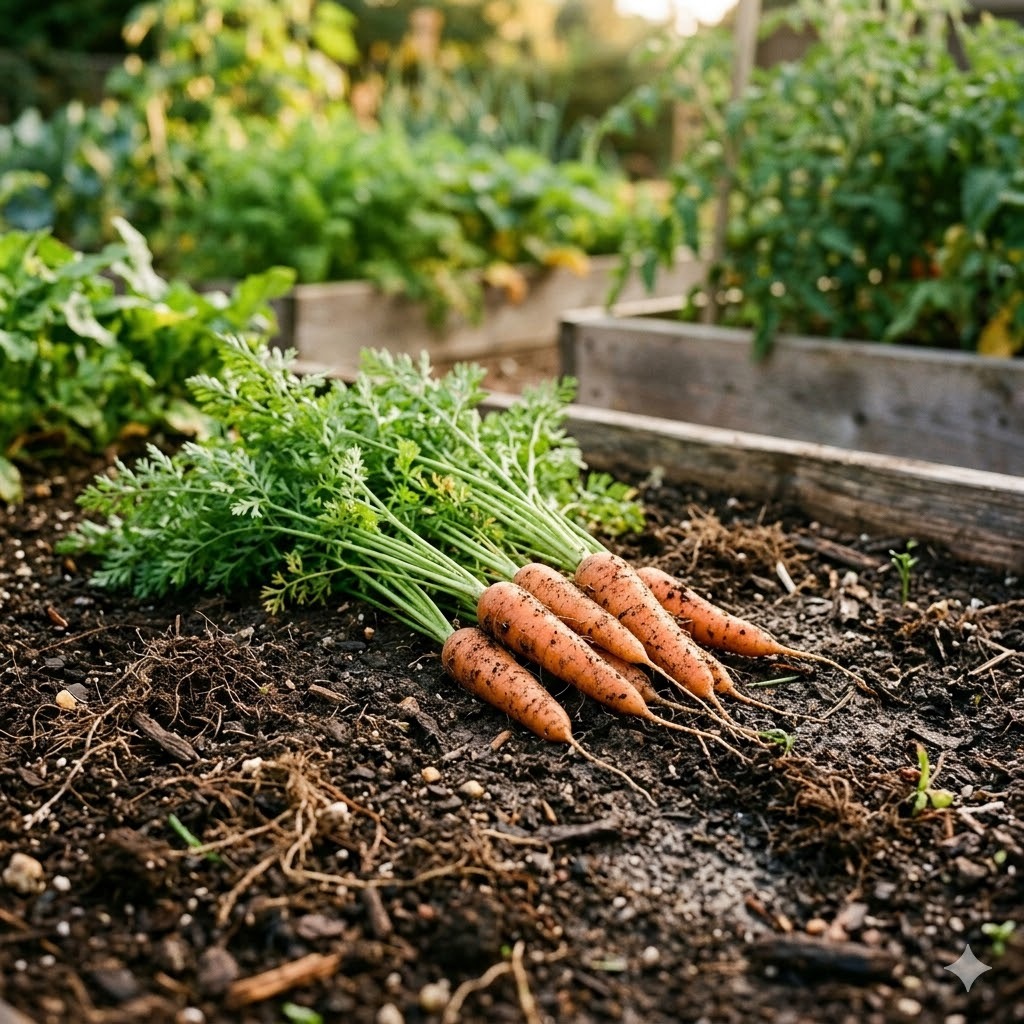
One of the pleasures of carrots is that there is no single harvest day. You simply pull them as you need them. Start lifting early carrots young and small for the sweetest, most tender eating, and let others size up if you want fuller roots.
To harvest, grip the base of the leaves close to the soil and pull steadily, easing the root out rather than snapping the top off. If the ground is dry and firm, water it first or loosen alongside the row with a fork so the roots come up cleanly.
Maincrop carrots can be left in the ground and lifted as required well into autumn. In many gardens you can keep pulling fresh carrots long after the growing season has ended, which is one of the crop's best features.
Storing and preserving
If you grow more than you can eat fresh, carrots store well with a couple of simple methods.
The traditional approach for maincrops is to lift them, twist off the tops, and pack the roots in boxes of just-moist sand or dry compost, layered so they do not touch. Kept somewhere cool, dark and frost-free, they will hold for months.
An even simpler option in milder areas is to leave maincrop carrots in the ground where they grew and cover the row with a thick layer of mulch such as straw or leaves. The mulch protects them from hard frost, and you lift them straight from the soil as needed through winter. Just be aware that leaving them in the ground longer keeps them exposed to soil pests, so it suits well-drained beds best.
For longer-term storage, carrots freeze well but need blanching first. Peel and slice or dice them, blanch briefly in boiling water, cool quickly in iced water, drain and freeze. Blanching stops the enzymes that would otherwise turn frozen carrots soft and off-flavoured.
Is it worth it?
For most home gardeners, carrots are absolutely worth growing - with one honest caveat. If your soil is stony, shallow or heavy clay, and you refuse to improve it or switch to a raised bed or deep container, you will be disappointed. Carrots are the one crop where you cannot skip the soil preparation.
But put in that bit of groundwork, protect against carrot root fly, and water steadily, and carrots become one of the most satisfying and low-maintenance crops in the garden. They take little space, keep giving over a long season, store for winter, and taste dramatically better than anything from a shop. For the sweetness alone, they earn their place in the bed.