How to Grow Leeks: Long, Sweet Stems That Stand All Winter
A practical guide to growing leeks from spring sowing to winter lifting, including how to blanch long white stems the easy way and stay ahead of leek moth and rust.
When to sow & harvest
A rough guide for a temperate climate - shift it to your own zone and last-frost date. Greenhouse growing stretches both windows earlier and later.
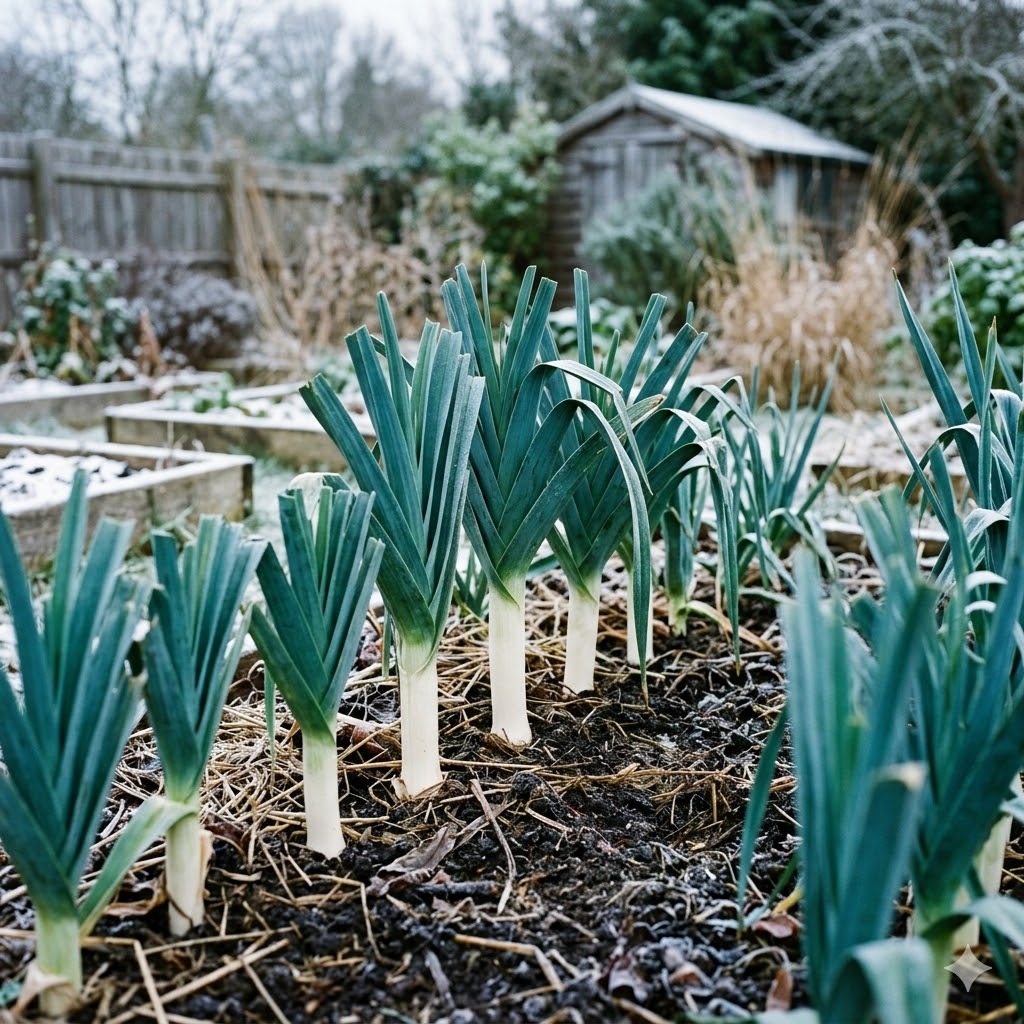
Leeks are one of those crops that quietly earn their keep. They take a long time in the ground, but they ask for very little while they are there, and they hand you fresh vegetables in the depths of winter when almost nothing else is standing. A row of leeks in December, thick and green and shrugging off the frost, is a genuinely reassuring sight.
They are not the fastest crop, and they are not quite as forgiving as, say, a turnip. But leeks sit comfortably in the middle: not a first-week beginner project, yet nowhere near as demanding as celery. If you can sow seed, wait patiently, and do one slightly odd planting trick, you will grow good leeks. This guide walks through the whole season, from that spring sowing to lifting stems out of frozen ground.
Why grow leeks
The main reason is timing. Leeks fill the hungry gap. You sow them in spring, they bulk up quietly through summer and autumn, and then they stand out in the garden all winter, ready to be lifted whenever you want one. Because they are so hardy, you do not have to harvest them all at once or race to store them. The ground itself is your larder.
They are also more useful in the kitchen than a lot of people realise, giving a milder, sweeter flavour than onions and holding their shape in soups, gratins and stews. Home-grown leeks tend to be cleaner-tasting and better textured than shop ones, partly because you can grow varieties chosen for flavour rather than for surviving a supply chain.
Finally, they are undemanding once established. There is no daily fussing. After planting, leeks mostly want to be left alone, kept weeded and watered in dry spells, and that is about it.
Choosing a variety
Leeks are grouped mainly by how early or late they mature, and this matters because it decides when you will be eating them.
Early varieties are ready from late summer into autumn. They tend to be taller and more slender, with a milder flavour, but they are generally less hardy, so they are for eating before the worst of the cold arrives.
Maincrop and late varieties are the winter workhorses. These are shorter, thicker, tougher plants bred to stand through hard frost, often with darker, blue-green leaves. If your main aim is fresh leeks from November through to early spring, this is the group to grow.
A sensible plan is to grow one early type for autumn eating and one hardy late type for the deep winter. That way you spread the harvest across many months rather than facing a glut.
You will also see varieties described as resistant to rust, which is worth seeking out if leek rust has been a problem in your garden before.
Sowing and starting off
Leeks have a long season, so they are usually started early. Sow in spring, from around late winter under cover to mid-spring outdoors. There are two common approaches.
The first is to sow in a seed bed or a module tray and grow the young plants on until they are about the thickness of a pencil, which is the ideal size for transplanting. Sow the seed thinly, a centimetre or so deep, keep it moist, and be patient - leek seedlings look like fine grass at first.
The second is to sow in modules, a few seeds per cell, and plant them out as small clumps. This is easier and gives you a decent crop of slightly slimmer leeks.
Either way, the key stage is transplanting, and this is where leeks do their one unusual trick. When your young plants are about pencil-thick, lift them carefully and, if you like, trim the very tips of the leaves and roots. Then make a deep hole with a dibber, around 15cm deep, and simply drop one plant into each hole. Do not backfill the hole with soil and do not firm it. Instead, water into the hole. The water washes just enough soil down around the roots to settle the plant, while leaving that long shaft of empty space around the stem. As the leek grows, the buried part of the stem stays white and tender because it is shielded from light. That is how you get those long blanched stems without any hard work.
Where to grow
Leeks are an outdoor crop through and through. They are hardy, they like an open sunny or lightly shaded spot, and they have no need of a greenhouse for the bulk of their life.
The only role protected growing plays is at the very start. An early sowing under cover in late winter, in a greenhouse, cold frame or on a windowsill, gets your young plants to transplanting size a little sooner, which can bring the harvest forward. Beyond raising those early seedlings, there is no benefit to keeping leeks under glass, and the space is far better used for tender crops that actually need the warmth.
So raise the seedlings wherever is convenient, but grow the crop itself out in the open ground.
Day-to-day care
Once your leeks are planted into their deep holes and watered in, the day-to-day demands are light.
Keep them weeded, especially in the early weeks when the young plants are small and easily swamped. Leeks do not compete well with vigorous weeds, so a clean bed pays off.
Water in dry spells. Leeks are not as thirsty as celery, but a long dry summer will check their growth, so give them a good soak when the weather turns hot and rainless. Steady moisture through summer builds bigger, sweeter stems.
If you want to lengthen the white part even further, you can gently draw a little soil up around the stems as they grow, a process called earthing up. Do it in stages and take care not to let soil fall down into the centre of the plant, where it lodges between the leaves and is a nuisance to wash out later. Earthing up is optional - the deep dibber hole already does most of the blanching for you.
A light feed midway through the season does no harm on poorer soil, but leeks are not heavy feeders in the way that, say, brussels sprouts are.
Common problems and pests
Two problems are worth watching for above the rest.
The first is leek moth. The adult moth lays eggs on the plants, and the caterpillars tunnel into the leaves and down into the stems, leaving pale patches, tunnels and a general mess. In areas where it is established it can be a serious pest. The most reliable defence is to cover the crop with fine insect mesh from early in the season so the moths cannot lay on the plants. Clearing away affected leaves and rotating where you grow leeks each year also helps.
The second is leek rust, a fungal disease that shows as bright orange or rusty pustules on the leaves. It is more common in wet seasons and on crowded, poorly ventilated plants. Mild attacks are more cosmetic than fatal, and the plants often grow through it, but bad cases weaken the crop. Reduce your risk by not planting too closely, avoiding overly rich nitrogen feeding, rotating your beds, and choosing rust-resistant varieties if it is a recurring problem. Remove and dispose of badly affected leaves rather than composting them.
Onion white rot can also affect leeks in soil where it is present, and it persists for years, so avoid growing leeks or onions repeatedly in the same ground.
Harvesting
There is no rush with leeks, which is one of their best features. You lift them as you want them, straight from the ground, right through autumn and winter.
Start harvesting once the stems have thickened to a useful size, and simply continue as the season goes on. To lift a leek, ease it out with a fork rather than yanking on the leaves, because the roots hold firm and the top can snap off. Loosen the soil alongside, then lift gently.
Because leeks are so hardy, you can leave them standing in the ground and take them one or two at a time over a long stretch. In very hard frosts the ground may freeze solid around them, so it can be worth lifting a few in advance during a mild spell so you always have some to hand.
Come spring, any leeks left in the ground will eventually start to send up a flower stem, going tough and woody in the centre. Try to use them all before that happens.
Storing and preserving
The simplest storage method with leeks is to leave them where they grew. Standing out in the winter garden, they hold perfectly well for weeks, so most people treat the bed itself as the store and lift as needed.
If you do need to clear the ground, or a hard freeze is coming, you can lift leeks and heel them in - that is, dig a shallow trench in a sheltered corner, lay the leeks in at an angle, and cover the roots and lower stems with soil. They will keep in good condition there for a few weeks.
Lifted leeks also keep for a week or two in the fridge, ideally trimmed and loosely wrapped so they do not dry out.
For longer storage, leeks freeze well. Trim, slice and wash them thoroughly to remove grit, then blanch briefly in boiling water, cool quickly, drain and freeze. Frozen leeks are excellent in soups and stews, though they lose their crispness, so they are best used cooked rather than raw.
Is it worth it?
Yes, with one honest caveat: leeks are a long-haul crop. From spring sowing to winter lifting is the best part of a year, and they occupy their patch of ground for that whole time. If you are short on space and want quick turnover, that commitment can feel steep.
But if you have the room to spare, leeks are one of the most rewarding things you can grow. They are hardy enough to laugh off frost, they need almost no daily attention, they give you fresh vegetables in the bleakest months, and the one clever planting trick that produces those long white stems is genuinely satisfying to pull off. For winter cooking especially, a standing row of leeks is hard to beat.