How to Grow Parsley: The Slow-Starting Herb That Pays You Back for Months
Parsley tests your patience at the seed tray and then rewards it with a long, generous harvest, so learn to start it right and keep it cropping.
When to sow & harvest
A rough guide for a temperate climate - shift it to your own zone and last-frost date. Greenhouse growing stretches both windows earlier and later.
Why grow parsley
Parsley is the workhorse of the kitchen herb bed. It is not glamorous and it will not win you compliments the way basil or coriander might, but once it gets going it just keeps producing, week after week, often well into the cold months when almost everything else has given up.
That is the honest appeal. Parsley is slow to start - genuinely slow, in a way that catches out a lot of beginners - but if you can get past that first frustrating stretch, you get a plant that crops steadily for the best part of a year. It is hardy enough to keep picking through light frosts, it grows happily in a pot or a windowsill box, and a couple of plants supply more than most households can use.
It also earns its keep in cooking. Flat-leaf parsley in particular carries real flavour, not just decoration, and a handful stirred into almost anything at the end lifts the whole dish. If you buy those little supermarket packs and watch half of each one rot in the fridge, growing your own quickly starts to look sensible.
Choosing a variety
There are two types worth knowing, and the choice comes down to what you cook.
Flat-leaf parsley, also sold as Italian parsley, has the stronger flavour. The leaves look a bit like coriander, and this is the one to grow if you actually cook with parsley - chopping it into sauces, stews, tabbouleh, salsa verde, that sort of thing. Most gardeners who use parsley in earnest settle on flat-leaf.
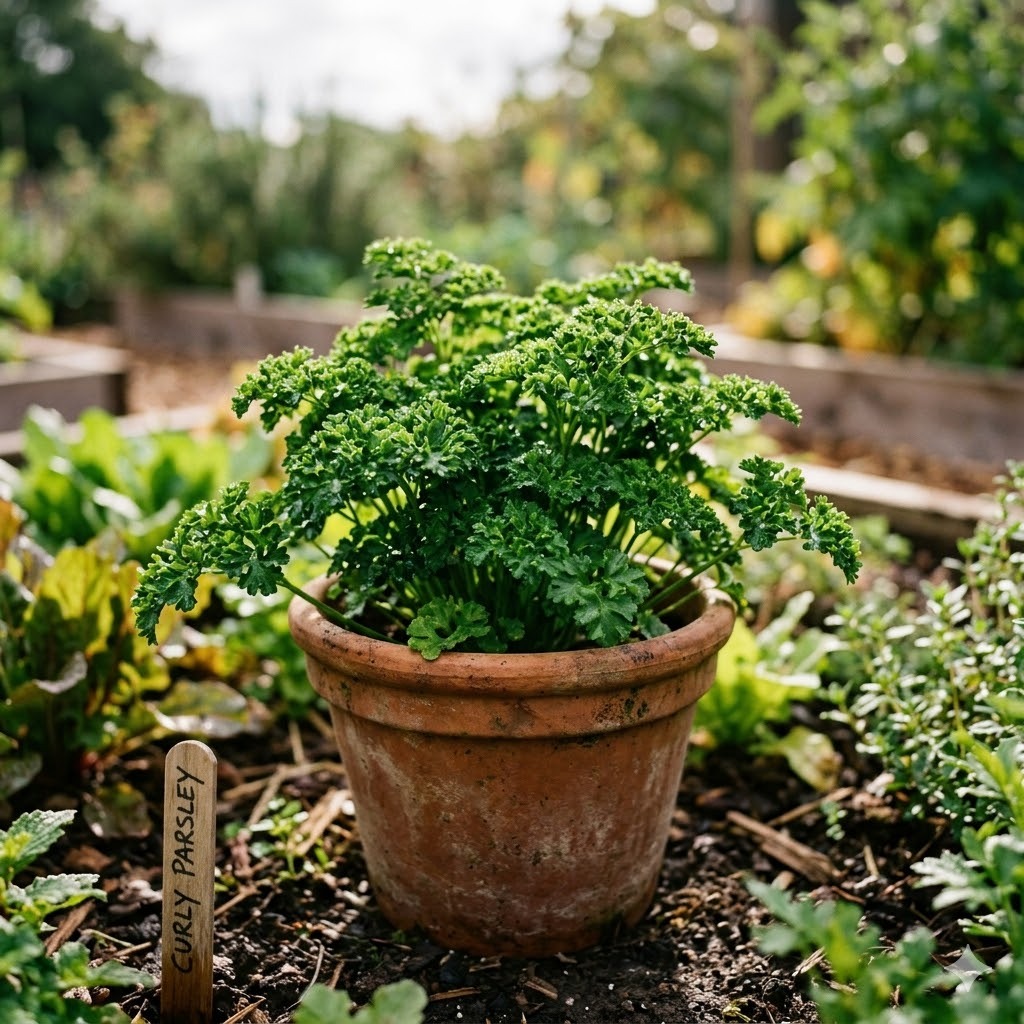
Curly parsley is milder and has the tightly ruffled leaves you see used as a garnish on a plate. The flavour is gentler and the plant looks tougher and more ornamental, which some people like in a bed or pot. It is a perfectly good herb, just less punchy.
There is no wrong answer. If you are unsure, grow one plant of each the first year and see which you reach for. Beyond the flat-leaf versus curly split the named varieties do not differ enormously, so do not agonise over the seed catalogue.
Sowing and starting off
Here is the part where honesty matters most. Parsley is famously slow and erratic to germinate. Two weeks is normal. Four or five weeks is not unusual. This has nothing to do with old wives' tales about parsley seed visiting the devil and back before it sprouts. It is just a slow seed, and knowing that in advance saves you from throwing out a tray that was about to come good.
A few things genuinely help. Soak the seed in water overnight before sowing - this softens the seed coat and takes the edge off the delay. Sow into warmth, ideally somewhere around 18-20C, because cold soil makes an already slow seed even slower. And keep the compost consistently moist the whole time, never letting it dry out, because a dry patch mid-germination will stall or kill the seedlings.
Sow from spring through to summer. Parsley does not love having its roots disturbed, so I would module-sow it - a few seeds into each cell of a module tray - and transplant the whole plug gently when it is big enough, without teasing the roots apart. You can also sow direct into the ground or a pot once the soil has warmed; that avoids transplanting altogether, you just have to be patient waiting for the row to appear.
Do not sow the whole packet at once expecting it all to come up together. Germination is patchy, so it is normal for some seedlings to appear a week or more after their neighbours.
Greenhouse or garden - where to grow
Parsley is happy outdoors and does not need protection to grow well, so treat a greenhouse as optional rather than necessary.
Outdoors it wants rich, moist soil and does not mind a bit of shade, especially in high summer. In fact part shade is often better than full sun in the hottest weeks, because parsley run dry and hot turns tough and bitter. A spot that gets morning sun and some afternoon shade, with soil that holds moisture, suits it well.
It also grows genuinely well in containers, which is worth knowing if you are short on ground. A decent pot on a patio, or a trough on a windowsill, keeps parsley within arm's reach of the kitchen. The main thing with pots is watering, since they dry out faster than open ground.
Where a greenhouse or a cloche earns its place is at the end of the season. Parsley is hardy and will keep going through light frosts anyway, but a bit of cover extends the useful picking window further into winter and keeps the leaves in better condition. If you have the space under glass, moving a pot in for the cold months gives you fresh parsley when the outdoor plants have slowed to a crawl.
Day-to-day care
Once parsley is up and growing, the care is simple and mostly comes down to water. Keep it moist. Dry parsley is tough, stringy and bitter, and stress from drought also pushes it towards bolting, so consistent watering is the single most useful habit. Containers especially need checking often in warm weather.
Feed is welcome but not fussy. Parsley likes rich soil, so if you started it in ground with plenty of organic matter it will do most of the work itself. In pots, where nutrients run out faster, an occasional liquid feed through the main growing season keeps the leaves coming and the colour good.
Beyond that, keep the area reasonably weed-free while the plants are small and slow, since young parsley competes poorly, and pick regularly. Regular picking is itself a form of care - it keeps the plant producing fresh growth from the centre rather than getting old and tired.
Common problems and pests
The most common problem is not really a problem at all: slow germination mistaken for failure. Countless trays of parsley get tipped onto the compost heap a few days before they would have come up. Give it the full four or five weeks before you write it off.
Carrot root fly is worth watching for, because parsley is in the same family as carrots and the larvae can attack its roots. If you grow carrots and cover them against this pest, it is sensible to give parsley the same consideration, particularly if it is in the ground near a carrot bed.
Aphids can gather on the leaves and stems, especially on stressed or crowded plants. A jet of water, squashing by hand, or encouraging ladybirds usually keeps them in check without anything drastic.
Celery leaf spot is a fungal disease that shows as small brown spots on the foliage; it spreads more in damp, crowded conditions, so good spacing and airflow help, and you can remove badly affected leaves.
Finally, bolting. Remember parsley is a biennial - it makes leaf in its first year, then in its second year it runs up to flower and set seed, and the leaf quality drops off once it does. Bolting can also come early if the plant is stressed by heat or drought in year one. The practical answer is to treat parsley as an annual and sow fresh each year rather than trying to nurse old plants through a second season for leaf.
Harvesting
Parsley is a cut-and-come-again herb, and how you pick makes a real difference to how long it lasts.
Take the outer stems first, cutting or snapping them off low down at the base of the plant, and leave the central growing point untouched. New leaves push up from the middle, so as long as you keep harvesting from the outside in, the plant keeps replacing what you take. Picking the odd leaf from here and there off the top is less effective than removing whole outer stems cleanly.
Harvest regularly rather than in big occasional raids. Frequent light picking actually encourages fresh growth, and a healthy plant grown this way crops for many months. Start once the plant is established with a decent clump of leaves - there is no need to wait for it to be huge.
Because parsley shrugs off light frost, you can keep picking well into autumn and, with a little cover, beyond. That long harvest window is the whole point of the plant.
Storing and preserving
Fresh parsley keeps for a few days in the fridge, ideally with the stems in a little water or wrapped in a damp cloth, but the herb does not store fresh for long. When you have a glut, preserve it.
Freezing is the best method by a clear margin. Chop the parsley and pack it into small bags or, better still, spoon it into an ice cube tray, top up with a little water or oil, and freeze into cubes you can drop straight into a pan. Frozen this way parsley keeps its colour and most of its flavour, and it is ready to use with no thawing needed.
Drying is possible but I would not lean on it. Parsley loses a lot of its flavour when dried, ending up faintly grassy and much weaker than the fresh or frozen leaf, so it is a poor substitute if you actually want that bright parsley taste.
Another good route is to lock the flavour into something else while it is fresh. Beating chopped parsley into softened butter and freezing it in a log, or blitzing it into a green sauce, both preserve the herb in a genuinely useful form and sidestep the flavour loss you get from drying.
Is it worth it?
Yes, with one honest caveat. Parsley asks for patience at the very start, and if slow, uneven germination is going to make you give up in the second week, it may frustrate you. Go in knowing it is simply slow, and the plant repays you many times over.
For a small amount of effort - soaking seed, sowing in warmth, keeping it watered - you get an herb that crops for the best part of a year, survives light frost, grows in a pot or windowsill as well as a bed, and freezes brilliantly for the winter. Compared with buying wilting supermarket packs and binning half of each one, a couple of home-grown plants are cheaper, fresher and far more generous. It is one of the most quietly useful things you can grow.