How to Grow Pecans: A Handsome Tree With Rich, Buttery Nuts
A realistic guide to growing pecans, from planting a young tree in winter to autumn harvest, and why in cool climates the tree earns its place as much for shade as for nuts.
When to sow & harvest
A rough guide for a temperate climate - shift it to your own zone and last-frost date. Greenhouse growing stretches both windows earlier and later.
Pecans are a warm-climate nut, and there is no getting around that at the outset. The pecan is a species of hickory from the southern United States, a tree built for long, hot, humid summers that ripen its rich, buttery kernels over many weeks. Grow one in a genuinely warm spot and you can be rewarded with the finest nut most people never manage to grow at home. Grow one in a cool, short-summer garden and you will still get a magnificent tree, but the nuts become a bonus rather than a promise.
This guide is honest about that split. If you garden somewhere with reliably hot summers, a pecan is a long-term crop worth planting for the harvest. If you garden somewhere cooler and wetter, treat it first as a beautiful, spreading shade tree with handsome foliage, and see any nuts it manages to ripen as a happy accident. Either way, this is an advanced, patient project. You plant a young tree in winter, wait years for it to settle and mature, and harvest in autumn. Nobody grows pecans for a quick return.
Why grow pecans
The obvious reason is the nut itself. A properly ripened pecan is soft, oily and sweet, with a richness that makes a walnut seem plain by comparison. Home-grown, freshly cracked pecans are a genuine luxury, and if your climate can ripen them, few crops repay the wait so handsomely. They are excellent raw, toasted, or baked into things, and they store well once dried.
The less obvious reason, and the one that matters most in cool climates, is the tree. A pecan is a large, graceful hickory with long divided leaves that cast beautiful dappled shade and colour up in autumn. It makes a fine specimen or shade tree in its own right, quite apart from any crop. If you have the space and you like the idea of planting something that will outlive you, a pecan earns its keep as a landscape tree even in a garden that never ripens a single nut.
There is also the simple satisfaction of growing something unusual and slightly ambitious. Pecans are not a common sight in home gardens outside their warm heartland, so raising one at all is a quiet achievement. Just go in with clear eyes: this is a slow, long-term planting, not a productive crop you will be eating from in a few seasons.
Choosing a variety
The first choice is not really about variety at all but about honesty over your climate. Pecans need a long, hot growing season to ripen their nuts fully, so before you fuss over cultivars, be realistic about whether your summers can deliver that heat. In marginal areas, look for the earliest-ripening, most cold-tolerant selections you can find, because these give you the best slim chance of a crop before autumn closes in.
Where you can get named cultivars, they are broadly grouped by how early they ripen and by their pollination type. Pecans have an unusual habit where a tree tends to shed its pollen and receive pollen at slightly different times, which means a single lone tree often pollinates itself poorly. For this reason it is well worth planting two different compatible cultivars so their timing overlaps and each helps pollinate the other. Even where a variety is described as partly self-fertile, a second tree noticeably improves the set.
If nuts are genuinely your aim, seek out grafted, named trees rather than unknown seedlings. A grafted tree of a known cultivar will crop sooner and more reliably, and you know what you are getting. Seedling pecans are cheaper and make perfectly good shade trees, but they are a lottery for nut quality and can take even longer to bear.
In short: choose the earliest-ripening cultivars for your area, plan for two trees for pollination, and prefer grafted named stock if the harvest matters to you.
Sowing and starting off
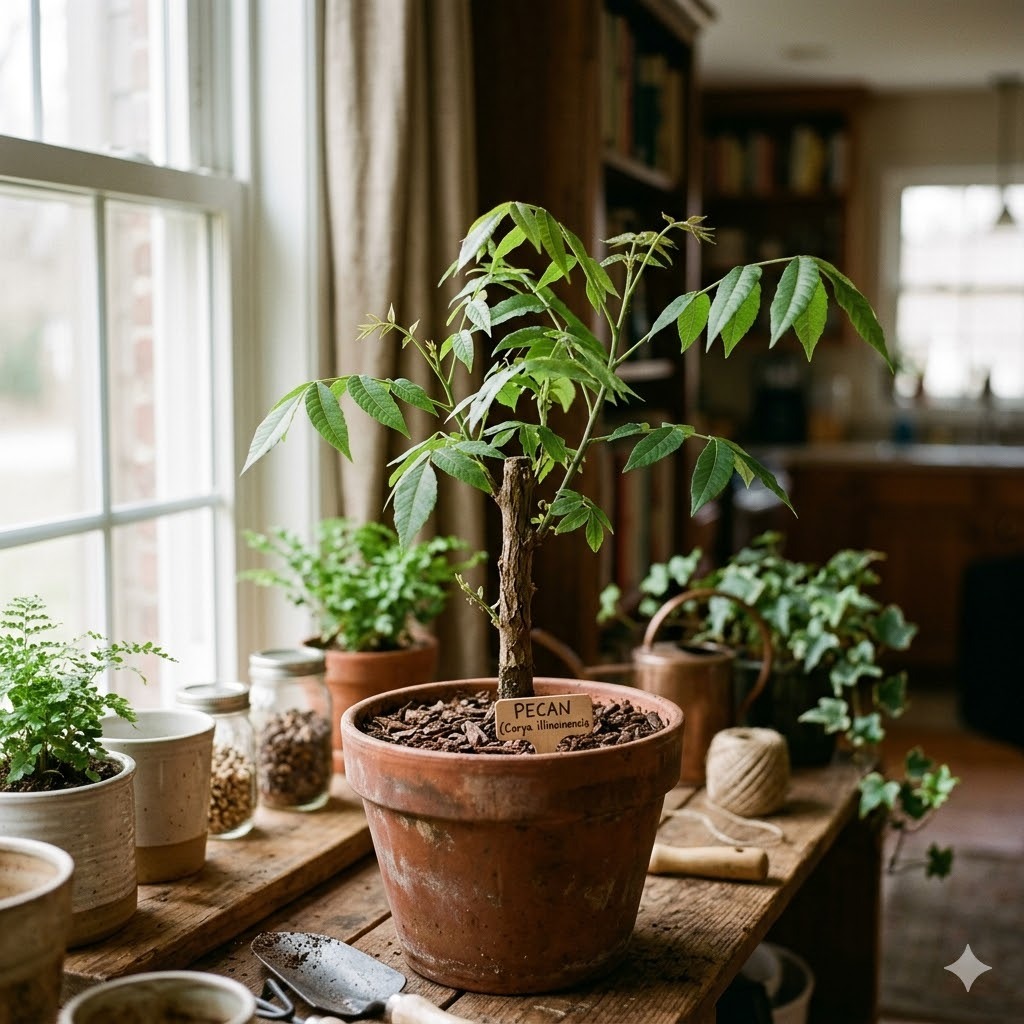
Most people begin with a young tree rather than raising a pecan from a nut, and in a cool climate that is by far the sensible route because it saves you several years. Plant bare-root or containerised young trees in winter, during the dormant season, when the tree is not in active growth. Winter planting lets the roots settle before the demands of spring.
Pecans have a long, deep taproot, and this shapes everything about how you plant them. Young trees resent having that taproot disturbed or bent, so handle them carefully and plant them without delay. Dig a deep hole that lets the taproot go straight down rather than curling round, spread out any side roots, and set the tree at the same depth it was growing before. Firm the soil gently, water it in well, and stake it if the site is exposed. Because of that taproot, pecans also transplant badly once established, so choose the final position carefully and plant to stay put.
If you do want to try raising one from a nut, sow a fresh, viable pecan in autumn or give it a cold, moist period over winter before spring sowing, then be prepared for a very slow start and an unknown result. Honestly, for a cool-climate garden, buying a young grafted tree is the wiser path. Whichever way you begin, the theme is the same: get the young tree in during winter, protect that taproot, and settle it before spring.
Where to grow
Pecans are big trees that want the hottest, sunniest, most sheltered spot you can give them. Full sun is essential, both to ripen the wood and to have any chance of ripening the nuts, so never tuck a pecan into shade. In a cool climate, a warm south-facing position against the reflected heat of a wall or in a sheltered sun-trap gives it the best possible summer.
Give it room. This is a large, spreading tree in the long run, so plant it well away from buildings, drains and other trees, and picture the mature canopy, not the slender young whip in your hand. If you are planting two for pollination, space them so both have light and air but are still close enough for pollen to travel between them.
Soil matters too. Pecans like a deep, fertile, free-draining soil that their taproot can drive down into. They dislike waterlogged, shallow or heavy ground that stays wet in winter, so avoid low, boggy spots. Deep soil suits their rooting habit and helps them ride out dry spells once established.
This is emphatically an outdoor, in-the-ground tree. It is far too large for a greenhouse or a permanent life in a pot, so the choice is simply the warmest, sunniest, deepest-soiled corner of your garden.
Day-to-day care
The good news is that an established pecan needs little fussing. The work is front-loaded into the early years while the tree settles and builds its frame.
In the first few seasons, keep the young tree well watered, especially through dry summers, because a deep drink helps that taproot establish. Keep the base clear of grass and weeds with a mulch, which conserves moisture and stops competition, but keep the mulch off the trunk itself. A stake and tie in an exposed spot will stop the young tree rocking until its roots take hold.
Feeding is best kept modest. A young pecan appreciates reasonable fertility to build growth, but do not force it with heavy nitrogen, which encourages soft, lush wood that will not ripen well before autumn. On decent soil, an annual mulch of compost is usually enough.
Pruning is light. In the early years you can shape the young tree to a sound framework with a clear central leader and well-spaced branches, doing this while it is dormant in winter. Once the shape is set, mature pecans need very little pruning beyond removing dead, damaged or crossing wood. Beyond that, the main day-to-day task is patience. A pecan grows steadily for years before it thinks about cropping, and there is simply no way to hurry it.
Common problems and pests
The single biggest problem in a cool climate is not a pest or a disease at all: it is the weather. If your summers are too short or too cool, the nuts simply will not fill and ripen properly, and you may get few nuts or none. This is not something you can spray or prune away. It is the fundamental limit of growing a warm-climate tree in the wrong place, and it is exactly why cool-climate gardeners are wise to value the tree for its shade and see nuts as a bonus.
Where pecans do crop, they can be prone to alternate bearing, meaning a heavy year is often followed by a light one as the tree recovers. This is normal for many nut trees and not a sign anything is wrong.
Among living pests, squirrels and other wildlife are the main competition for any nuts that do ripen, and they are frustratingly good at stripping a crop just as it matures. There is no easy answer beyond harvesting promptly. In damp climates, fungal leaf and nut diseases such as scab can affect susceptible trees, showing as dark blotches on leaves and husks, though in cooler areas where the tree is grown more for looks this is less of a concern. Choosing more disease-resistant cultivars where you have the choice helps.
Otherwise, an established pecan is a tough, long-lived tree with few serious troubles. Most of the frustration a cool-climate grower feels comes down to that one honest fact about summer heat.
Harvesting
Harvest comes in autumn, and only once the tree is mature enough to bear, which can be several years or more after planting. Do not expect nuts from a young tree, and do not be surprised if a marginal climate delivers them late, sparsely, or not at all.
When pecans are ready, the green outer husks split open and the nuts inside are ripe. Many simply fall to the ground, which is the easiest harvest of all: you gather them up from beneath the tree. You can also gently shake branches or knock them to bring down nuts that are ready. Collect them promptly, both because they are better fresh and because wildlife will help themselves if you leave them lying.
Once gathered, remove any clinging bits of husk and sort out any that are shrivelled, mouldy or clearly empty. In a good, warm season the shells will be plump and heavy; in a poor season you may find a lot of light, unfilled shells, which is simply the price of a cool climate. Pick over your harvest, keep the good ones, and do not be disheartened if the yield is modest. Even a handful of home-ripened pecans is a real treat.
Storing and preserving
Fresh-harvested pecans need drying, or curing, before they store well. Spread the cleaned, in-shell nuts out in a single layer somewhere dry, airy and out of direct sun for a couple of weeks so the kernels firm up and any surface moisture goes. Well-cured nuts feel light and the kernels snap crisply rather than bending.
Once dried, pecans keep best in their shells in a cool, dry, airy place, and stored this way they will last for several months. Because pecans are so rich in oil, they can eventually turn rancid, and warmth speeds that up, so cool storage really matters.
For longer keeping, pecans do very well in the fridge or freezer, either in the shell or shelled. Shelled kernels in a sealed container will keep for many months in the fridge and even longer frozen, staying fresh and sweet far beyond what a cupboard allows. If you have shelled a large batch, freezing is the reliable way to hold on to that rich flavour.
Shelling itself takes a little effort, as pecan shells are fairly hard, but a good nutcracker makes short work of it, and the intact halves are worth the fiddling.
Is it worth it?
The honest answer depends entirely on where you garden. If you have long, hot summers, a pecan is absolutely worth planting: it is a superb nut you can rarely buy truly fresh, and a magnificent tree into the bargain. Plant two for pollination, give them deep warm soil and full sun, and be patient, and in time you will be well rewarded.
If you garden somewhere cool and short-summered, be clear-eyed. The nuts are marginal and slow, and in some years you may get none. But the tree itself is beautiful, long-lived and generous with shade, and there is real pleasure in growing something ambitious. Plant a pecan in a cool climate as a handsome shade tree first, hope for nuts second, and you will not be disappointed. Go in expecting reliable harvests from cool ground, and you probably will be. Either way, it is a tree for the patient gardener who plants for the long term.