How to Grow Sweet Chestnuts: The Real Roasting Chestnut for Your Garden
A practical guide to growing sweet chestnuts from a winter planting to an autumn harvest, including why they need warm summers, the right acid soil, and how to tell them apart from the toxic horse chestnut.
When to sow & harvest
A rough guide for a temperate climate - shift it to your own zone and last-frost date. Greenhouse growing stretches both windows earlier and later.
The sweet chestnut is the tree behind the roasting chestnuts of winter, the glossy brown nuts you pull hot from the fire or buy from a street brazier in December. Growing your own is a real pleasure, but it comes with one absolutely vital point to understand first, and it is worth stating plainly at the very start: the sweet chestnut is not the same as the horse chestnut, the tree that produces conkers. Horse chestnut conkers are toxic and must never be eaten. The two trees are entirely unrelated despite the similar name, and this guide is only about the edible sweet chestnut, Castanea sativa.
With that cleared up, the sweet chestnut is a big, fast-growing, handsome tree that rewards a warm, sheltered garden with a crop of sweet nuts encased in fiercely spiny burrs. It is not the fussiest nut to grow, but it is particular about two things: it needs a warm summer to ripen its nuts, and it strongly prefers a light, slightly acid soil, disliking chalk and lime. This guide walks through the whole business, from choosing and planting bare-root in winter, through the gloves-on autumn harvest, to storing a crop that, unlike walnuts, will not keep for long.
Why grow sweet chestnuts
The obvious reason is the nuts. There is nothing quite like your own roasted chestnuts on a cold evening, and the flavour of a fresh, home-grown chestnut, sweet and floury, is a world away from the sometimes tired specimens in the shops. Chestnuts are one of the few nuts you cook and eat almost like a vegetable, roasted, boiled, made into stuffing or puree, and having your own supply is a genuine seasonal luxury.
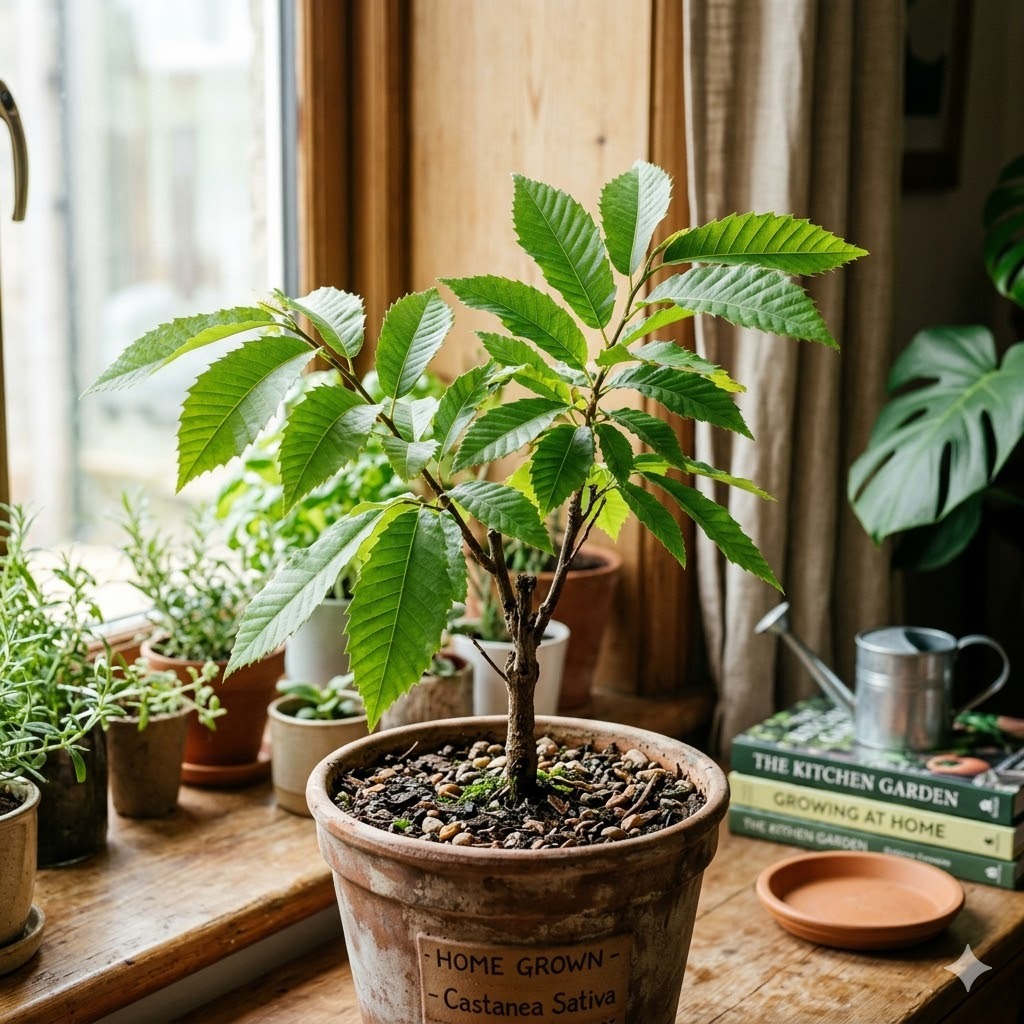
The tree itself is also a fine thing. Sweet chestnut grows quickly and becomes a large, majestic specimen with handsome long, glossy, saw-toothed leaves and a deeply ridged, spiralling bark that is one of the most characterful of any tree. In a big garden it makes a superb feature, and it is long-lived, so like a walnut it is partly a tree you plant for the future.
Sweet chestnut also has the useful habit of coppicing well, meaning it regrows strongly if cut back, which is why it has long been grown for poles and fencing timber. For the home grower that mostly means a mature tree can be rejuvenated if it outgrows its space, though a full-sized chestnut is a big commitment either way.
Choosing a variety
The species to plant is the sweet chestnut, Castanea sativa, and it is worth double-checking the label when you buy, precisely because of the confusion with the inedible horse chestnut. A reputable nursery selling it as an edible or fruiting tree will be selling the right thing, but it never hurts to confirm you are buying Castanea and not the ornamental conker tree.
As with walnuts, the big decision is between a plain seedling tree and a grafted, named variety, and the difference is significant. A seedling chestnut is cheaper but slower to crop and variable in nut size and quality. A grafted named variety is bred for good, large nuts and generally crops sooner and more reliably. For a home garden where you want the best nuts in the shortest time, a grafted named variety is the sensible choice. Many of the finest named chestnut varieties come from warmer countries where the tree is a serious crop, and these often produce the large, single-kernelled nuts prized for roasting.
Pollination is worth thinking about. Sweet chestnuts are wind-pollinated and, although a single tree may set some nuts, they crop far better with a second, different variety nearby for cross-pollination. Where you have room, plant two different trees for a reliable harvest. If space only allows one, choose a variety known to crop reasonably on its own, but expect lighter yields. In a cooler climate, it is also worth seeking out varieties selected for earlier ripening, so the nuts have the best chance of maturing before autumn closes in.
Planting and starting off
Sweet chestnuts are planted in the dormant season, and bare-root trees, sold through the winter without soil on the roots, establish well and are the most economical way to buy. As with all nut trees, a younger, smaller tree transplants more successfully than a large one and often catches up quickly, so resist the temptation to buy the biggest specimen.
Choose the position thoughtfully, because a sweet chestnut becomes a very large tree and cannot easily be moved once settled. Dig a wide hole, deep enough to take the roots comfortably, and plant at the same depth the tree grew before, shown by the soil mark on the stem. Firm the soil gently around the roots, water in well, and stake the young tree securely for the first few years, as chestnuts grow fast and can catch the wind while their roots are still shallow.
Because the tree grows both quickly and large, give it plenty of space. A single garden tree needs an open position with room to spread widely over the years, well clear of buildings and boundaries, and if you are planting two for pollination, allow a good 10 metres or more between them. Underestimating the eventual size is the commonest mistake with chestnuts, so err on the side of too much space.
Protect the young stem from rabbits and deer with a guard, keep the base clear of grass and weeds while the tree establishes, and a mulch of compost or bark over the root zone after planting will conserve moisture and suppress weeds.
Where to grow
The two things a sweet chestnut cares most about are warmth and soil, and getting both right is the key to a good crop.
Warmth first. The sweet chestnut is at heart a tree of warmer climates, and it needs a good, warm summer to ripen its burrs and fill the nuts. In a cool, dull summer, or in a cold northern garden, the tree will grow perfectly well but may set few nuts or fail to ripen them properly, leaving you with small, empty or immature kernels. So give it the warmest, sunniest, most sheltered position you can, a spot that catches the sun and is protected from cold winds. Frost pockets are best avoided, as late frosts can damage the young growth. In a genuinely cold region, expect the tree to be more of a handsome ornamental than a reliable cropper, and choose an early-ripening variety to give it the best chance.
Soil is the second decisive factor. Sweet chestnut strongly prefers a light, free-draining, slightly acid soil, ideally a sandy or gravelly loam. What it particularly dislikes is chalk and lime, and on shallow chalky or strongly alkaline ground it grows poorly, often becoming stunted and yellow. If your soil is chalky, the sweet chestnut is probably not the tree for you, and this is one of its firmest requirements. Good drainage matters too, as it will not tolerate heavy, wet, waterlogged ground.
Put simply, the ideal is a warm, sheltered, sunny spot on a light, slightly acid, well-drained soil. The further your garden is from that ideal, the lighter the crop is likely to be.
Day-to-day care
A young sweet chestnut needs the usual care of any new tree in its first few years: keep the base free of grass and weeds, water well in dry spells, and check the stake and tie so they hold the tree firm without rubbing. As a fast grower, it will make good progress once settled.
Once established, the tree is largely self-reliant. Feeding is seldom necessary on a suitable soil, and an annual spring mulch of compost over the roots is generally all it wants. Because the tree dislikes lime, do not add lime or mushroom compost, which is often alkaline, around it. Avoid heavy nitrogen feeding, which produces soft growth rather than nuts.
Pruning is minimal. Sweet chestnut naturally forms a good shape, so beyond removing dead, damaged, crossing or crowded branches there is little to do. Any pruning is best done in late summer or when the tree is dormant, keeping cuts small. In the early years you may want to encourage a single strong central leader by removing competing shoots, but otherwise the tree is best left to grow into its natural form. If an old tree outgrows its space it can be cut back hard and will regrow, thanks to its coppicing habit, though this is a drastic step for a garden specimen.
Common problems and pests
The most fundamental problem is not a pest at all but climate: in a cool summer or a cold garden, the tree simply may not ripen a decent crop, however healthy it looks. This is the honest limitation of growing chestnuts in a marginal climate, and no amount of care fully overcomes a lack of summer warmth.
Where pests are concerned, squirrels are again a serious rival, taking nuts as they ripen, and there is little to be done on a large tree beyond gathering the crop promptly. Various caterpillars and the occasional infestation of the developing nuts by grubs can also occur, leaving nuts hollow or spoiled, and clearing fallen debris helps keep numbers down.
Among diseases, the two most talked-about are chestnut blight and ink disease, both of which are serious problems where they occur and can kill trees. Ink disease, a root and collar rot that thrives in wet soils, is another good reason to insist on the free-draining ground the tree prefers in the first place. Buying healthy stock from a reputable nursery and giving the tree the light, well-drained, slightly acid soil it wants are the best protections. On a well-sited garden tree, serious disease is the exception rather than the rule, but it is sensible to keep an eye on the health of the trunk and foliage.
Harvesting
Sweet chestnuts ripen in autumn, typically from around October, and the signal that they are ready is unmistakable: the spiny green burrs turn brown and split open, and the glossy nuts inside begin to fall to the ground.
Here comes the practical warning that every chestnut grower learns quickly. The burrs are armed with fierce, needle-sharp spines, and handling them bare-handed is genuinely painful. Wear thick, sturdy gloves for the entire harvest, and stout footwear too if you are treading among fallen burrs. The easiest method is to gather the ripe nuts from the ground as they drop, ideally daily so squirrels and damp do not spoil them, either picking the fallen nuts that have already come free of their burrs or using a gloved hand, or even feet, to press open the split burrs and release the nuts.
Take the plump, well-filled nuts and discard any that feel light, as these are empty or immature, a particular risk in a cool season. A quick test is to drop the nuts in water: the good, dense ones sink, while empty or spoiled ones tend to float. Sort as you go, and keep only the sound, heavy nuts for storing.
Storing and preserving
Here is the important difference from walnuts and hazelnuts: fresh sweet chestnuts do not store nearly as long. They are moist, starchy nuts rather than dry, oily ones, so they cannot simply be dried and kept in a bowl for months. Left in the warm they quickly dry out, go hard and mouldy, or begin to rot, so they need more care and are best thought of as a crop to use within a few weeks unless you preserve them properly.
For short-term keeping, store fresh chestnuts somewhere cool and slightly humid, such as the fridge in a perforated bag, where they will hold for a few weeks. Check them over and remove any that go soft or mouldy. Some growers first cure or condition the nuts for a few days in a cool, airy place, which can improve the flavour by allowing some of the starch to convert to sugar, before moving them to cold storage.
For longer keeping, the best methods are freezing and drying. To freeze, it is usual to prepare the chestnuts first: scoring, cooking or peeling them, since the shells and inner skins are troublesome to remove. Cooked and peeled chestnuts freeze well and are then ready to use straight from the freezer in stuffings, soups and purees. Alternatively, chestnuts can be dried until hard for long-term storage and later reconstituted by soaking and cooking, a traditional method in the countries where they are a staple. Whichever you choose, plan to process a chestnut crop fairly promptly, rather than leaving it sitting around as you might with a bag of walnuts.
Is it worth it?
The answer hinges almost entirely on your climate and your soil. If you garden somewhere with warm summers, on a light, slightly acid, free-draining soil, and you have room for a large tree, then a sweet chestnut is a wonderful thing to grow, giving you the real roasting chestnut fresh from your own garden and a magnificent, characterful tree into the bargain. Few crops feel more seasonal or more rewarding on a winter evening.
But be honest about the requirements. In a cold garden or a cool-summer climate, the tree may grow handsomely yet crop poorly, and on chalky or limy soil it will struggle from the start. It also becomes a big tree that needs real space, the harvest demands thick gloves against those vicious burrs, and the nuts will not keep like walnuts, so you must use or preserve them fairly soon. And, of course, never confuse it with the toxic horse chestnut, whose conkers must not be eaten. Match the tree to a warm spot on the right soil, and the sweet chestnut is a superb and characterful crop; ask it to grow where it does not want to, and it will politely refuse to fill its burrs.