How to Grow Tomatoes: The Crop That Earns Its Space
A practical guide to raising tomatoes in a greenhouse or an outdoor bed, from your first seed tray to a winter shelf of passata.
When to sow & harvest
A rough guide for a temperate climate - shift it to your own zone and last-frost date. Greenhouse growing stretches both windows earlier and later.
Tomatoes are the crop most people start with, and there is a good reason for that. They are forgiving enough for a first-time grower, but they reward attention in a way that keeps you coming back season after season. A shop tomato and one you have picked warm off the vine are barely the same fruit. This guide walks you through the whole run, from sowing a tray in early spring to storing the glut in autumn, with honest notes on what tends to go wrong along the way.
Why grow tomatoes
The short answer is flavour. A ripe tomato picked at the right moment tastes of something, where supermarket fruit is bred for shelf life and long-haul transport rather than eating. Growing your own also opens up varieties you will never see for sale: striped heirlooms, tiny sweet cherries, meaty beefsteaks for slicing.
They are productive, too. A single healthy cordon plant can give you several kilos of fruit across a summer, and a row of them will hand you more than you can eat fresh, which is where the preserving section later comes in. Tomatoes are classed as a fruiting crop and they genuinely fruit all summer once they get going, from midsummer until the first cold snap ends the run.
They are a beginner-friendly crop, but "beginner" does not mean "no effort." Tomatoes want steady watering and a bit of routine care. Give them that and they are one of the most satisfying things you can grow.
Choosing a variety
The single most important choice is not the flavour, the colour, or the size. It is the growth habit, because it dictates how you grow and support the plant.
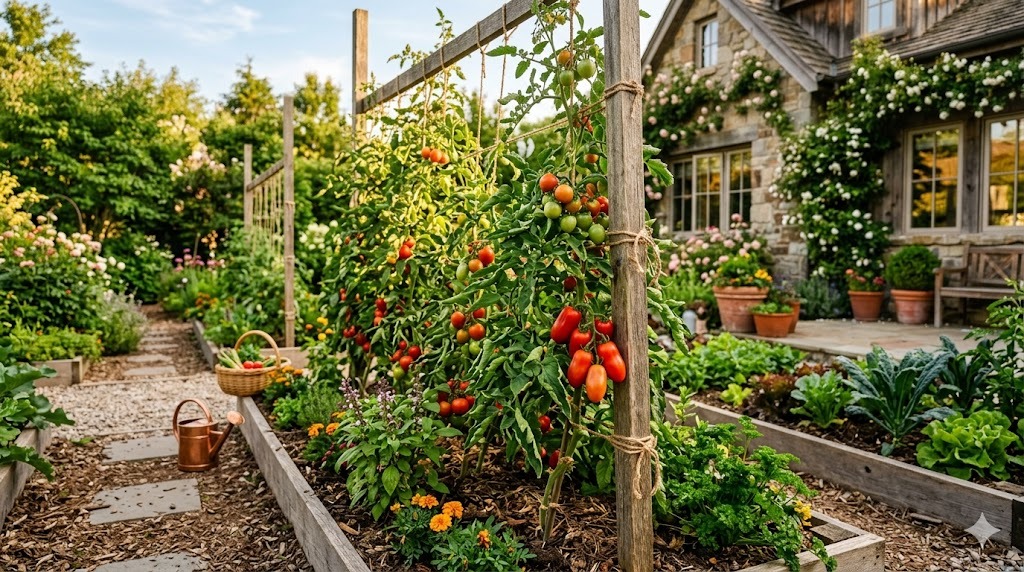
Cordon (indeterminate) varieties grow as a single tall stem that keeps extending all season, often to 1.8 metres or more. You train them up a string or cane, remove the side-shoots, and they fruit steadily over a long period. Most greenhouse tomatoes and many classic outdoor ones are cordons: think 'Gardener's Delight', 'Sungold', 'Alicante', 'Shirley'. They need support and regular pinching, but they crop heavily in a small footprint.
Bush (determinate) varieties grow to a set size, then stop and set most of their fruit in a shorter window. They need little or no side-shooting and often need less support, which makes them well suited to containers, hanging baskets, and outdoor beds where you do not want fiddly maintenance. 'Roma', 'Tumbling Tom', and many patio types are bush.
If you are unsure, a good starting pair is one reliable cherry cordon (they are hard to fail with and taste superb) and one bush type if you want a low-fuss plant or a container crop. For sauce and preserving, a plum or 'Roma' type has fewer seeds and less water, so it cooks down well. For outdoor growing in a cool or wet climate, look specifically for blight-resistant varieties such as 'Crimson Crush' or the 'Mountain Magic' type, because blight is the outdoor grower's main enemy.
Sowing and starting off
Tomatoes are a warm-season crop and they hate cold, so timing is tied to your last frost date rather than the calendar. Sow indoors 6 to 8 weeks before your last expected frost. For much of the UK that means late February to early April, earlier if you have a heated greenhouse to move them into, later if you are growing outdoors in a cold spot.
Sow the seed thinly on the surface of moist seed compost, cover with a light dusting of compost or vermiculite, and keep them warm, around 18 to 21C. A windowsill above a radiator or a heated propagator both work. Germination usually takes 5 to 10 days. As soon as seedlings are up, get them into the brightest light you can, because warmth without light gives you tall, weak, leggy plants that flop over.
When each seedling has its first pair of true leaves (the second set, which look tomato-shaped rather than the plain oval seed leaves), pot them on into individual 9cm pots. Tomatoes are unusual in that you can bury the stem deeper than it sat before, right up to the lowest leaves, and it will grow extra roots along the buried stem. This makes for a stronger plant.
Keep potting on into larger pots as they grow so they never get root-bound and starved. About a week or two before they go outside or into an unheated greenhouse, harden them off: put them out during the day and bring them in at night, gradually leaving them out longer, so the shift from cosy windowsill to real weather is not a shock. Do not plant out until all danger of frost has passed. A single frost will kill an unprotected tomato.
Greenhouse or garden - where to grow
This is where the two routes really diverge, and it is worth being clear-eyed about the trade-offs.
Greenhouse growing is earlier, longer, cleaner, and more reliable. The warmth lets you plant out weeks sooner and keeps plants cropping later into autumn, so you get a noticeably longer harvest. The big win is that keeping the leaves dry and the air warm dramatically reduces the risk of blight, which is a wet-weather, outdoor-air disease. Greenhouse plants also ripen more fruit in a cool climate because they get the heat they crave.
The catch is that a greenhouse is a closed box. It gets very hot in high summer, so you must ventilate hard on warm days, open doors and vents, and damp down the floor to keep humidity up and stop plants stressing. Enclosed warmth also suits pests, whitefly and red spider mite in particular, so you have to keep an eye out. And you must water diligently, because nothing dries out a pot faster than a sunny greenhouse.
Outdoor growing is simpler in some ways: rain does some of the watering, and there is natural airflow, so red spider mite and whitefly are far less of a problem. The downsides are a shorter, later season and the ever-present threat of blight in a wet summer, which can wipe out a healthy-looking crop in days. Outdoors, choose a warm, sheltered, sunny spot, grow blight-resistant varieties, and give plants space and airflow.
A practical middle path many gardeners use: start everything in the greenhouse, keep the cordons in there for the reliable long crop, and put a few tough bush or blight-resistant plants outdoors as a bonus. Space plants about 45 to 60cm apart in beds, or one per large (30cm plus) pot or growbag position.
Day-to-day care
Once plants are in their final home, the routine is where the crop is won or lost.
Support and training. Tie cordons loosely to a cane or twist them up a string as they grow. For cordons, remove the side-shoots - the small shoots that appear in the "armpit" between the main stem and each leaf. Pinch them out while small so the plant puts its energy into fruit rather than a tangle of stems. Bush types do not need this; leave them be. When a cordon reaches the top of its support or you have four or five good trusses of fruit, pinch out the growing tip so it ripens what it has rather than starting new fruit it cannot finish.
Watering is the single biggest thing to get right, and consistency matters more than volume. Water regularly and evenly so the soil never swings from bone dry to soaking. Erratic watering is the direct cause of two of the most common complaints: blossom end rot (a sunken dark patch on the base of the fruit, caused by calcium not reaching the fruit when watering is uneven) and split or cracked fruit (when a dry plant suddenly gets a lot of water and the fruit swells faster than its skin). Containers and growbags dry out fastest and need the most attention, often daily in summer heat.
Feeding. Until the first flowers appear, plants do not need much beyond good compost. Once flowering starts, feed with a high-potash tomato feed, following the pack rate, usually once a week. Potash drives flowering and fruiting; too much nitrogen at this stage gives you a jungle of leaves and little fruit.
Remove yellowing lower leaves as the plant grows, especially those touching the soil, to improve airflow and reduce disease.
Common problems and pests
Tomatoes are hardy, but a handful of issues turn up again and again.
Blight is the big one, mainly outdoors and in wet summers. Brown patches appear on leaves and stems, then the fruit rots. There is no cure once a plant has it; you remove and bin (do not compost) affected plants to slow the spread. Prevention is everything: grow under cover, choose resistant varieties, and keep leaves dry and airflow good.
Blossom end rot, described above, is not a disease and not contagious. It is a watering and calcium problem. Fix your watering routine and later fruit will come clean.
Splitting is likewise a watering issue - steady moisture prevents it.
Whitefly are tiny white insects that fly up in a cloud when you disturb a plant, most common under cover. They weaken plants and leave sticky honeydew. Yellow sticky traps help you monitor and catch them, and biological controls (the parasitic wasp Encarsia) work well in a greenhouse.
Red spider mite thrives in hot, dry greenhouse air, giving fine mottling and webbing on leaves. Damping down to raise humidity is the simplest deterrent.
Aphids can cluster on soft new growth; a squash by hand or a jet of water usually keeps them in check early.
Harvesting
Pick tomatoes when they are fully coloured and come away from the plant with a gentle twist, ideally warm from the sun, which is when they taste best. Regular picking encourages the plant to keep producing, so do not let ripe fruit sit.
As the season cools and light fades, the plant will slow and some fruit will stubbornly stay green. This is normal and not a failure. Green tomatoes ripen happily indoors. Bring them in and leave them on a warm windowsill, or in a paper bag or bowl with a ripe banana or apple, whose natural ethylene gas speeds ripening. At the very end of the season you can lift whole plants and hang them upside down somewhere frost-free to ripen the last of the crop. Whatever refuses to ripen becomes green tomato chutney, which is a genuinely good thing rather than a consolation prize.
Storing and preserving
A good year gives you far more than you can eat fresh, so it pays to have a plan.
Passata and sauce. The classic use for a glut. Cook down ripe tomatoes (plum types are best) into a smooth sauce or passata and either freeze it in portions or process it in sterilised jars for the shelf. This is the most useful thing you can do with a big harvest.
Freezing. The simplest method of all. You can freeze tomatoes whole and unpeeled straight onto a tray, then bag them; the skins slip off easily under a warm tap later, and they are perfect for cooking (though not for salads, as freezing softens them).
Drying. Slow-roasting or dehydrating slices concentrates the flavour into intense, chewy pieces you can store in oil or freeze. Cherry and plum types dry particularly well.
Chutney. Both ripe and green tomatoes make excellent chutney, and it is the standard rescue for the unripe fruit left at the end of the season. Sealed jars keep for many months.
Do not store fresh tomatoes in the fridge if you can help it - cold dulls their flavour and turns the texture mealy. Keep them at room temperature and eat them at their best.
Is it worth it?
Honestly, yes, more so than almost any other crop for the space and effort. The gap between a home-grown tomato and a shop one is enormous, the plants are productive, and the routine - a weekly feed, steady watering, pinching out side-shoots - is light once you have the habit.
If you have a greenhouse, tomatoes are close to a sure thing: earlier, longer, and largely free of the blight that troubles outdoor crops. If you are growing outdoors, go in with blight-resistant varieties and a sunny, airy spot, and accept that a wet summer is a gamble. Either way, one season usually hooks people for good, because few things in the garden pay you back as generously as a summer of tomatoes and a winter shelf of your own passata.