How to Grow Walnuts: A Magnificent Tree for the Truly Patient Gardener
A practical guide to growing walnuts from a bare-root winter planting to an autumn harvest, including the long wait before cropping, how much space they need, and why little grows beneath them.
When to sow & harvest
A rough guide for a temperate climate - shift it to your own zone and last-frost date. Greenhouse growing stretches both windows earlier and later.
Growing a walnut is less a piece of gardening than an act of faith in the future. A walnut is a magnificent, long-lived tree that can stand for a century or more, growing into a huge, spreading specimen that shades a whole corner of a garden. In return for that grandeur, it asks two things of you: a great deal of space, and a great deal of patience. A walnut planted today may take ten years or more before it crops well, and a seedling tree longer still.
This is not a crop for a small plot or an impatient grower. But if you have the room, the right kind of soil and a willingness to plant for the long term, a walnut is one of the most rewarding trees you can put in the ground. This guide is honest about the demands, from the years of waiting to the strange fact that little will grow beneath the tree, and walks through choosing, planting bare-root in winter, and finally harvesting nuts in autumn.
Why grow walnuts
The first reason is the tree itself. A mature walnut is a genuinely beautiful thing, broad-crowned and stately, casting cool shade in summer and turning a soft gold in autumn. Even setting the nuts aside, it is a specimen tree of real character, the kind that defines a garden and outlives the people who plant it.
Then there are the nuts. Home-grown walnuts, dried and stored, are far better than most shop-bought ones, richer and less bitter, and a productive mature tree can crop heavily. There is also the treat of the fresh, or wet, walnut in early autumn, eaten within days of picking, with a milky, mild sweetness that dried nuts lose entirely. And walnuts picked green in early summer, before the shell hardens, are the traditional raw material for pickled walnuts, a distinctly old-fashioned pleasure.
Finally, a walnut is a legacy. Because it is so slow and so long-lived, planting one is a gift to the future as much as to yourself. Many of the finest walnut trees in the country were planted by people who never tasted a nut from them. If you have the space and the patience, joining that tradition is quietly satisfying.
Choosing a variety
For eating, the tree you want is the common or English walnut, Juglans regia. This is the species behind virtually all edible walnuts, and it is the one to plant for a decent kitchen crop. Other walnuts exist, such as the black walnut, which is grown more for timber and has a hard-shelled nut that is far more difficult to crack, so unless you specifically want it, stick with the common walnut.
Within the common walnut, the single most important choice is between a seedling tree and a grafted, named variety, and it makes an enormous difference to how long you wait. A seedling walnut, grown from a nut, is cheap but slow, often taking well over a decade, sometimes fifteen years or more, to crop, and the quality of its nuts is a lottery. A grafted named variety, by contrast, is a known quantity bred for good nuts, and crucially it crops years sooner, sometimes within five or six years of planting. For a home garden, a grafted named variety is almost always the better buy despite the higher price. The years you save are worth it.
Look for named varieties chosen for reliability and earlier cropping. Some are self-fertile enough to crop with a single tree, while others do better with a second walnut nearby for pollination, so it is worth asking the nursery about the pollination habits of any variety you are considering. Where space allows, two trees give a more reliable crop. Also consider that walnuts flower in spring and the young growth can be caught by late frosts, so later-leafing varieties are safer in cold or frost-prone gardens.
Planting and starting off
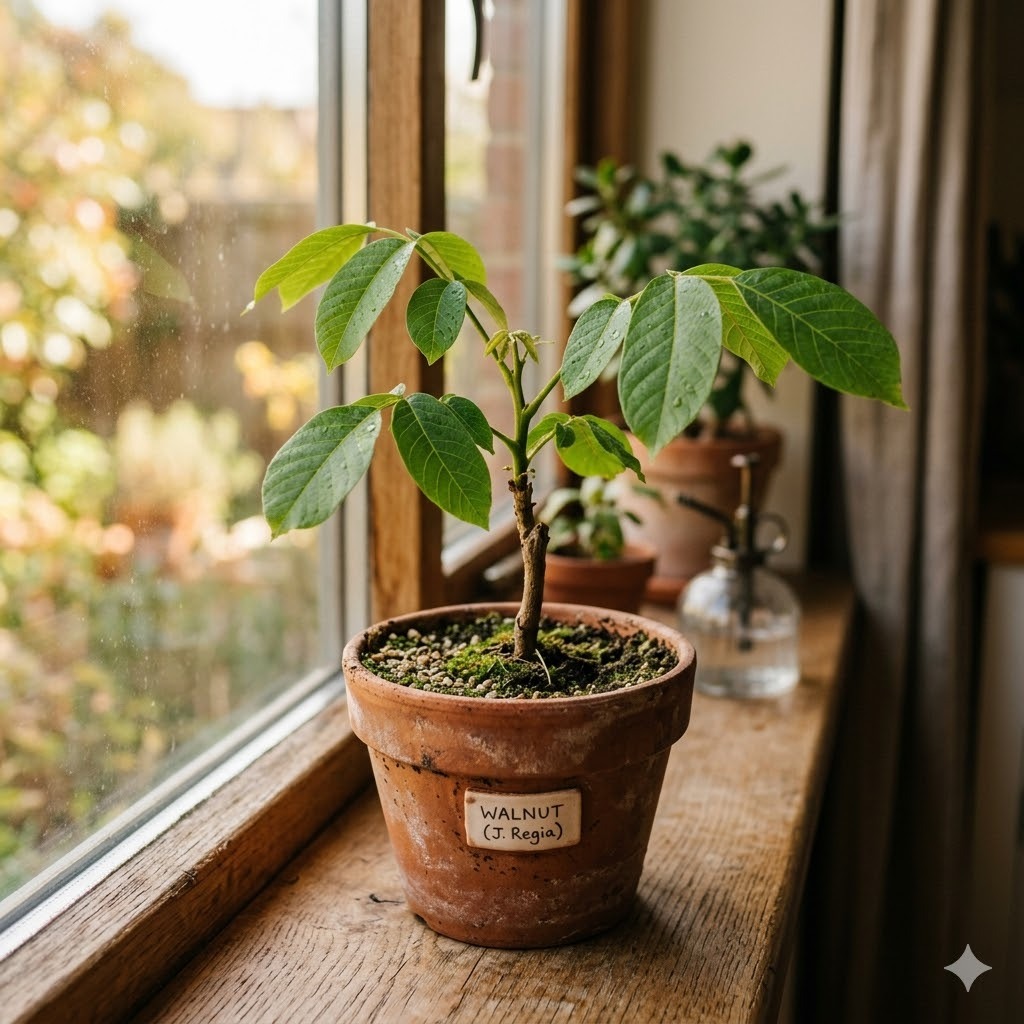
Walnuts are planted in the dormant season, and bare-root trees, lifted from the field without soil and sold through winter, establish well and cost less than large potted specimens. Buy the youngest, smallest tree you sensibly can, because young walnuts transplant far more successfully than big ones. A walnut has a strong taproot and resents disturbance, so a small tree that settles quickly will often overtake a larger one that sulks for years.
Choose the planting spot with great care, because a walnut is there for life and nearly impossible to move once established. Dig a generous hole, wide enough for the roots and deep enough to take the long taproot without bending it. Plant at the same depth the tree grew before, shown by the soil mark on the stem, firm the soil gently, and water in well. A stout stake is essential for the first few years, as a young walnut in an open, windy site needs support while it anchors itself.
Because walnuts eventually become huge, spacing matters enormously. A single garden tree needs an open position with room to spread to perhaps 10 to 15 metres across in time, and well away from buildings, drains and boundaries. If you are planting more than one, allow at least 10 metres between them, and preferably more. It is a common and costly mistake to plant a walnut too close to a house or fence, only to face the problem of a vast tree in the wrong place decades later.
Protect the young tree from rabbits and deer with a guard, and keep grass and weeds cleared from around the base for the first few years while it establishes.
Where to grow
Walnuts want a sunny, open, sheltered position in deep, fertile, well-drained soil. Deep soil suits their taproot, and good drainage is essential, as they will not tolerate waterlogging. A slightly alkaline to neutral soil suits them well, and they do not appreciate thin, poor or permanently wet ground.
Shelter matters more than you might expect. Although a mature walnut is a tough tree, the young spring growth and flowers are vulnerable to late frosts, which can destroy a season's crop and check the tree's growth. Avoid frost pockets, the low-lying spots where cold air collects on still nights, and if your garden is prone to hard late frosts, choose a later-leafing variety and a sheltered position.
There is one crucial siting consideration unique to walnuts. The roots, leaves and fallen husks release a natural chemical called juglone, which suppresses the growth of many other plants beneath and around the tree. Sensitive plants, including tomatoes, potatoes, apples and many others, may grow poorly, yellow or fail entirely within the tree's root zone. This means you cannot treat the ground beneath a walnut as ordinary growing space. Plan for it: keep vegetable beds and susceptible fruit trees well clear of a walnut, and underplant, if at all, only with the grass and tolerant plants that cope with juglone. Think of the area under and around a mature walnut as effectively out of bounds for most cropping.
Day-to-day care
For its first few years a young walnut needs the standard attentions of any new tree: keep the base clear of grass and weeds, water thoroughly in dry spells, and check the stake and tie regularly so they support without chafing. Establishing well in those early years sets the tree up for its long life.
Once established, a walnut is largely self-sufficient and asks very little. Feeding is rarely needed on decent soil, and an annual mulch of compost over the root area in spring is plenty. Avoid heavy nitrogen feeding, which encourages soft growth at the expense of a sturdy, fruiting tree.
Pruning is the one job that needs particular care, because walnuts have an unusual and important quirk: they bleed sap heavily if cut in late winter or spring. A walnut pruned at the wrong time can lose so much sap that it is weakened. The safe window is late summer, roughly July to early autumn, when the tree does not bleed. Keep pruning to a minimum in any case, as walnuts naturally form a good shape. In the early years, remove any competing leading shoots to encourage a single strong trunk, and later simply take out dead, damaged, crossing or crowded branches, always in that late-summer window. Beyond that, the best pruning policy for a walnut is to leave it largely alone.
Common problems and pests
For all its grandeur, the walnut is a fairly healthy tree, and its biggest challenges are as much about time and weather as about pests. The greatest single risk to a crop is late spring frost, which can kill the flowers and young growth in a single cold night and cost you the whole year's nuts. Choosing a later-leafing variety and a sheltered, frost-free site is the main defence.
Squirrels are the other major foe, and as with hazels they will take walnuts, often before they are fully ripe. On a large tree there is little you can do beyond gathering the crop promptly and hoping the tree produces more than the squirrels can carry off.
Among diseases, walnut leaf blotch and walnut blight are the two most likely to appear. Both cause dark spots and blotches on the leaves and, in the case of blight, on the young nuts, and they are worse in wet seasons. On a garden tree they are usually more disfiguring than fatal, and good hygiene, clearing fallen leaves and affected debris, reduces their carry-over. A codling moth caterpillar and various aphids may also visit, but on an established tree these rarely cause serious harm.
The condition most likely to disappoint is simply barrenness in the early years. A young walnut, especially a seedling, may grow strongly for a decade and produce almost nothing, which is entirely normal and not a sign of anything wrong. The cure is patience, and choosing a grafted variety in the first place.
Harvesting
Walnuts ripen in autumn, generally from about September into October depending on the variety and season, and the timing of your harvest depends entirely on what you want to do with them.
For pickling, walnuts are picked green and immature in early summer, usually around midsummer, while the whole nut, shell and all, is still soft enough to pierce right through with a pin. At this stage the shell has not yet hardened. This is a specialist harvest for the traditional pickled walnut and is done long before the nuts are ripe.
For eating, wait until the nuts are properly ripe in autumn, which you can tell because the green outer husks split and begin to blacken, and the nuts start to fall. The easiest method is to let them drop and gather them from the ground, ideally every day, before squirrels, mice or damp get to them. You can also knock ripe nuts down from the lower branches. Wear gloves, because the husks stain hands, clothes and everything else a stubborn brown that is very hard to remove.
Once gathered, deal with them promptly. Peel off the green or blackening husks, which are messy and can taint the nut if left, and wash the shells clean. A little scrubbing removes the fibres and staining from the shell. At this point you have wet, fresh walnuts, which can be eaten straight away as a seasonal delicacy, or dried for keeping.
Storing and preserving
Fresh wet walnuts are a treat but do not keep, so eat them within a few days of picking. For storage, the nuts must first be dried, or they will go mouldy in the shell.
To dry them, spread the cleaned nuts in a single layer somewhere warm, dry and airy, out of direct sun, such as an airing cupboard, a warm shed or a spare room, and turn them from time to time. Depending on conditions this takes a couple of weeks or so. They are properly dry when the kernels are crisp rather than rubbery and the shells are hard and clean.
Once dried, walnuts in their shells store well for many months in a cool, dry, airy place. Keep them in netting, slatted boxes or open trays rather than sealed containers, so any residual moisture can escape and mould does not take hold. Check them over occasionally and remove any that feel light, rattle oddly or smell rancid. Well-dried, well-stored walnuts will comfortably see you through winter and beyond.
Shelled walnut kernels have a shorter shelf life, because the oils eventually turn rancid, but they freeze very well. Pack the kernels into bags or tubs and freeze them, and they will keep in good condition for a year or more, ready for baking and cooking. Freezing is the most reliable way to keep a large crop.
Is it worth it?
That depends entirely on your circumstances, and this is a crop where honesty matters. If you have a small garden, want nuts soon, or need to use every square metre productively, a walnut is the wrong choice. It takes a decade or more to crop well from a seedling, it grows into a huge tree that needs a great deal of space, and its roots poison the ground beneath so that little else will grow there. Those are serious commitments, not minor drawbacks.
But if you have the room, the deep soil and, above all, the patience, a walnut is a magnificent thing to grow. It is a beautiful, long-lived tree that will outlast you, it eventually crops generously, and it gives you delicacies, wet walnuts and pickled walnuts, that money can barely buy. Choose a grafted named variety to cut the waiting years, site it with real care because you cannot move it, and think of it as a tree you are planting as much for the future as for yourself. For the patient gardener with space to spare, few crops repay the long wait so grandly.