Carnivorous Plants Indoors: Care Guide
Practical indoor care for Venus fly traps, sundews, and pitcher plants - the right water, the right light, the dormancy rule, and the mistakes that kill them in weeks.
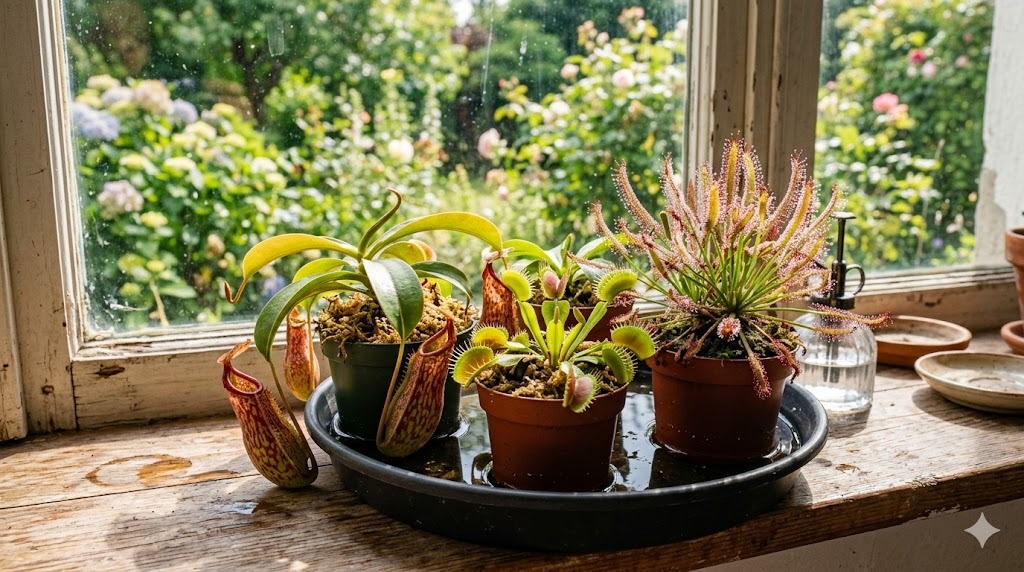
Carnivorous plants are the most misunderstood group in the houseplant world. Garden centres sell them in plastic-domed novelty pots beside the cacti and the picture books promise pet-replacement levels of bug-eating drama. The reality: most novelty-bought carnivorous plants die within three months, not because they’re delicate but because nothing about the standard houseplant playbook applies to them.
Water from your tap will poison them. Standard potting soil will burn their roots. Room temperature year-round will exhaust them. They want bog conditions - pure rainwater, nutrient-free soil, full sun, and (for the temperate species) a cold winter dormancy. Provide that and they live for decades. Provide the normal houseplant care that suits most tropical foliage, and they last weeks.
This guide covers the three most-sold carnivorous plants - Venus fly trap, sundew, pitcher plant - and the few non-obvious rules that make them genuinely easy once you understand them.
The Four Rules That Apply to All Carnivorous Plants
1. Pure water only
Tap water and bottled mineral water contain dissolved minerals that build up in the soil and kill the plant within months. Use only:
- Rainwater (best)
- Distilled water (from a supermarket or a home distiller)
- Reverse-osmosis water (from an aquarium shop)
Total dissolved solids should be under 50 ppm. Most tap water is 200-500 ppm.
2. Nutrient-free soil
Carnivorous plants evolved in bogs precisely because the soil there has no nutrients - they get nitrogen from prey instead. Normal potting soil burns their roots.
Standard CP mix:
- 50% peat moss (sphagnum)
- 50% perlite or silica sand
- No fertiliser, no compost, no Miracle-Gro of any kind
Pre-bagged “carnivorous plant soil” is fine if you can find it.
3. Full sun
All three species want intense direct sunlight - typically 4-6 hours of direct sun, or a strong grow light for 12 hours. A “bright” room is not enough. A south-facing window or outdoor sun.
4. Sit in a water tray
Unlike almost every other houseplant, carnivorous plants prefer to sit in standing water. Keep the saucer filled with 1-3 cm of pure water, especially in summer.
Venus Fly Trap (Dionaea muscipula)
The icon of carnivorous plants, and one of the few widely sold as a houseplant. Native to a tiny region of the Carolinas in the southeastern US.
Light: 4+ hours of direct sun or a strong grow light. Pale, floppy traps mean too little light.
Water: Sit the pot in a tray of pure water; refill so the pot base is always wet.
Soil: 50/50 peat + perlite, no fertiliser.
Feeding: Don’t feed if it lives outdoors (it’ll catch its own). Indoors, every 2-4 weeks drop a small live or freshly killed insect (housefly, mealworm) into a trap, then gently massage the trap to trigger digestion. Never feed dead processed insects (no canned tuna, no cheeseburger - both common viral memes, both kill the plant).
Dormancy (critical): Venus fly traps need a cold winter dormancy of 3-4 months at 0-10°C (32-50°F). Without it, they live 1-2 years instead of decades. The easiest way: leave them in a cold sheltered porch or unheated garage from November to February, watering only enough to keep the soil moist. Indoor warm winters slowly kill them.
Trap-snapping rule: Each trap can close 3-7 times in its life before it dies. Triggering them for fun (poking with a pencil) exhausts the plant. Resist.
Sundews (Drosera)
A huge genus with species from temperate bogs to tropical highlands. The most beginner-friendly is Drosera capensis (Cape sundew) - tropical, no dormancy needed, prolific.
Light: Bright direct sun or a grow light. Red dew droplets mean enough light; pale green means too little.
Water: Sit in pure water as with the Venus fly trap.
Soil: Same 50/50 peat + perlite.
Feeding: Drosera capensis catches its own fungus gnats and fruit flies - often eliminating an indoor gnat problem within weeks. If your plant is starving (no insects available), drop a small piece of crushed bloodworm (from a pet shop) onto a sticky leaf every few weeks.
Dormancy: Drosera capensis - none, year-round growth. Temperate sundews (D. rotundifolia, D. filiformis) need a cold winter rest like Venus fly traps.
Bonus: Drosera capensis self-seeds prolifically - within a year a single plant can become a pot full of seedlings.
Pitcher Plants
Two main groups for indoor growers:
Sarracenia (American trumpet pitchers)
Big, beautiful, fully outdoor plants in temperate climates. Need a cold winter dormancy. Not really an indoor plant - better as a bog-garden specimen on a balcony.
Nepenthes (tropical pitcher plants)
The genuinely indoor pitcher plant. Vines from Southeast Asia with hanging or sitting pitchers up to 20 cm long.
Light: Bright indirect to bright direct - east-facing window is ideal.
Water: Pure water only; keep the soil moist but not standing in water like the other carnivores. Nepenthes prefer top-watered, well-drained pots.
Soil: Long-fibred sphagnum moss alone, or 50/50 sphagnum + perlite. Looser and airier than Venus fly trap mix.
Humidity: 60-80% is ideal. A bathroom window or a small humidifier nearby. Pitchers won’t form in dry air.
Feeding: Drop a small insect into a pitcher every few weeks if you want, or let it catch its own.
No dormancy - Nepenthes are tropical, year-round growth.
The Five Mistakes That Kill Indoor Carnivorous Plants
- Watering with tap water. Minerals build up and burn the roots within 1-4 months. Pure water only.
- Repotting into “good” soil. Carnivorous plants die in nutrient-rich potting mix. Only peat + perlite or sphagnum.
- Skipping dormancy for Venus fly traps and Sarracenia. No winter rest = death within 1-2 years.
- Triggering traps for fun. Each Venus fly trap closure consumes energy. Stop poking.
- Feeding processed food. Hamburger, cheese, dead packaged shrimp - all viral nonsense that rots the trap.
A Realistic First-Year Plan
- Month 1: Buy a Cape sundew (most forgiving) plus a Venus fly trap (icon). Repot into proper mix if they came in something dense. Place in your sunniest window with a water tray.
- Months 2-4: Establish routine - refill tray with rainwater or distilled water; never feed processed food.
- Months 5-8: Watch the sundew catch gnats; let the Venus fly trap catch outdoor flies in summer if possible.
- Months 9-12: Move the Venus fly trap to a cold porch or shed for winter dormancy. Keep the Cape sundew on the window - it grows year-round.
Frequently Asked Questions
Can I water a Venus fly trap with bottled water?
Only if it’s distilled. Mineral water, spring water, and most filtered tap water still contain enough dissolved minerals to kill the plant within months. Rainwater or distilled only.
Why are my Venus fly trap’s traps turning black?
Most often: tap water (cumulative damage), insufficient light (traps weaken and rot), or normal trap end-of-life after several closures. Less commonly, the plant is entering winter dormancy and dying back naturally.
How often should I feed my carnivorous plants?
Most indoor carnivorous plants don’t need feeding at all if they catch the occasional gnat. If you want to feed, every 2-4 weeks with one small live or recently killed insect per plant. Never overfeed.
Do I really need to give a Venus fly trap a cold winter?
Yes. Without 3-4 months of cold dormancy, a Venus fly trap survives 1-2 years instead of 20+. An unheated shed, garage, or sheltered porch at 0-10°C works.
Will a sundew eliminate my fungus gnat problem?
A healthy Drosera capensis often does, yes. The sticky dew traps adult gnats efficiently. Pair with a yellow sticky trap and good watering hygiene and you can clear a gnat infestation in a few weeks.
🛒 Recommended Gear on Amazon
- Venus flytrap (live) - browse current options and reviews on Amazon.
- Carnivorous plant soil mix - browse current options and reviews on Amazon.
- Sphagnum moss - browse current options and reviews on Amazon.
As an Amazon Associate, we earn from qualifying purchases - at no extra cost to you. This helps us keep producing free, in-depth guides.