Phalaenopsis Orchid Care: Watering, Light, Reblooming
Phalaenopsis orchid care without the mystery - exact watering technique, the right light, why yours stops blooming, and how to trigger a second flower spike.
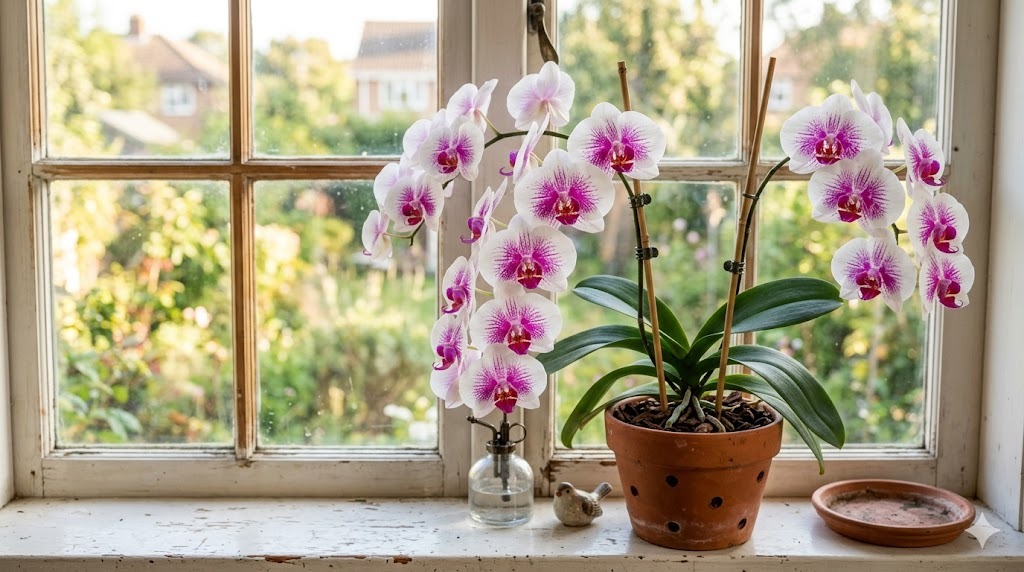
The Phalaenopsis - moth orchid - is the houseplant that most often comes home blooming and most often ends up in the bin. People love the flowers, water them like a normal plant, and watch the leaves yellow and the roots blacken over the following months. The plant didn’t die because it was difficult. It died because almost nothing about caring for a Phalaenopsis matches what you’d do for a leafy houseplant.
Phalaenopsis are epiphytes, and our dedicated moth orchid profile covers their quirks at a glance. In the wild they grow on tree branches in tropical Southeast Asia, with their roots clinging to bark and exposed to air. They’ve never seen soil. Pot them in soil and they suffocate. Water them like a pothos and they rot. Put them in low light and they refuse to bloom.
Get the basics right - chunky bark mix, careful watering, bright indirect light, and a cool autumn - and they’re one of the longest-lived, most rewarding houseplants you can own. A Phalaenopsis can flower for 3-4 months at a time, twice a year, for decades.
What’s Different About Orchids
Three things separate Phalaenopsis from every other houseplant:
- They don’t grow in soil. They grow in chunky orchid bark mix - pieces of fir or pine bark with air gaps between. Roots need air.
- Roots photosynthesise. That’s why orchids are sold in clear plastic pots - the roots themselves are green and contribute to photosynthesis when wet.
- They need a cool autumn trigger to rebloom. Indoor warmth year-round can stop them flowering forever after the first spike fades.
Light: Bright, Indirect, Lots of It
Phalaenopsis want bright indirect light - significantly more than most people give them. An east-facing window is ideal. A south-facing window works if filtered by a sheer curtain. A north-facing window or a corner away from windows is too dark - leaves stay glossy but the plant never blooms again.
The leaf colour test:
- Bright medium-green leaves → correct light.
- Dark green leaves → too little light (looks healthy, won’t flower).
- Yellowish or reddish leaves → too much direct sun.
If your orchid hasn’t flowered in two years, the most common reason is insufficient light, not a watering problem.
Watering: The Single Rule
Forget the “ice cube” advice you’ll see in supermarkets. Here’s the proper method:
Method
- Wait until the bark feels mostly dry and the roots inside the clear pot look silvery-grey (not green).
- Take the plant to the sink.
- Run room-temperature water through the bark for 30-60 seconds, letting it drain freely.
- Let it sit and finish draining for 10 minutes - no standing water in the outer decorative pot.
- Return it to its spot.
Frequency
- Spring/summer: roughly every 7-10 days.
- Autumn/winter: every 10-14 days.
The exact interval depends on your home, pot size, and bark dryness. Always check first - don’t water on a fixed schedule.
The Root Colour Trick
Phalaenopsis are sold in clear plastic pots precisely so you can read root colour:
- Silvery-grey = dry, time to water.
- Vivid green = recently watered, full of moisture, do not water.
It removes the guesswork.
Why “Ice Cubes” Is Bad Advice
Phalaenopsis are tropical plants. Ice water shocks the roots and over time damages them. The ice-cube system became popular because it limits water to “the right amount,” but the correct technique (drench, drain, dry between) is just as easy and doesn’t cold-shock the plant.
The Pot and Bark Mix
Phalaenopsis live in chunky orchid bark mix - never in regular potting soil. Repot every 1-2 years (or whenever the bark breaks down into small black bits) in spring; our repotting size calculator helps you pick the next pot up without over-potting.
- Clear plastic pots with drainage slits are ideal - visible roots, generous airflow.
- Outer decorative pot is fine, but never let water sit at the bottom.
- Orchid bark mix is sold pre-bagged at any garden centre; avoid generic “orchid potting mix” that contains peat or compost.
Rebloom: How to Get a Second Spike
The single most common Phalaenopsis frustration: “It bloomed when I bought it and never again.”
The cause is almost always insufficient light combined with no temperature drop in autumn. Phalaenopsis trigger flower-spike formation when they sense a cool night phase - typically 18-22°C day, 12-16°C night - for 4-6 weeks. Centrally heated rooms at 22°C constant prevent this trigger.
How to provoke a rebloom
- Step 1: Move the orchid to a brighter spot in summer. East window or filtered south.
- Step 2: In autumn, move it to your coolest room - a guest bedroom, a north-facing windowsill, an unheated porch. Aim for nights of 12-16°C.
- Step 3: Reduce watering slightly (every 14 days).
- Step 4: Wait. A new flower spike - a green stem distinct from a root - appears within 6-10 weeks if conditions were right.
- Step 5: Once the spike is 10 cm long, return the plant to its normal warm spot. Stake the spike loosely.
Blooms usually open 2-3 months after the spike appears and last 2-4 months.
Pruning the Spent Flower Spike
After all flowers drop, you have three options:
- Cut the entire spike at the base. The plant rests, focuses on root and leaf growth, and may produce a stronger new spike next year. Best long-term option.
- Cut just above the second visible node on the old spike. A secondary side spike sometimes forms within weeks. Smaller, less spectacular blooms.
- Leave the spike alone. Sometimes nothing happens; sometimes a side spike. Common compromise.
If the spike turns brown and woody, cut it off - it’s dead.
Aerial Roots
Phalaenopsis grow some roots out of the pot, into the air. Don’t bury them. They’re functioning as designed - absorbing humidity, photosynthesising. Mist them occasionally if your air is very dry, but otherwise leave them.
Feeding
Light feeding is helpful but not essential. A balanced orchid fertiliser at quarter strength every 2-3 waterings during spring and summer. Skip in autumn and winter.
Common Problems
- Yellow lower leaf - usually normal aging; the orchid sheds its oldest leaf every year or two.
- Yellow upper leaves - overwatering, often with root rot underneath.
- Wrinkled leaves - usually underwatering or root damage (paradoxically, often from overwatering that killed the roots).
- Mushy black roots - root rot from over-watering. Unpot, trim all dead roots back to firm tissue, repot in fresh dry bark.
- No new spike after years - too dim, too warm, never given an autumn cool-down.
Frequently Asked Questions
How often should I water a Phalaenopsis orchid?
Every 7-14 days, depending on the season and your home. Check the roots in the clear pot - silvery-grey means water; bright green means wait. Always drench thoroughly and drain completely.
Why isn’t my orchid blooming again?
Almost always insufficient light or no autumn temperature drop. Move to a brighter spot (east or filtered south window) and a cool room for 4-6 weeks in autumn to trigger a new spike.
Can I cut the flower spike after the blooms fall off?
Yes. Cutting the entire spike at the base lets the plant rest and often produces a stronger new spike next year. Cutting just above a node may give a smaller side spike sooner.
My orchid roots are growing out of the pot - should I bury them?
No. Aerial roots are normal and functional. Leave them in the air, mist occasionally if the room is dry. Only repot when the bark mix has broken down or roots are massively outgrowing the pot.
Is the ice cube method really bad?
It works in the sense that the plant survives a while - but it shocks tropical roots with cold and trains you to ignore actual moisture levels. The traditional drench-and-drain method is just as easy and far better long-term.
🛒 Recommended Gear on Amazon
- Orchid bark mix - browse current options and reviews on Amazon.
- Orchid pots with holes - browse current options and reviews on Amazon.
- Orchid fertilizer - browse current options and reviews on Amazon.
As an Amazon Associate, we earn from qualifying purchases - at no extra cost to you. This helps us keep producing free, in-depth guides.