Aeonium
The Aeonium is a succulent that breaks all the usual succulent rules, and that is exactly what makes it so striking.
🗓️ Last reviewed: July 2026
Overview
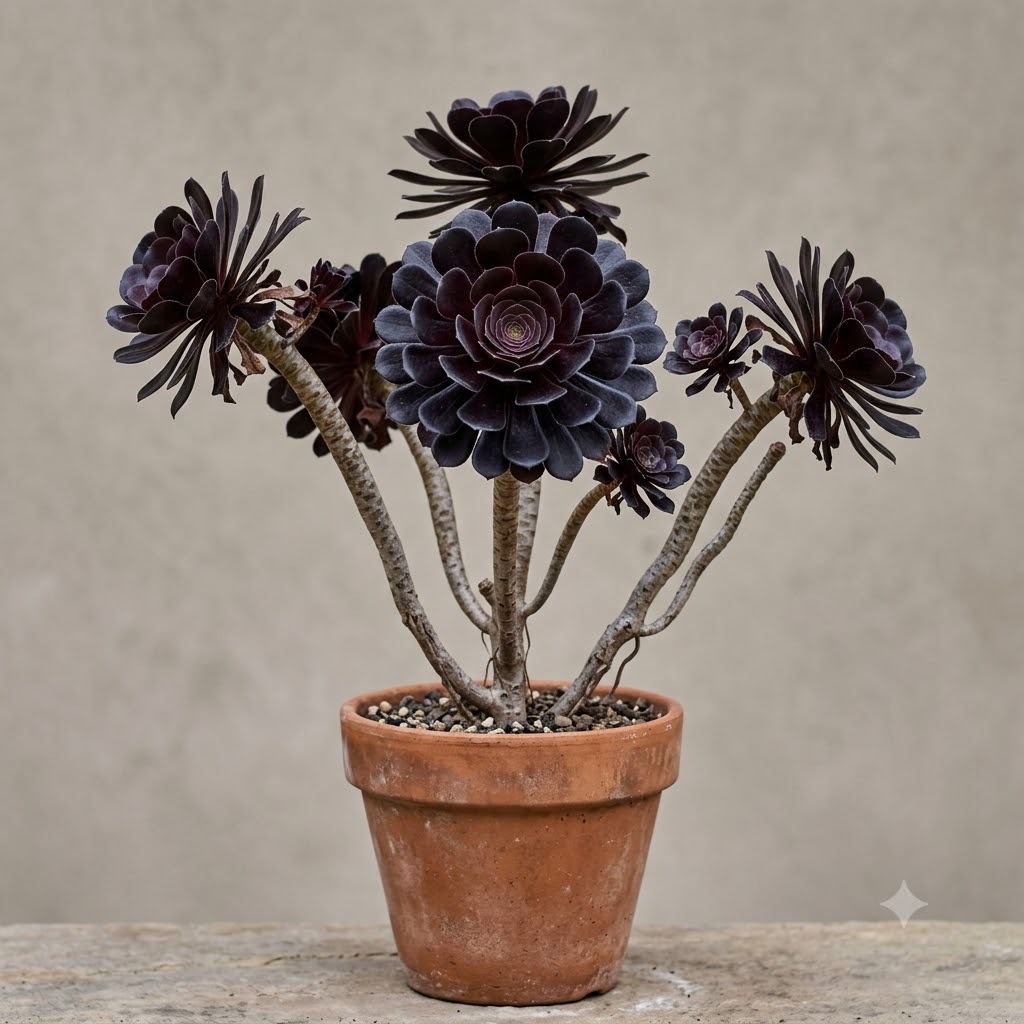
The Aeonium is a succulent that breaks all the usual succulent rules, and that is exactly what makes it so striking. Instead of a fat, spiky rosette hugging the ground, an Aeonium holds a flat, geometric rosette of thin, glossy leaves aloft on a bare branching stem, like a living flower on a stick. The dark varieties - especially the famous near-black "Black Rose" - are some of the most dramatic and architectural plants you can grow, ranging from apple green to deep burgundy to almost pure black. But there is a twist that catches many owners off guard: unlike most succulents, Aeoniums are winter growers. They do their growing in the cool, moist months and go dormant in the heat of summer, which flips the standard watering advice on its head. Get their unusual seasonal rhythm right, and Aeoniums are easy, generous, and endlessly photogenic.
Origin & Natural Habitat
Aeoniums come mainly from the Canary Islands off the northwest coast of Africa, with some species from Madeira, Morocco, and East Africa. The Canaries have a Mediterranean-style climate: mild, damp winters and hot, dry summers. This is the key to the whole plant.
In their homeland, Aeoniums grow actively through the cool, rainy winter and then shut down and rest through the hot, dry summer to conserve water. During summer dormancy they often curl their leaves inward into a tight cup and drop lower leaves - a survival response that looks alarming but is completely normal. This upside-down (compared to most succulents) growth calendar is why care advice written for cacti and Echeverias often fails an Aeonium.
Appearance
The Aeonium's signature is its rosette-on-a-stem form:
- Rosettes: flat, symmetrical, almost geometric rosettes of thin, spoon-shaped, glossy leaves - very different from the plump leaves of most succulents.
- Stems: bare, woody stems that branch as the plant ages, lifting the rosettes above the pot.
- Color: enormous range - bright green, chartreuse, variegated cream and pink, coppery red, and the celebrated near-black burgundy of varieties like 'Zwartkop' (the "Black Rose").
- Size: from small single rosettes to branching shrubs up to a meter or more in the right conditions; indoors usually more compact.
Color intensity depends on light: the dark varieties turn their deepest, most dramatic near-black only in strong sun, and revert to greener tones in lower light.
Why People Love It - Qualities & Benefits
- Striking, sculptural form: the rosette-on-a-stem look is unlike any other succulent - architectural and elegant.
- Dramatic dark colors: the near-black "Black Rose" types are showstoppers and genuinely uncommon.
- Easy in the right rhythm: once you understand their winter-growing schedule, they are low-fuss and drought-tolerant.
- Great for arrangements: their flat rosettes and branching stems make them favorites for pots, dish gardens, and cuttings.
- Very easy to propagate: a single cutting roots readily, so one plant becomes many.
Care
Light
Aeoniums want bright light with some direct sun to keep their compact rosette form and rich color. A sunny windowsill (south or west) is ideal indoors. In too little light they stretch, the rosettes loosen and flatten, and dark varieties lose their color. Introduce full sun gradually to avoid scorching.
Watering - flipped from other succulents
This is the crucial difference. Aeoniums grow in the cool season and rest in summer heat, so their watering follows suit:
- Autumn, winter, and spring (growing season): water thoroughly when the top of the soil dries, keeping them lightly but regularly moist. They are more thirsty than a typical succulent during active growth.
- Summer (dormancy): water sparingly, just enough to keep the roots from shriveling. During dormancy they curl their leaves and drop lower leaves - do not respond by drenching them.
Overwatering a dormant summer Aeonium is a common way to rot one. As always, never let it sit in standing water.
Soil & Potting
Use a gritty, fast-draining succulent or cactus mix. Their shallow roots do not need a deep pot. Always use a pot with drainage holes.
Temperature
Aeoniums like mild conditions and dislike extremes - they are happiest around 10-24 °C. They are not frost-hardy and should be protected from freezing, but they also dislike intense summer heat, which pushes them into dormancy.
Feeding
Feed lightly with a dilute balanced or succulent fertilizer during the cool growing season. Do not feed during summer dormancy.
A note on monocarpic rosettes
Some Aeonium species and varieties are monocarpic: an individual rosette flowers once, sets seed, and then dies. When a rosette sends up a tall cone of flowers, that specific rosette is at the end of its life. This is natural and not a care failure. On branching plants only the flowering rosette dies while the rest carry on; to keep the plant going, take cuttings from healthy rosettes before or after flowering.
Propagation
Aeoniums are among the easiest plants to propagate from stem cuttings. Cut a rosette with a few centimeters of stem, let the cut end callus (dry over) for a day or two, then place it in gritty, barely moist soil. Roots form within a few weeks, especially during the cool growing season. This is also the way to save a plant whose main rosette is about to flower and die - simply root cuttings of the healthy rosettes to continue the plant.
Common Problems & Pests
- Stretched, loose rosettes: not enough light - move to a sunnier spot.
- Curled leaves and dropped lower leaves in summer: normal summer dormancy, not a problem. Ease off watering.
- Mushy, rotting stem: overwatering, especially during summer dormancy or in poorly drained soil.
- A rosette dying after flowering: natural monocarpic behavior - take cuttings from other rosettes.
- Loss of dark color: too little light; dark varieties need strong sun to stay near-black.
- Pests: watch for mealybugs (white fluff in leaf joints and at the rosette center), aphids on flower stalks, and occasionally spider mites. Isolate and treat with insecticidal soap or neem oil.
Toxicity & Safety
Aeoniums are generally considered non-toxic to cats, dogs, and humans, and are not listed among the succulents that cause poisoning. This makes them a safe, low-worry choice for homes with pets and children. As with any plant, eating a large amount of foliage may cause mild stomach upset, so it is still best to keep curious pets from making a meal of the rosettes.
Pros & Cons
Pros
- Striking, sculptural rosette-on-a-stem form.
- Dramatic dark "Black Rose" varieties.
- Non-toxic and pet-safe.
- Extremely easy to propagate from cuttings.
- Low-fuss once the seasonal rhythm is understood.
Cons
- Winter-growing, summer-dormant schedule confuses new owners.
- Easy to rot by overwatering a dormant summer plant.
- Needs strong light to stay compact and colorful.
- Monocarpic rosettes die after flowering.
- Not frost-hardy and dislikes intense heat.
Best Suited For
- Sunny windowsills and bright spots.
- Succulent lovers who want something more sculptural and unusual.
- People who enjoy propagating and building a collection from cuttings.
- Pet-owning households wanting a safe, dramatic succulent.
Not ideal for dim rooms, heavy-handed waterers who cannot adjust to the summer dormancy, or anyone expecting standard cactus care to apply.
FAQ
Why is my Aeonium curling its leaves and dropping the bottom ones in summer? That is normal summer dormancy - the plant is conserving water in the heat. Water sparingly and it will open back up when the cool growing season returns.
Why did one of my rosettes shoot up flowers and then die? That rosette was monocarpic - it flowers once, then dies. On a branching plant the rest survive. Take cuttings from healthy rosettes to keep the plant going.
Why is my "Black Rose" turning green? Not enough light. The dark varieties only reach their deep near-black color in strong direct sun.
When should I water it? Regularly through autumn, winter, and spring while it is growing; only sparingly in summer while it is dormant. This is the opposite of most succulents.
How do I make more plants? Take a rosette cutting with a bit of stem, let it callus for a day or two, then root it in gritty soil - it is very easy.