Bird's Nest Fern (Asplenium nidus)
The Bird's Nest Fern - Asplenium nidus - is one of the most welcoming ferns you can bring indoors.
🗓️ Last reviewed: June 2026
Overview
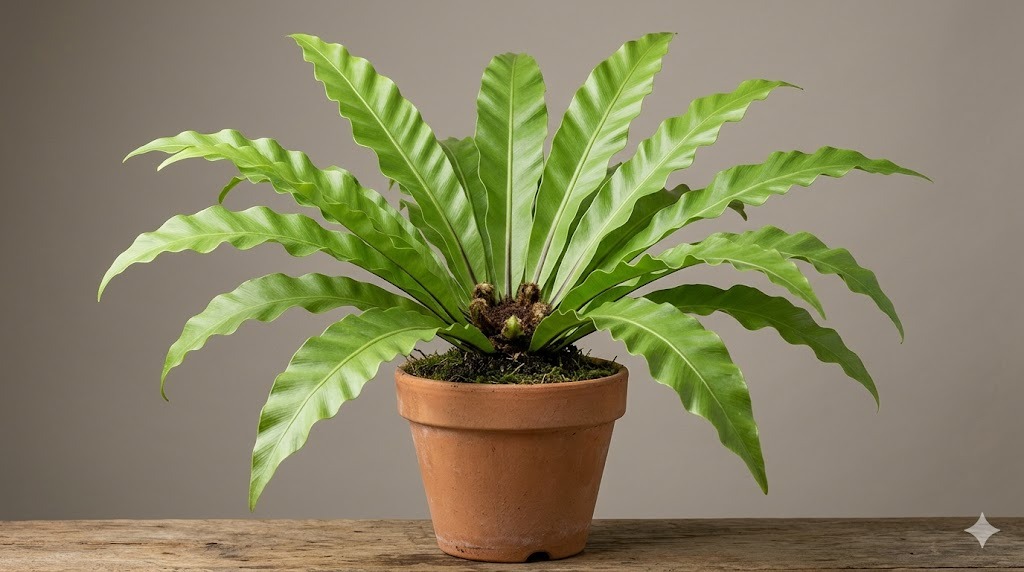
The Bird's Nest Fern - Asplenium nidus - is one of the most welcoming ferns you can bring indoors. Instead of the fine, lacy fronds people picture when they think "fern," it grows a lush rosette of broad, rippled, apple-green fronds that emerge one by one from a fuzzy central "nest." It is sculptural, soft, and surprisingly forgiving, which makes it a favourite for anyone who loves a tropical look without the fuss of the fussier ferns. It does adore humidity, and it will tell you when the air is too dry, but as ferns go it is genuinely one of the easier ones to keep happy indoors. Give it gentle light, steady moisture, and a humid spot, and it rewards you with fresh fronds unfurling from the heart of the plant.
Origin & Natural Habitat
Bird's Nest Fern is native to the tropical rainforests of Southeast Asia, eastern Australia, East Africa, Hawaii, Polynesia, and other warm, humid regions across the Old World tropics. Crucially, it is an epiphyte - in the wild it does not grow in soil at all. Instead it perches high up in the forks and branches of rainforest trees, anchoring itself to bark with its roots. Its upright rosette of fronds forms a natural funnel that catches falling leaves, debris, and rainwater, collecting them in the centre like a nest. That trapped litter slowly breaks down into nutrients the fern can absorb - a tidy, self-feeding arrangement perched in the canopy.
The name carries its own small story. Asplenium comes from Greek - a- meaning "not" and splen meaning "spleen" - a reference to an old herbal association the plant once had (mentioned here only as the origin of the name, not as any kind of medical guidance). Nidus is simply Latin for "nest." Put the two together with the way the rosette cradles debris in its centre, and the common name writes itself: the Bird's Nest Fern.
Appearance
A Bird's Nest Fern looks quite unlike the feathery ferns most people know. Its fronds are broad, strap-like, and undivided, often gently wavy or crinkled along the edges, and they radiate outward from a single point to form a vase-shaped rosette. At the very centre sits a fuzzy, dark crown - the "nest" - from which every new frond emerges, tightly coiled, before slowly unfurling. The look is lush, glossy, and architectural.
- Fronds: broad, undivided, and strap-shaped, with a rippled or wavy margin; bright apple-green and slightly glossy, paler and softer when young.
- Central rosette / nest: fronds spiral outward from a single funnel-like crown, and the fuzzy brown centre is where new growth appears - this is the "nest" the plant is named for.
- Midrib: each frond has a distinct dark central rib running its length, a striking contrast against the bright green blade.
- Growth habit: an epiphytic rosette - it perches and clumps rather than climbs, with no true vining or trailing habit at all.
There are several popular cultivars worth knowing: 'Crispy Wave' with deeply ruffled, upright fronds, 'Osaka' with narrow wavy leaves, and 'Antiquum' with broad, gently rippled fronds. Indoors the fronds commonly reach around 60-90 cm long on a mature, happy plant, forming a generous bowl of green.
Why People Love It - Qualities & Benefits
- Lush tropical rosette: the bowl of bright, rippled fronds is soft and sculptural, bringing a calm jungle feel to a room without looking spiky or wild.
- Tolerates lower light: as a shade-dwelling understory epiphyte, it copes with medium and even lower light far better than most houseplants, making it useful for spots a sun-lover would hate.
- Pet-safe and non-toxic: this is a real selling point - it is listed as non-toxic to cats and dogs, so it suits homes with curious pets and small children.
- No spikes or mess: there are no sharp edges, no thorns, and no constant leaf drop - it is a tidy, gentle plant to live with.
- Great for bathrooms: because it loves humidity, a bright bathroom or kitchen is one of the best places it can live, turning a tricky spot into a feature.
- Atmosphere: like most broad-leaved tropicals it adds a little humidity to the room through transpiration and contributes to a greener, calmer space. (The famous "air-purifying" claims are real but modest in a normal home - the main benefit is psychological: greenery measurably lowers stress and lifts mood.)
Care
Light
Medium, indirect, filtered light is ideal - the kind of soft light it would get on the shaded floor of a rainforest. A spot near an east or north window is perfect, or a little back from a brighter window where the direct rays don't reach it. It tolerates lower light better than most plants, so a dimmer corner is fine, though growth slows there. What it will not tolerate is direct sun: harsh rays scorch and bleach the delicate fronds quickly, leaving pale, crispy patches. Remember it is a shade understory epiphyte, not a sun plant.
Watering
Keep the soil consistently lightly moist - never soggy, and never allowed to dry out completely to bone dry. Water when the top centimetre or so starts to feel dry, then let the excess drain fully. The single most important rule is this: water the soil around the edges of the pot, not into the central rosette. Water that pools in the crown of the nest sits there and causes crown rot, which can quietly destroy the plant from its heart outward. Reading the plant helps - limp, wilting fronds and dry soil mean it is thirsty, while yellowing fronds usually mean it has been kept too wet. When in doubt, aim for evenly damp, like a wrung-out sponge.
Soil & Potting
Use a loose, rich, well-draining, organic mix that echoes its epiphytic roots. A blend of orchid bark with peat or coco coir and a generous handful of perlite works beautifully - airy and moisture-retentive without ever turning to mud. The roots want to breathe, just as they would clinging to bark in the canopy. Always use a pot with drainage holes so water can escape freely.
Humidity & Temperature
This is a humidity lover - it is happiest at 50% or higher, and dry indoor air is its biggest enemy. In a dry room the frond edges turn brown and crispy. A bright bathroom or kitchen, a pebble tray of water beneath the pot, or a small humidifier nearby all make a real difference. It enjoys warmth of roughly 18-27 C and dislikes cold drafts, sudden chills, and anything below about 15 C.
Feeding
Feed sparingly. Use a balanced liquid houseplant fertilizer diluted to half strength or weaker, no more than monthly through spring and summer, and always apply it to the soil rather than into the crown. Stop feeding entirely in autumn and winter when growth slows. Bird's Nest Ferns are sensitive to over-feeding - too much fertilizer causes deformed, distorted new fronds - so when it comes to food, less is genuinely more.
Repotting
Repot infrequently, only every 2-3 years, as this fern actually likes to be a little snug in its pot. The best time is spring, just as new growth begins. When you do repot, be very gentle with the central crown and the roots - the nest is the growing point of the whole plant, and damaging it sets the fern back badly. Move up just one pot size and settle it back in at the same depth it was before.
Water the soil, not the nest - the key to a healthy crown
This is the single most important tip for a Bird's Nest Fern, and it is the one mistake that quietly kills more of them than anything else. Never pour water into the central crown - the "nest" at the heart of the rosette. Water that collects there has nowhere to go, and it rots the soft growing point from the inside, a problem called crown rot. By the time the centre turns brown and mushy, it is often too late. So always direct your watering can to the soil around the edges of the pot, keeping the crown itself dry. Pair that with steady humidity - 50% or more, helped along by a pebble tray, a humidifier, or a humid room - and you have covered the two things this fern cares about most. Get watering and humidity right, and the rest is easy.
Propagation
Here is the honest truth: the Bird's Nest Fern is one of those plants you generally buy rather than propagate at home. Unlike many houseplants, it cannot be grown from leaf or stem cuttings - the fronds have no nodes, so a cut piece will simply wither rather than root. It also does not divide well, because the whole plant grows from a single central crown rather than from multiple offsets, so splitting it usually just injures that one growing point. Ferns reproduce instead by spores - the tiny dust-like cells produced in the neat brown lines (sporangia) on the undersides of mature fronds. In theory you can collect and sow those spores, but it is a slow, fiddly, and unreliable process that takes many months and ideal sterile conditions, well outside what most homes can offer. So if you fall in love with this fern, the realistic and stress-free path is to buy another one, and to admire those brown spore lines for what they are: a sign of a healthy, mature plant.
Common Problems & Pests
- Brown crispy frond edges: the most common complaint, caused by low humidity, dry air, or underwatering. Raise the humidity and keep the soil evenly moist.
- Yellowing fronds: usually a sign of overwatering or soggy soil. Let the mix dry slightly more between waterings and check the drainage.
- Brown mushy centre / crown rot: caused by water sitting in the central nest. Always water the soil around the edges, never into the crown - once the centre rots it is very hard to save.
- Pale or scorched fronds: too much direct light. Move the fern to a spot with bright, indirect, filtered light instead.
- Deformed new fronds: often over-fertilizing, or exposure to cold drafts and chills. Feed less and keep it warm and steady.
- Pests: scale and mealybugs are the usual culprits, and fungus gnats sometimes appear in soil kept too wet. Treat gently with insecticidal soap or neem oil, wiping carefully so you don't damage the delicate fronds, and ease off on watering for gnats.
- Normal, not a problem: the neat brown lines on the undersides of mature fronds are spore cases (sporangia), a completely natural sign of maturity - not a pest, disease, or sign of anything wrong.
Toxicity & Safety
Non-toxic and pet-safe. The Bird's Nest Fern is considered non-toxic to cats, dogs, and humans - true ferns like Asplenium nidus are listed as non-toxic, so this is one of the safest green choices you can make for a home with pets or small children. A curious cat batting at a frond or a dog brushing past it has nothing to fear. (This is a care note, not an invitation to eat it - it isn't food, and like any plant it could cause a mild tummy upset if a pet munched a lot - but it will not poison a curious nibbler.) For households that want lush foliage without the worry, this fern is an easy yes.
Pros & Cons
Pros
- Pet-safe and non-toxic - genuinely worry-free around cats, dogs, and kids.
- Lush, soft, sculptural rosette with a real tropical feel.
- Tolerates lower light better than most houseplants.
- No spikes, thorns, or constant messy leaf drop.
- Turns a humid bathroom or kitchen into a feature spot.
Cons
- Needs higher humidity to truly thrive.
- Gets crispy brown edges in dry rooms.
- Hard to propagate - effectively a buy-don't-share plant.
- Crown rots easily if you water into the centre.
- Fronds bruise and mark easily, so it dislikes rough handling and busy thoroughfares.
Best Suited For
- Homes with pets or small children, thanks to its non-toxic, pet-safe nature.
- Bathrooms, kitchens, and other naturally humid rooms.
- Lower-light spots and shaded corners away from direct sun.
- Anyone who wants a soft, lush, tropical look without spiky or fussy plants.
Not ideal for very dry homes with no way to raise humidity, bright sunny windowsills, or people who want a plant they can propagate and share with friends.
FAQ
Why are the edges of my bird's nest fern brown and crispy? Almost always dry air or low humidity, sometimes combined with underwatering. This fern wants humidity of 50% or more, so move it to a more humid room or add a pebble tray or humidifier, and keep the soil evenly moist.
What are the brown lines on the underside of the fronds? Those are spores - the neat rows of spore cases (sporangia) that ferns produce on mature fronds. They are completely normal and a sign of a healthy, grown-up plant, not pests, scale, or disease. Leave them be.
Can I propagate a bird's nest fern? Realistically, no - not in any easy way at home. It has no nodes for cuttings and grows from a single crown, so it doesn't divide well either. It only spreads by spores, which is slow and very difficult indoors. This is a fern you generally buy rather than propagate.
Is it safe for cats and dogs? Yes. Asplenium nidus is non-toxic and listed as pet-safe, making it a great choice for homes with cats, dogs, or curious toddlers. It isn't food, but it won't poison a pet that nibbles a frond.
How do I water it without rotting the plant? Keep the soil lightly and evenly moist, and always pour water onto the soil around the edges of the pot - never into the central nest. Water sitting in the crown causes rot, so keeping that centre dry is the whole secret.