Burro's Tail (Sedum morganianum)
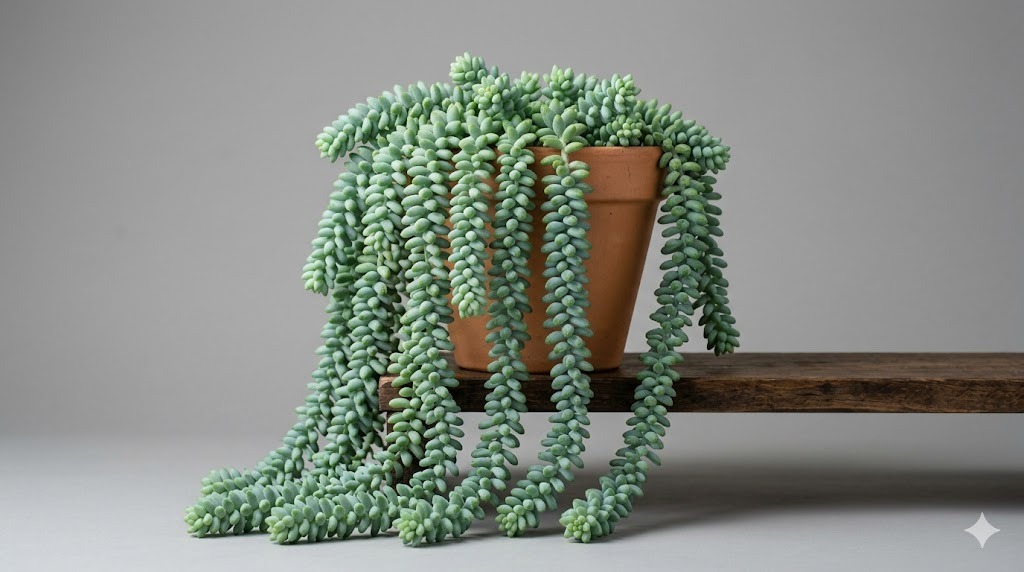
The Burro's Tail - Sedum morganianum, also known as the donkey's tail - is a trailing succulent grown for one unforgettable feature: its long, ropey stems packed with plump, blue-green, bead-like leaves that overlap like braids and spill straight down toward the floor.
🗓️ Last reviewed: June 2026
Overview
The Burro's Tail - Sedum morganianum, also known as the donkey's tail - is a trailing succulent grown for one unforgettable feature: its long, ropey stems packed with plump, blue-green, bead-like leaves that overlap like braids and spill straight down toward the floor. Hung in a basket or set on a high shelf, a mature plant looks like a cascade of woven green tails, sometimes reaching half a metre or more in length. That dramatic, draping shape is the whole appeal, and it is the reason the plant has stayed a windowsill favourite for generations. It suits anyone who wants living sculpture with very little upkeep, because under all that drama it is a tough, drought-tolerant succulent. Be honest with yourself before you buy, though: it asks for bright light and a careful hand, and its leaves are famously fragile - they pop off at the lightest bump. Give it a sunny spot, water it sparingly, and put it somewhere it will not get knocked, and it will trail happily for years.
Origin & Natural Habitat
Sedum morganianum is native to southern Mexico, where it grows on rocky cliffs and ledges in warm, dry, sun-drenched conditions. In the wild it trails down over rock faces, anchored at the top while its heavy stems hang in the open air and bake in bright light - which is exactly why it stores so much water in those swollen leaves and copes so well with drought. It belongs to the Crassulaceae, the stonecrop family, making it a relative of the jade plant, echeverias, and the many other sedums. The botanical name carries a small piece of horticultural history. Sedum comes from the Latin "sedere," to sit, a nod to the way these low succulents settle onto rocks and walls. The species name morganianum honours Dr. Meredith Morgan, a California plant grower in whose collection the plant was studied and described in the 1930s. The plant's true wild origins stayed a little mysterious for years, which only added to its appeal as a passed-along, shared-by-cuttings classic.
Appearance
Picture long, trailing, rope-like stems, each one densely covered from tip to base with plump, pointed, overlapping leaves in a soft blue-green, often dusted with a pale powdery coating. The leaves are the star: thick and juicy, shaped like fat little beads or grains of rice, packed so tightly that the stem itself almost disappears. That powdery coating is a natural waxy bloom called farina, and it gives the plant its frosted, silvery look - it also rubs off easily, so handling the leaves leaves marks. In strong light the tips can blush a gentle pink or amber. Healthy mature stems hang straight down in heavy braids, which is where both common names come from - a burro's or donkey's tail. There is a close relative worth knowing, too: Sedum burrito (sometimes called the baby burro's tail), which has rounder, shorter, more bean-shaped leaves and is often sold under the same common name.
- Leaves: plump, juicy, pointed blue-green beads dusted with a pale powdery bloom, overlapping tightly along the stem like braided rope.
- Stems: long, trailing, and rope-like, growing heavier and longer with age as they fill with water-storing leaves.
- Colour: soft blue-green to grey-green, often frosted silver, with pink or amber tips in bright light.
- Growth habit: a trailing, cascading succulent rather than an upright plant, which makes it ideal for hanging baskets and high shelves.
Indoors the trailing stems commonly reach around 30-60 cm, and on an old, well-grown plant can spill well past that into long, dramatic tails.
Why People Love It - Qualities & Benefits
- Dramatic trailing shape: few houseplants make a statement like a mature burro's tail spilling a metre of braided green stems over the edge of a basket - this is the headline reason to grow it.
- Genuinely low-water and forgiving: as a true succulent it stores its own water, shrugs off the occasional missed watering, and asks far less attention than most trailing plants.
- Pet-safe and non-toxic: it is listed as non-toxic to cats and dogs, which is a real selling point for homes with curious animals.
- Perfect for hanging baskets and high shelves: the natural cascading habit does the styling work for you, and a high spot keeps the brittle stems safely out of reach.
- Effortless to propagate: every leaf that drops can become a new plant, so one basket quietly turns into many for free.
- Atmosphere: like most succulents it adds a calm, sculptural, living touch to a room. (The popular "air-purifying" claims are real but modest in a normal home; the bigger benefit is psychological, since greenery measurably lifts mood and lowers stress.)
Care
Light
Bright light is essential, and it is the single biggest factor in keeping the plant compact, colourful, and full. A spot right by a bright south or west window is ideal, and unlike many houseplants the burro's tail welcomes some direct sun - a few hours of it a day deepens the colour and keeps the stems densely packed. Too little light is the classic mistake: the stems stretch, the leaves space out and shrink, and the plant looks thin and leggy instead of plump and braided. If you are moving it from a dim spot into strong sun, do it gradually over a week or two, because a sudden jump can scorch the leaves and bleach the powdery bloom. Outdoors in summer it loves a bright, sheltered position, but acclimatise it slowly to full sun.
Watering
This is a succulent, so the golden rule is to water thoroughly but infrequently, and let the soil dry out completely between drinks. In the growing season, soak the mix until it drains through, then leave it alone until the soil is bone dry - the plump leaves are a built-in water reserve, so the plant is far happier slightly too dry than too wet. Cut watering right back in winter, when growth slows and the plant is resting; once a month or even less is often plenty. Overwatering is the number one killer: soggy soil rots the roots and stems fast. Learn to read the leaves - firm, plump beads mean the plant is well hydrated, while soft, shrivelled, or wrinkling leaves are the signal that it is genuinely thirsty and ready for a proper soak.
Soil & Potting
Use a gritty, fast-draining mix made for cacti and succulents, or loosen ordinary potting soil with plenty of coarse sand, perlite, or pumice. The roots must never sit in moisture, so drainage is everything. Always plant into a container with drainage holes - a terracotta pot is ideal, since the porous clay helps wick away excess water and dries the soil faster.
Humidity & Temperature
Coming from dry Mexican cliffs, it has no need for extra humidity and is perfectly happy in normal, even dry, household air - no misting required. It likes warmth, roughly 18-27 C through the growing season, and grows best in those conditions. It is not frost-hardy and should be kept above about 10 C; if you move it outdoors for summer, bring it back inside well before the first cold nights of autumn. Avoid cold drafts and freezing windowsills in winter.
Feeding
Feed lightly. Once or twice through spring and summer is plenty, using a balanced or cactus/succulent fertilizer diluted to half strength or weaker. Succulents are slow, lean feeders, and overfeeding pushes soft, weak, stretched growth that the brittle stems cannot really carry. Stop feeding entirely in autumn and winter while the plant is resting.
Repotting
Repot infrequently, only every few years and only when the plant is genuinely crowded or top-heavy. The real challenge here is not timing but handling - the leaves drop at the slightest touch, so repotting a long-stemmed plant inevitably costs you some leaves. Work gently and slowly, support the stems as little as you can get away with, and do it in spring. Many growers simply leave a happy plant in its pot for as long as possible to avoid disturbing those fragile tails.
Handling - the one thing to get right with a burro's tail
This plant deserves its own note, because its biggest quirk is not light or water - it is fragility. The leaves are attached loosely and pop off at the gentlest bump, brush, or knock, and once they are off they will not reattach. A single careless move while watering, dusting, or moving the plant can shower the floor with beads. So the trick is simple: choose its spot carefully and then leave it there. Hang it or shelve it somewhere it will not be brushed past, knocked, or handled - out of walkways, away from busy hands and tails. Water it in place rather than carrying it to the sink where you can. And do not be too upset by the leaves that do fall, because every one of them is a free new plant, which is the subject of the next section.
Propagation
The Burro's Tail is one of the easiest plants on earth to propagate, almost to a fault - it practically does it for you. Every healthy leaf that drops can grow into a whole new plant. Lay fallen leaves on top of a tray of dry, well-draining succulent mix, leave them somewhere bright but out of harsh direct sun, and wait: within a few weeks most will sprout tiny pink roots and a miniature rosette at the base. Keep the mix barely moist - a light misting now and then is enough - and resist the urge to bury or overwater them. You can also take stem cuttings, let the cut end callus over and dry for a day or two, then lay or set them on the same gritty mix to root. It is slow but utterly reliable, and the best way to grow a thick, full basket is to start several leaves or cuttings together in one pot.
Common Problems & Pests
- Dropped leaves: the most common complaint, and usually mechanical rather than a health problem - the brittle leaves simply pop off when bumped, brushed, or handled. Site the plant where it will be left undisturbed.
- Leggy, stretched stems with spaced-out leaves: a clear sign of too little light - move it to a brighter spot with some direct sun to keep the stems plump and dense.
- Soft, mushy, translucent stems or leaves: overwatering and rot - let the soil dry out fully, cut away any rotted parts, and ease off the watering can.
- Shrivelled, wrinkling leaves: the plant is genuinely thirsty - give it a thorough soak and the beads should firm back up.
- Brown, scorched, or bleached patches: sunburn from too much sudden direct sun, especially after a move from a dim spot - acclimatise it to strong light gradually.
- Loss of the silvery powdery coating: that frosted bloom (farina) rubs off permanently with handling - it is cosmetic, but a reason to touch the plant as little as possible.
- Pests: watch above all for mealybugs, which love to hide between the packed leaves, and occasionally aphids or scale. Isolate the plant and treat carefully with insecticidal soap or a cotton swab dipped in alcohol, dabbing gently to avoid knocking leaves off.
Toxicity & Safety
Non-toxic and pet-safe. The Burro's Tail (Sedum morganianum) is listed as non-toxic to cats, dogs, and humans, which makes it a genuinely reassuring choice for homes with curious pets and small children. This is a care note rather than an invitation to eat it - it is an ornamental succulent, not food - but a nibbling cat or dog will not be poisoned by it, and that peace of mind is one of its quiet strengths. The far bigger everyday concern is its fragility: a curious pet or child that bumps the plant is more likely to send a shower of leaves onto the floor than to come to any harm.
Pros & Cons
Pros
- Dramatic, sculptural trailing stems - real living statement in a basket.
- Non-toxic and pet-safe for homes with animals and children.
- Genuinely low-water and forgiving, like a true succulent should be.
- Ideal habit for hanging baskets and high shelves.
- Extremely easy to propagate - every dropped leaf is a free new plant.
Cons
- Leaves are very fragile and drop at the lightest touch.
- Needs bright light and some direct sun to stay plump and compact.
- Easy to kill by overwatering if treated like a regular houseplant.
- The powdery silver bloom rubs off permanently when handled.
- Not frost-hardy and dislikes cold winter drafts.
Best Suited For
- People who want a dramatic trailing succulent with very low watering needs.
- Homes with curious pets, thanks to its non-toxic status.
- Bright, sunny spots and hanging baskets where the stems can cascade undisturbed.
- Gardeners happy to choose a permanent, knock-free spot and then leave the plant alone.
Not ideal for dark rooms, high-traffic spots where the plant gets brushed past, heavy-handed waterers, or anyone who wants a plant they can move and fuss over constantly.
FAQ
Why is my burro's tail dropping all its leaves? Almost always physical handling rather than a health issue - the leaves are attached loosely and pop off when the plant is bumped, brushed, or moved. Pick a spot where it will not be disturbed and water it in place. The good news is every fallen leaf can be propagated into a new plant.
Why is my burro's tail stretching out and looking thin? That leggy, spaced-out look is a sign of too little light. Move it to a brighter window with a few hours of direct sun, and new growth will come back plump and densely packed.
Is the burro's tail safe for cats and dogs? Yes. Sedum morganianum is listed as non-toxic to cats and dogs, so it is a safe choice for pet households - though it is still an ornamental plant, not something to be eaten.
How often should I water it? Water thoroughly, then let the soil dry out completely before watering again - roughly every couple of weeks in summer and far less in winter. When in doubt, wait: shrivelled leaves mean it is thirsty, while soft mushy ones mean you have overdone it.
Can I really grow new plants from the leaves that fall off? Yes, and it is remarkably easy. Lay fallen leaves on dry, gritty succulent mix in a bright spot, keep it barely moist, and most will sprout roots and a tiny rosette within a few weeks. Start several together for a full new basket.