Ctenanthe (Never Never Plant)
The Ctenanthe - often sold as the "Never Never Plant" - is a lush, patterned foliage plant that brings a soft, tropical, hand-painted look to a room.
🗓️ Last reviewed: July 2026
Overview
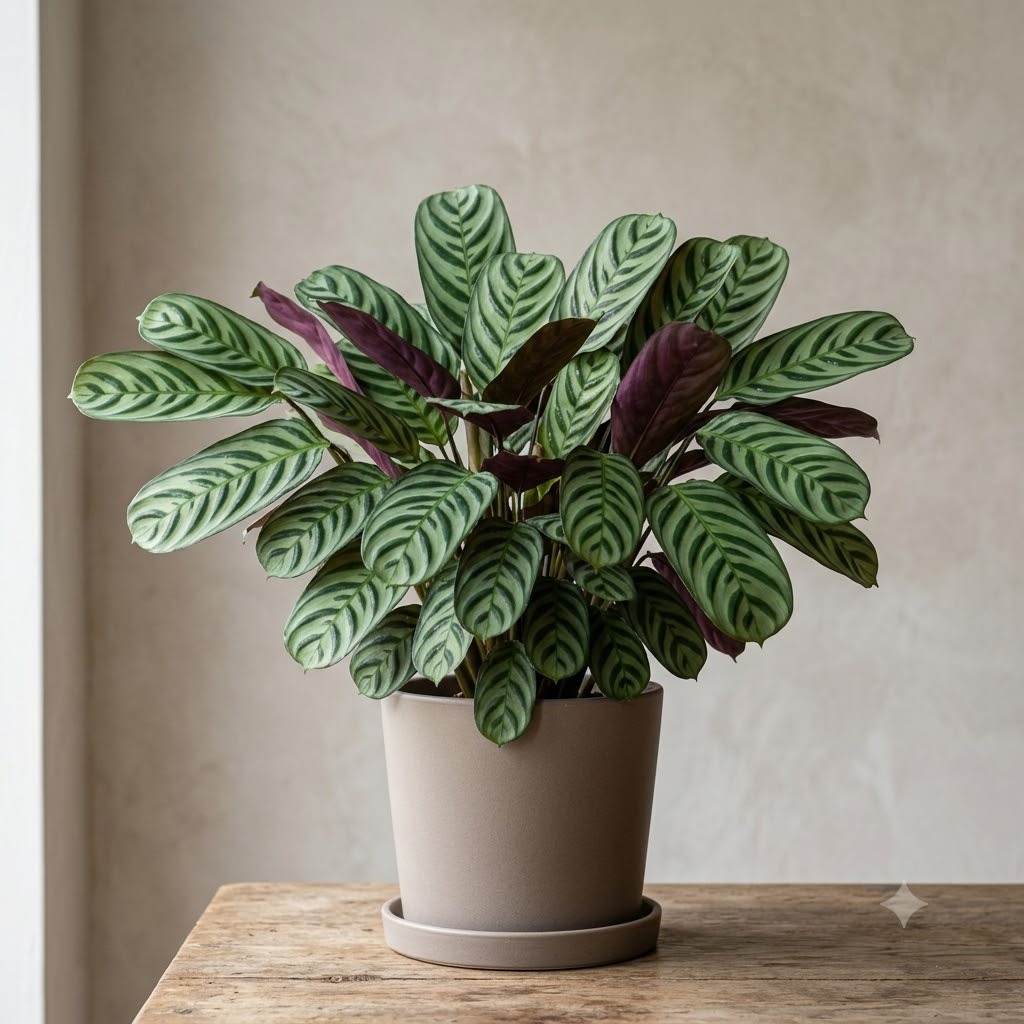
The Ctenanthe - often sold as the "Never Never Plant" - is a lush, patterned foliage plant that brings a soft, tropical, hand-painted look to a room. Its long, oval leaves are marked with feathery brushstrokes of light and dark green, and in many varieties the undersides are a rich burgundy-purple. It belongs to the prayer-plant family, so it shares that family's love of humidity and its gentle daily leaf movement. Ctenanthe is a touch more forgiving than its fussier cousins the Calatheas, but it is still a humidity-loving plant that rewards steady, attentive care rather than neglect. For anyone who wants intricate patterned foliage and a full, bushy shape, it is a beautiful choice.
Origin & Natural Habitat
Ctenanthe species are native to the tropical rainforests of Brazil and Central America, where they grow as understory plants on the humid, shaded forest floor beneath the canopy. They live in warm, consistently moist conditions with filtered light and soft rainwater. The genus belongs to the Marantaceae - the prayer-plant family alongside Calathea, Maranta, and Stromanthe.
The name "Never Never Plant" is a bit of houseplant folklore with no single clear origin, but the care lesson is clear from the habitat: this is a warm-loving, humidity-loving, shade-adapted plant. Recreating a little of that sheltered, humid forest floor - warmth, moisture, filtered light, and clean water - is the whole secret to keeping it thriving indoors.
Appearance
Ctenanthe is grown for its foliage, which is elegant and intricately patterned. The most popular varieties, such as Ctenanthe burle-marxii ("Fishbone Prayer Plant") and Ctenanthe 'Amagris', have oval to lance-shaped leaves marked with alternating bands or brushstrokes of pale silvery green and deeper green, often with contrasting purple undersides.
Key features:
- Patterned foliage: feather-like or fishbone bands of light and dark green across each leaf.
- Colored undersides: many varieties show maroon or purple reverses.
- Prayer-plant movement: leaves lift and fold at night, lower and open by day.
- Bushy, clumping habit: it grows as a full, spreading clump on upright stems rather than a vine.
Indoors a Ctenanthe typically reaches 60-90 cm tall and spreads outward into a generous, leafy mound over time. New leaves emerge rolled and unfurl to reveal fresh pattern.
Why People Love It - Qualities & Benefits
- Intricate foliage: the painted, feathery patterns are eye-catching and elegant without being loud.
- Full, lush shape: it fills a pot with a bushy mound of leaves, ideal for adding softness to a corner or shelf.
- Living movement: the daily raising and lowering of the leaves gives it charm and character.
- A little more forgiving: compared with fussier Calatheas, Ctenanthe tends to be somewhat more tolerant, making it a gentler entry into the prayer-plant family.
- Humidity and calm: like most rainforest foliage it adds moisture and a soothing green atmosphere to a living space.
Care
Light
Bright, indirect light is ideal - enough to keep the patterns strong, but no harsh direct sun, which scorches and fades the leaves. An east or north window, or a spot set back from a brighter window, suits it well. In too little light the patterns dull and growth becomes sparse and leggy.
Watering
Keep the soil lightly and evenly moist during the growing season - moist but never waterlogged, and never bone dry. Water when the top centimeter or two starts to dry, and let excess drain away. Like its prayer-plant relatives, Ctenanthe is sensitive to water quality: hard, chlorinated, or fluoridated water can cause brown leaf edges. Where possible use filtered water, rainwater, or tap water left to stand overnight. Reduce watering in winter but do not let it dry out completely.
Soil & Potting
Use a light, moisture-retentive but well-draining mix - a peat- or coir-based potting mix with some perlite. Always use a pot with drainage holes.
Humidity & Temperature
Humidity is important. Ctenanthe is happiest above 50-60% and shows brown edges in dry air. Group it with other plants, use a pebble-and-water humidity tray, or run a humidifier. Keep it warm at 18-27 °C and away from cold drafts and anything below about 15 °C.
Feeding
Feed every 2-4 weeks through spring and summer with a balanced liquid houseplant fertilizer at half strength. It is sensitive to fertilizer salt buildup, so keep feeding light and flush the soil occasionally. Stop in winter.
Repotting
Repot every 1-2 years in spring when the clump becomes crowded, moving up one pot size. This is also the perfect time to divide the plant if you want more.
Propagation
Ctenanthe is propagated by division, not by cuttings. At repotting time, gently separate the root ball into clumps, making sure each section has healthy roots and several leaves. Pot each division into fresh moist mix and keep it warm and humid. Divisions may sulk for a few weeks while they settle before growing again, so be patient. Stem or leaf cuttings in water do not work for this plant.
Common Problems & Pests
- Brown, crispy leaf edges: dry air, underwatering, or hard/chlorinated water - the most common complaint. Raise humidity and use filtered or rested water.
- Curling or tightly folded leaves: usually thirst or very low humidity.
- Faded, dull pattern: too little light (or occasionally too much direct sun bleaching it).
- Yellowing lower leaves: overwatering or soggy soil.
- Leggy, sparse growth: not enough light.
- Pests: spider mites thrive in the dry air that stresses this plant - watch for fine webbing and stippling. Mealybugs can also appear. Raise humidity, wipe the leaves, and treat with insecticidal soap or neem oil.
Toxicity & Safety
Non-toxic to cats and dogs. Ctenanthe, like other members of the prayer-plant family, is considered pet-safe and is not poisonous to people. It is a good patterned foliage choice for homes with pets or children, though as with any plant it is still best to discourage animals and toddlers from chewing the leaves.
Pros & Cons
Pros
- Beautiful, intricate patterned foliage.
- Full, bushy, lush growth habit.
- Charming daily leaf movement.
- Pet-safe and non-toxic.
- A little more forgiving than fussy Calatheas.
Cons
- Needs decent humidity - browns in dry air.
- Sensitive to hard and chlorinated water.
- Patterns fade and growth thins in low light.
- Prone to spider mites when stressed.
- Divisions can be slow to settle.
Best Suited For
- Owners who love intricate patterned foliage and a bushy shape.
- Humid rooms, or homes where a humidifier or pebble tray is realistic.
- Pet households wanting a non-toxic patterned plant.
- Bright spots out of direct sun.
Not ideal for very dry heated rooms with no humidity boost, dark corners, or people who want a plant they can completely ignore.
FAQ
Why are my Ctenanthe's leaf edges turning brown? Usually dry air, underwatering, or hard/chlorinated water. Raise the humidity above 50-60%, keep the soil evenly moist, and switch to filtered, rested, or rainwater.
Is Ctenanthe the same as a Calathea? No - they are close relatives in the same prayer-plant family and look similar, but Ctenanthe is its own genus and tends to be a bit more forgiving.
Is it safe for cats and dogs? Yes. Ctenanthe is non-toxic to pets and people, making it a good pet-friendly option, though it is still wise to discourage chewing.
How do I propagate it? By division at repotting time - split the clump so each piece has roots and leaves. Cuttings in water do not work for this plant.
Why does my plant look leggy and pale? Too little light. Move it to a brighter spot with indirect light to restore fuller growth and stronger leaf patterns, but keep it out of direct sun.