Dendrobium Orchid
The Dendrobium is one of the largest and most diverse genera of orchids in the world, with well over a thousand species and countless hybrids.
🗓️ Last reviewed: July 2026
Overview
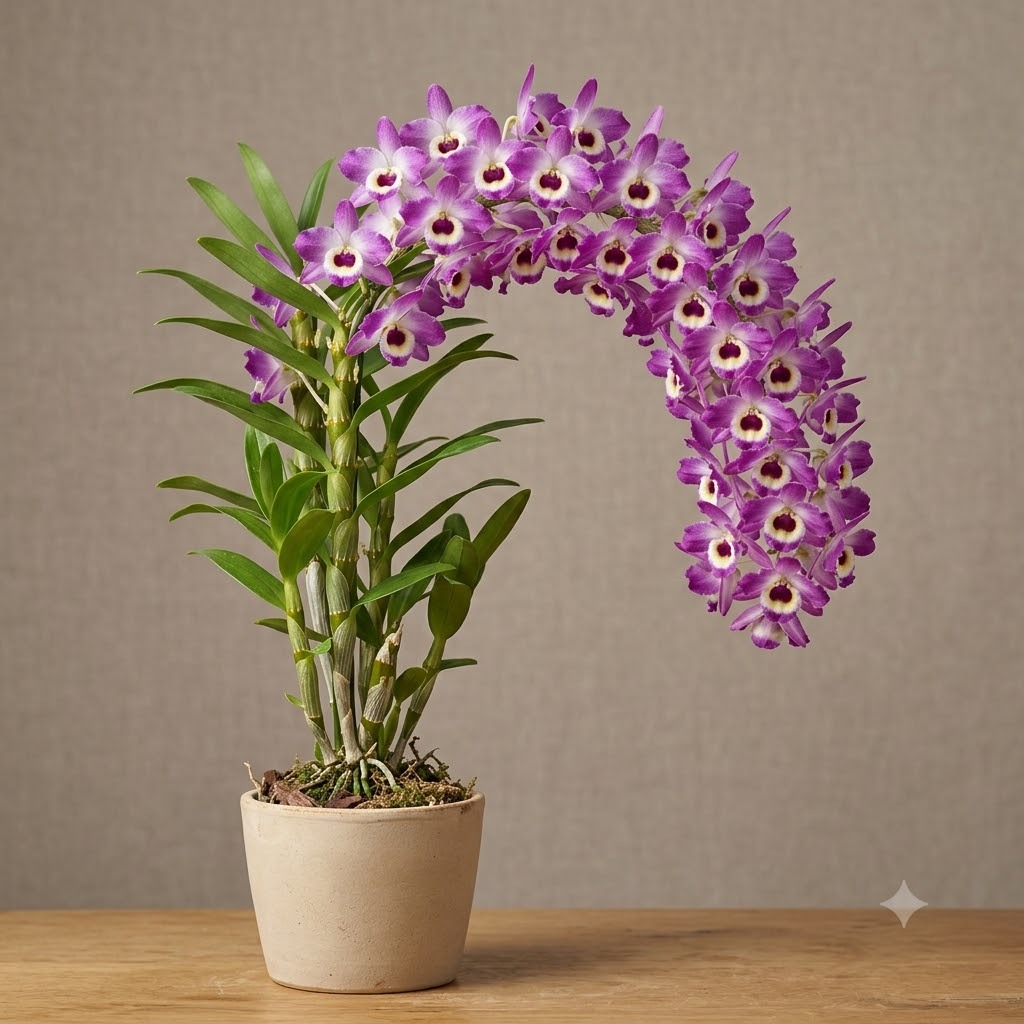
The Dendrobium is one of the largest and most diverse genera of orchids in the world, with well over a thousand species and countless hybrids. If your only experience of orchids is the supermarket Phalaenopsis (the "moth orchid"), a Dendrobium is a different creature - it grows from tall, upright, cane-like stems and produces sprays of flowers along those canes, often in dense, showy arches of white, pink, purple, or yellow. It is prized for its long-lasting, abundant blooms and its more architectural, structural shape. It is not a difficult plant, but it is a distinct one: many Dendrobiums want brighter light than a Phalaenopsis, and a large group of them need a genuine cool, dry rest period in winter to bloom at all. Understand which type you have and what it wants, and a Dendrobium will reward you with some of the most generous flowering of any houseplant orchid.
Origin & Natural Habitat
Dendrobium orchids are native to an enormous range across Asia and Oceania - from India and the Himalayan foothills through Southeast Asia to southern China, and down into Indonesia, New Guinea, and Australia. This vast range is why the genus is so varied: some come from cool mountain slopes, others from hot, humid lowland jungle.
The name Dendrobium comes from the Greek for "living on trees," and that is exactly what they do - the great majority are epiphytes, growing perched on tree branches with their roots clinging to bark, not planted in soil. Their thick canes (properly called pseudobulbs) store water and energy to survive dry spells. Understanding this epiphytic, cane-storing, seasonal nature is the key to growing them well indoors.
Appearance
The Dendrobium's look is defined by its upright canes:
- Canes (pseudobulbs): tall, slender, upright stems that store water. They can range from a few centimeters to over a meter tall depending on the type.
- Leaves: strap-like or oval leaves emerge along the canes. Some types are evergreen; others (the deciduous "nobile" type) drop their leaves before blooming.
- Flowers: borne along the upper canes, often in profusion - some canes bloom their entire length, creating a spectacular arch of flowers.
- Roots: thick, silvery aerial and potting roots typical of epiphytic orchids.
- Size indoors: commonly 30-90 cm tall, depending on type and age.
The two most common houseplant groups are the nobile-type (deciduous, needs a cool dry winter rest, flowers along the cane) and the phalaenopsis-type or "den-phal" (evergreen, warm-growing, flowers on sprays from the cane tops, easier and more forgiving).
Why People Love It - Qualities & Benefits
- Spectacular, generous blooms: a well-grown Dendrobium can flower along the whole length of its canes, far more prolifically than many orchids.
- Long-lasting flowers: blooms often last many weeks, sometimes a couple of months.
- Architectural form: the upright canes give a structured, elegant look even out of flower.
- Huge variety: with so many types and colors, there is a Dendrobium for almost any taste.
- Rewarding reblooming: with the right seasonal care, they reliably flower year after year - a satisfying long-term relationship rather than a disposable bloom.
Care
Light
Most Dendrobiums want bright light - brighter than a Phalaenopsis. Aim for a bright spot with some gentle direct morning sun, such as an east window, or filtered light at a bright south or west window. The leaves should be a light, slightly yellowish green rather than dark green; dark, floppy leaves usually mean too little light and are a common reason a plant refuses to bloom.
Watering
Water thoroughly, then let the potting medium approach dryness before watering again - orchids rot in constantly wet media. In active growth (spring and summer) this is often once or twice a week; the canes should stay plump. The exception is the winter rest for nobile-type Dendrobiums, described below, when watering is deliberately reduced. Water with room-temperature water and always let it drain freely.
The Winter Rest - the key to blooming many Dendrobiums
This is the single most important point for nobile-type Dendrobiums, and where most people go wrong. In autumn and winter, these plants need a cool, bright, dry rest: cooler nights (around 10-15 °C), much less water, and no fertilizer for several weeks. This seasonal stress is the signal that triggers flowering. Kept warm and well-watered all winter, a nobile Dendrobium tends to grow leafy shoots instead of flowers. Den-phal (evergreen) types do not need this cool dry rest and can be grown warm year-round.
Potting Medium
Pot in a coarse, open orchid medium such as bark chips, not regular soil. Dendrobiums like a relatively snug pot and often bloom better when slightly pot-bound. Use a pot with drainage.
Humidity & Temperature
They enjoy humidity of 50-70% and good air movement. Day temperatures of 18-27 °C suit most types; remember the cooler nights needed by nobile types in winter for blooming.
Feeding
Feed with a dilute orchid fertilizer regularly during active growth in spring and summer. Reduce or stop feeding in autumn and during the winter rest.
Repotting
Repot every 2-3 years, ideally when new growth begins, using fresh bark. Handle the roots gently and do not over-pot into a large container.
Propagation
Dendrobiums can be propagated in a couple of home-friendly ways. Large clumps can be divided at repotting, keeping several canes together in each division. More charmingly, many Dendrobiums produce keikis - baby plantlets that sprout along the canes, complete with their own leaves and roots. Once a keiki has several roots a few centimeters long, gently detach it and pot it in fresh bark to grow on as a new plant.
Common Problems & Pests
- No flowers: the most common complaint. For nobile types, it usually means the plant did not get its cool, dry winter rest. For all types, it can mean too little light.
- Shriveled, wrinkled canes: usually underwatering or a damaged root system - the plant cannot take up water.
- Yellowing leaves: normal for deciduous nobile types before blooming; otherwise can indicate overwatering or root rot.
- Rotting base or mushy roots: from a soggy, broken-down medium - repot into fresh bark and cut away dead roots.
- Pests: watch for scale, mealybugs, and spider mites, especially in dry air. Wipe them off, isolate the plant, and treat with insecticidal soap or neem oil suitable for orchids.
Toxicity & Safety
Dendrobium orchids are generally considered non-toxic to cats, dogs, and humans. They are not among the plants known to cause poisoning, which makes them a reasonably safe choice for pet-owning households. As always, it is still sensible to discourage pets and children from chewing on the plant, since any foliage can cause mild stomach upset if eaten in quantity.
Pros & Cons
Pros
- Spectacular, long-lasting, often profuse blooms.
- Elegant architectural cane form.
- Enormous variety of colors and types.
- Reliable rebloomer with the right seasonal care.
- Non-toxic and reasonably pet-safe.
Cons
- Nobile types need a cool, dry winter rest to bloom - easy to get wrong.
- Wants brighter light than the familiar Phalaenopsis.
- Grown in bark, not soil, which takes some adjustment.
- Confusing variety - care differs between types.
- Not a plant to ignore; it responds to seasonal attention.
Best Suited For
- Bright windowsills, especially with some morning sun.
- Orchid growers ready to move beyond the Phalaenopsis.
- People who can provide (or naturally have) a cooler winter spot for nobile types.
- Anyone who wants generous, reliable orchid blooms year after year.
Not ideal for dim rooms, growers unwilling to adjust care by season, or those who want a completely hands-off plant.
FAQ
Why won't my Dendrobium bloom again? If it is a nobile type, it almost certainly did not get a cool, dry winter rest - cooler nights, much less water, and no feeding for several weeks in winter trigger flowering. Too little light is the other common cause.
Is Dendrobium cared for like a Phalaenopsis? Not quite. Dendrobiums generally want brighter light, and many need a seasonal rest that a Phalaenopsis does not. Identify whether you have a nobile or den-phal type to know which rules apply.
What are the little plants growing on the canes? Those are keikis - baby orchids. Once they have their own roots, you can detach and pot them up as new plants.
Should my Dendrobium's leaves fall off? For deciduous nobile types, yes - they naturally drop leaves before blooming. For evergreen den-phal types, leaf drop is a sign of stress.
What do I pot it in? Coarse orchid bark, not soil. Dendrobiums like an open, fast-draining medium and a slightly snug pot.