Euphorbia Trigona (African Milk Tree)
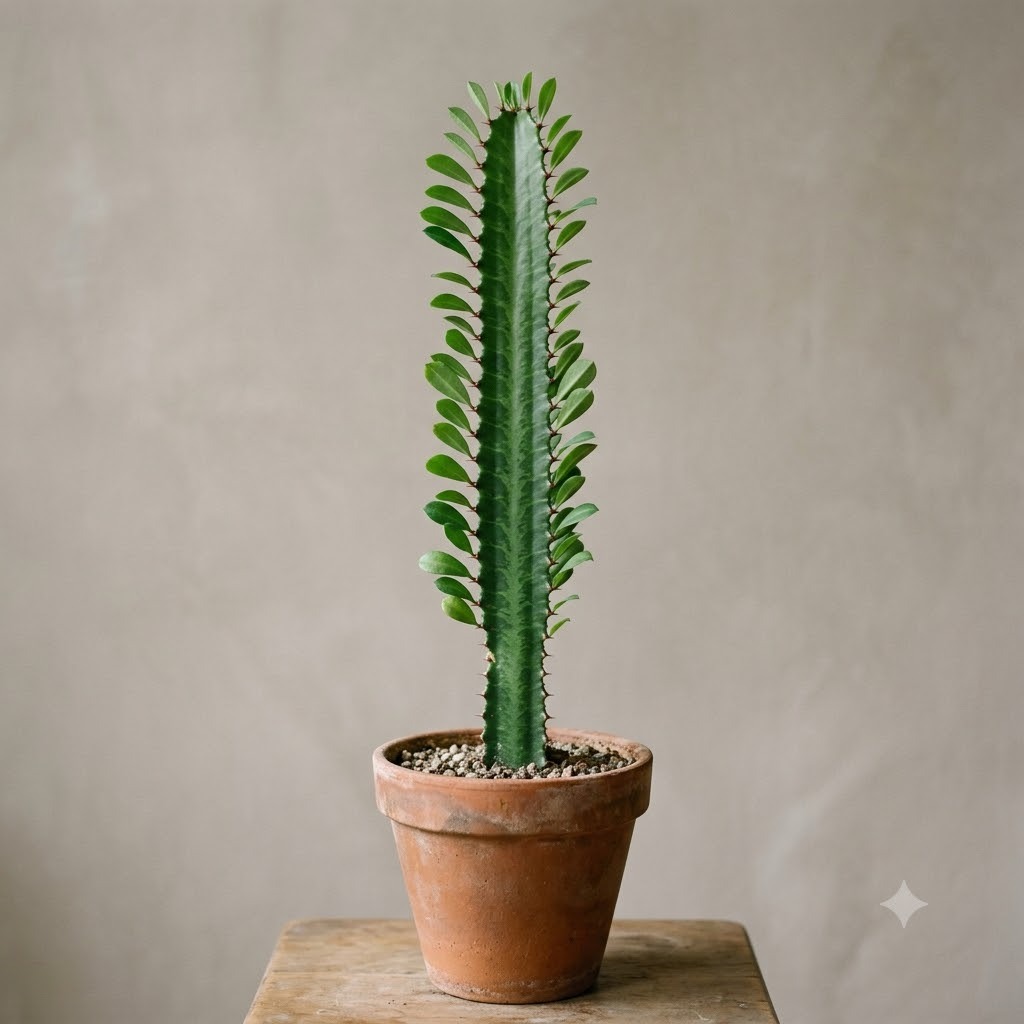
The African Milk Tree, Euphorbia trigona, is a bold, architectural houseplant that looks exactly like a cactus - tall green columns, ridges lined with spines - but is not a cactus at all.
🗓️ Last reviewed: July 2026
Overview
The African Milk Tree, Euphorbia trigona, is a bold, architectural houseplant that looks exactly like a cactus - tall green columns, ridges lined with spines - but is not a cactus at all. It is a succulent euphorbia, and that distinction matters: the plant carries a milky white sap that irritates skin and eyes. Set that one caution aside and you have one of the easiest, fastest-growing statement plants you can own. It asks for a bright spot and almost nothing else, growing steadily into a striking green candelabra that anchors a room with very little fuss. For anyone who wants a dramatic, low-effort, upright plant, the African Milk Tree is hard to beat.
Origin & Natural Habitat
Euphorbia trigona comes from Central and West Africa, where it grows in warm, dry, sunny scrub and thicket. Like many euphorbias, it evolved to survive long dry spells: it stores water in its thick, upright stems and closes down water loss through a cactus-like body rather than broad leaves. In the wild and in frost-free gardens it can form dense, branching hedges several meters tall.
It is worth naming the family confusion early. Euphorbias and true cacti look alike because they solved the same problem - surviving heat and drought - in similar ways, an example of convergent evolution. But they are unrelated. True cacti belong to the Americas; euphorbias like this one are Old World plants. The clearest tell is the sap: cacti do not bleed milky latex when cut, and euphorbias do.
Appearance
The African Milk Tree grows as an upright, three-sided (sometimes four-sided) green column with pronounced ridges running its full height. Along those ridges sit paired short spines and small, spoon-shaped green leaves that emerge near the growing tips.
- Stems: vertical, ribbed, deep green, often branching upward into a candelabra shape as the plant matures.
- Leaves: small, teardrop leaves along the top of the ridges - unlike a true cactus, it does carry real leaves, though it may drop them in stress or low light.
- Spines: small, paired thorns along the ridge edges - firm but not the fearsome spines of a large cactus.
- Height: indoors it commonly reaches 1-2 meters over a few years and can grow quite fast in good light.
There is also a popular red-blushed cultivar, Euphorbia trigona 'Rubra' (or 'Royal Red'), whose leaves and stem edges flush burgundy in strong light - the same plant, dressed in deeper color.
Why People Love It - Qualities & Benefits
- Architectural drama: the tall, ribbed green columns give instant structure and a sculptural, modern look.
- Genuinely easy: it thrives on neglect. Bright light plus occasional water is essentially the whole care routine.
- Fast and rewarding: in a sunny spot it grows noticeably each season, which keeps owners engaged.
- Compact footprint: it grows up, not out, so it fits narrow corners and bright windowsills where a spreading plant would not.
- Long-lived and tough: an established plant is remarkably resilient and can live for many years with minimal intervention.
Care
Light
This is a sun lover. Give it the brightest spot you have - a south or west window is ideal, and it happily takes several hours of direct sun. In good light the plant stays compact, upright, and richly colored (especially the 'Rubra' form). In low light it grows pale, stretched, and floppy, and may drop its leaves. If it starts leaning hard toward the window, rotate it every week or two.
Watering
Treat it like a succulent, not a tropical. Water thoroughly, then let the soil dry out completely before watering again. In a bright spot in summer that is often every 1-2 weeks; in winter it may want water only once a month or less. Overwatering is the main way people kill this plant - soggy soil rots the base and roots quickly. When unsure, wait. Soft, yellowing, or mushy stems near the soil are a rot warning; leave the plant dry and check the roots.
Soil & Potting
Use a gritty, fast-draining mix - a cactus and succulent soil, or regular potting mix cut heavily with perlite, pumice, or coarse sand. Always use a pot with drainage holes. A heavy pot (terracotta is ideal) also helps counterbalance a tall, top-heavy plant.
Humidity & Temperature
It prefers warm, dry air and is comfortable at normal room humidity - no misting needed. It enjoys 18-27 C and dislikes cold. Keep it above about 10 C and away from cold drafts and frost, which it will not survive.
Feeding
Feed lightly - a diluted cactus or balanced fertilizer once a month through spring and summer is plenty. Do not feed in autumn and winter.
Support & Handling
A tall specimen can become top-heavy; a heavy pot usually keeps it stable, and you can stake a leaning stem if needed. Always wear gloves when pruning or repotting (see safety below).
Propagation
The African Milk Tree propagates easily from stem cuttings, but this is the step where the sap caution matters most. Wearing gloves and eye protection, cut a branch or stem tip with a clean knife. The cut will ooze milky white latex - rinse or dab the cut end to stop the flow, then set the cutting aside in a dry, shady spot for several days until the cut forms a dry callus. Once callused, plant it in dry, gritty succulent mix and water only sparingly until roots establish over a few weeks. A cutting planted while still wet and un-callused tends to rot.
Common Problems & Pests
- Stretched, pale, floppy growth: not enough light. Move it to the brightest window available.
- Dropped leaves: usually low light, cold, or a sudden change; often recovers in a brighter spot.
- Soft, yellow, or mushy base: rot from overwatering or poor drainage - the most serious problem. Stop watering, unpot, and check for firm roots; you may need to take a healthy top cutting to save the plant.
- Corky brown patches on old stems: often natural aging or old sun exposure, usually harmless.
- Pests: mealybugs (white fluff in the ridges) and, less often, spider mites. Wipe them off and treat with insecticidal soap; check the hidden inner ridges.
Toxicity & Safety
The milky white sap (latex) is the key hazard. All parts of Euphorbia trigona contain an irritant latex that can cause redness, burning, and rash on skin, and serious irritation if it contacts the eyes - eye exposure can be genuinely painful and warrants rinsing and medical advice. The sap is also toxic if ingested, causing mouth and stomach irritation in people and pets. Always wear gloves and eye protection when cutting, pruning, or repotting, avoid touching your face, and wash hands and tools afterward. Keep the plant out of reach of children and pets. The spines are a minor, secondary concern next to the sap.
Pros & Cons
Pros
- Striking, sculptural, upright form.
- Extremely easy - thrives on neglect.
- Fast-growing and rewarding in bright light.
- Narrow footprint; fits tight, sunny spots.
- Very easy to propagate from cuttings.
Cons
- Irritating, toxic sap requires careful handling.
- Needs strong light; sulks and stretches in dim rooms.
- Rots quickly if overwatered.
- Can become tall and top-heavy.
- Not pet or child friendly.
Best Suited For
- Beginners who want a dramatic, low-maintenance plant.
- Bright, sunny windows and warm rooms.
- People who like an architectural, modern look.
- Anyone who tends to forget watering rather than overdo it.
Not ideal for homes with curious pets or small children, dim rooms with little direct light, or anyone unwilling to wear gloves when handling it.
FAQ
Is the African Milk Tree a cactus? No. It looks like one, but it is a succulent euphorbia. The giveaway is the milky sap - true cacti do not bleed latex when cut.
Why is my plant leaning or stretching? Almost always too little light. Move it to the brightest window and rotate it regularly so it grows straight.
The sap got on my skin - is that dangerous? The latex is an irritant. Wash it off promptly with soap and water. If sap gets in your eyes, rinse thoroughly with water and seek medical advice - eye exposure can be serious.
How often should I water it? Only when the soil is fully dry - roughly every week or two in summer, and much less in winter. When in doubt, wait; it far prefers dry to soggy.
Why is the base turning soft and yellow? That is rot from overwatering or poor drainage. Stop watering immediately, check the roots, and if the base is failing, take a healthy top cutting, callus it, and start over in dry gritty mix.