Ficus Audrey (Ficus benghalensis)
Ficus Audrey - Ficus benghalensis - is the houseplant quietly taking the crown from the famously temperamental fiddle-leaf fig.
🗓️ Last reviewed: June 2026
Overview
Ficus Audrey - Ficus benghalensis - is the houseplant quietly taking the crown from the famously temperamental fiddle-leaf fig. It is grown for one thing above all: it makes a beautiful indoor tree. The leaves are soft and matte rather than glossy, a gentle sage-to-deep-green with pale, almost ivory veins running through them, and they have a faint velvety feel that the fiddle-leaf simply does not have. What has earned it a devoted following, though, is its temperament. Audrey is sturdier, more forgiving, and far less prone to sudden tantrums than its fashionable cousin, which makes it a much better choice if you have ever killed a fiddle-leaf and sworn off figs for life. It suits anyone who wants a real statement tree - something with height and presence - without signing up for daily anxiety. Be honest with yourself before you buy: it is forgiving, not indestructible. It still wants good light and steady, sensible watering. Give it those, and it will grow with you for years into a genuine indoor tree.
Origin & Natural Habitat
Ficus benghalensis is the banyan fig, and it is native to the Indian subcontinent - across India, Bangladesh, Pakistan, and Sri Lanka. It is the national tree of India, and in the wild it is anything but a tidy little houseplant. A mature banyan is one of the largest trees on Earth by canopy area: it drops aerial roots from its spreading branches down to the ground, where they thicken into new trunks, so a single tree can march outward over time until it looks like a small forest. Some famous specimens shade areas the size of several football fields. It belongs to the fig family (Moraceae), which makes it a close relative of the rubber plant (Ficus elastica), the fiddle-leaf fig (Ficus lyrata), and the edible fig. The species name benghalensis simply means "of Bengal," the region where Europeans first catalogued it. None of this should alarm you indoors - in a pot, confined roots and your pruning keep it to a manageable, upright tree - but it tells you the important thing about Audrey: this is a strong, fast, light-hungry tree at heart, and it grows with real vigour when it is happy.
Appearance
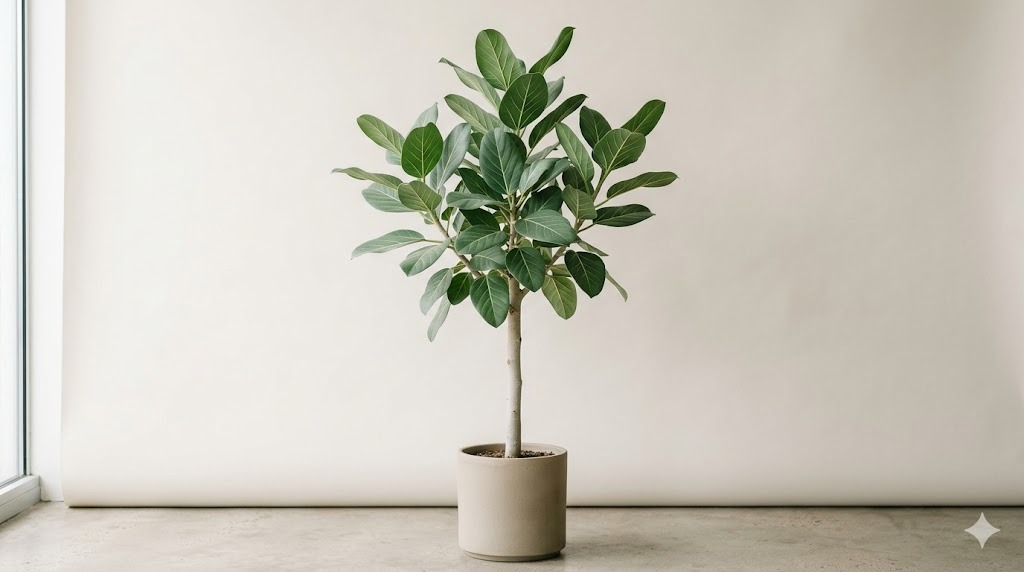
Picture an upright, branching tree with a pale woody trunk and soft, oval, gently pointed leaves held out on short stalks. The leaves are the signature: matte rather than shiny, a muted sage-green deepening to a richer green, with distinct lighter veins - often creamy or pale - tracing across the surface. New growth is a little softer and lighter, and the whole plant has a calm, slightly dusty, understated look rather than the high-gloss drama of a rubber plant. Left to grow and lightly pruned, it forms a shapely, tree-like canopy, which is exactly why people buy it.
- Leaves: soft, matte, oval to elliptical with a gentle point, in a muted sage-to-deep-green with pale ivory veins and a faint velvety texture - the opposite of the fiddle-leaf's big glossy paddles.
- Trunk & branches: a pale grey-tan woody trunk that can be grown as a single stem or braided, branching into an open, tree-shaped canopy.
- New growth: emerges from a pale sheath at the branch tips, soft and light green before it firms up and darkens.
- Growth habit: an upright, vigorous tree rather than a trailing or bushy plant, and a fairly fast grower indoors when it gets enough light.
Indoors it is commonly sold around 60-120 cm and will, over a few years in good conditions, grow into a 1.8-2.5 m indoor tree - taller still if you let it.
Why People Love It - Qualities & Benefits
- A real statement tree: few houseplants give you genuine height and a tree-like silhouette the way Audrey does - it anchors a room like a piece of furniture.
- Far easier than the fiddle-leaf fig: this is the headline reason people switch. It is sturdier, more tolerant of imperfect care, and much less prone to dropping leaves at the first complaint.
- Distinctive soft, matte foliage: the velvety sage leaves with pale veins look more natural and calming than glossy plastic-looking foliage, and they suit almost any decor.
- Fast, rewarding growth: in good light it actually grows for you, putting out fresh leaves through the season so you can watch it become a tree.
- Flexible styling: sold as a single trunk, branched, or braided, it works as a floor tree in a corner, by a window, or as a centrepiece.
- Atmosphere: like most large-leaved tropicals it adds a lot of life and a little humidity to a room. (The popular "air-purifying" claims are real but modest in a normal home; the bigger benefit is psychological, since greenery measurably lifts mood and lowers stress.)
Care
Light
Bright light is what Audrey wants, and it is the single biggest factor in whether it thrives or sulks. Give it the brightest spot you have: right beside an east or west window, or a little back from a south window, is ideal. Unlike many houseplants it will genuinely appreciate some direct sun - a few hours of gentle morning or late-afternoon sun is welcome and keeps it dense and strong. It will tolerate bright indirect light, but in a dim corner it grows leggy, pale, and slow, and it sheds older leaves. If you are moving it into much stronger light, do it gradually over a week or two so the leaves do not scorch, and turn the pot now and then so it grows evenly instead of leaning toward the glass.
Watering
This is where most figs are won or lost, and Audrey is no exception. Water when the top inch or two (about 2.5-5 cm) of the mix has dried out, then water thoroughly until it runs from the drainage holes and tip away anything left in the saucer. The two extremes both cause trouble: leaving it sitting wet and soggy is the fast route to root rot, while letting it go bone-dry stresses it badly. The key thing to understand about Audrey is that it can drop leaves when stressed - by overwatering, by drought, by being moved, or by a cold draft - so the goal is steady, consistent moisture rather than dramatic swings. Check the soil with your finger before you reach for the can, water a little less in winter when growth slows, and try not to relocate it constantly. Consistency keeps the leaves on the tree.
Soil & Potting
Use a rich but well-draining mix - a good general houseplant or indoor-tree potting soil loosened with perlite, and some bark or coarse material for structure, works well. The roots need to breathe and must never stay waterlogged, so drainage is non-negotiable. Always plant into a container with drainage holes.
Humidity & Temperature
Audrey is more tolerant of normal room humidity than its rainforest relatives, but it still appreciates a bit more - aim for 40-60% if you can. Occasional misting or a nearby humidifier helps in dry, heated rooms. It is happiest warm, roughly 18-29 C, and dislikes cold. Keep it away from cold drafts, frosty windows in winter, and the blast of heating vents or air conditioning, all of which can trigger leaf drop.
Feeding
Feed every 2-4 weeks through spring and summer with a balanced liquid houseplant fertilizer at half strength to fuel its vigorous growth. Ease off in autumn and stop in winter while growth has slowed, then resume in spring as the days lengthen and new leaves appear.
Wiping the leaves
This is its own little job because it matters more than people expect. The soft matte leaves are large and they collect dust, and a dusty leaf is a leaf that cannot photosynthesise properly. Every couple of weeks, wipe both sides gently with a soft, damp cloth, supporting each leaf with your other hand. It keeps the foliage breathing, lets in more light, looks far better, and gives you a regular chance to spot pests early.
Repotting & pruning
Repot every couple of years in spring, or when roots fill the pot and start circling or poking from the drainage holes, moving up just one pot size - too big a pot holds too much wet soil. Audrey responds very well to pruning: trim back the growing tips to control height, encourage branching, and shape it into a fuller, more tree-like canopy. Prune in spring or summer. A quick caution that leads straight into the next section: pruning, and any broken stem or leaf, releases a milky white sap, so wear gloves and keep it off your skin, furniture, and pets.
Propagation
Ficus Audrey propagates from stem cuttings, and it is satisfying once you know the trick. Take a healthy stem-tip cutting with a few leaves, cut just below a node, and first rinse or blot the milky sap from the cut end (it will keep weeping briefly). Remove the lowest leaves, optionally dip the end in rooting hormone, and root it either in water or directly in a moist, well-draining mix. Warmth, bright indirect light, and a little humidity - a loose clear bag over the pot helps - speed things along. Be patient: figs root more slowly and less reliably than something like a pothos, so do not be discouraged if it takes several weeks, and start more than one cutting to improve your odds. For larger, more established plants, air layering is the more dependable method.
Common Problems & Pests
- Leaf drop: the classic fig complaint. Usually a reaction to stress - overwatering, letting it dry out completely, a sudden move, cold drafts, or a big change in light. A few lost lower leaves is normal; a sudden shower of them means check water and location first.
- Yellowing leaves: most often overwatering and soggy roots - let the top of the mix dry more between waterings and make sure the pot drains.
- Brown, crispy leaf edges or tips: typically very dry air, under-watering, or salt build-up from fertilizer; raise humidity, water more consistently, and flush the soil occasionally.
- Brown patches in the leaf: can be sunburn from a sudden jump into harsh direct sun - acclimate it gradually.
- Leggy, sparse growth: a sign of too little light - move it brighter and prune to encourage a bushier shape.
- Dropping leaves after you bring it home or move it: a normal adjustment shock; pick a good permanent spot, then leave it alone to settle.
- Pests: watch for spider mites (especially in dry air), mealybugs, scale, and thrips. Wipe the leaves regularly to catch them early, isolate the plant, and treat with insecticidal soap or neem oil.
Toxicity & Safety
Toxic to pets and people - and a skin irritant. Like other figs in the genus, Ficus benghalensis contains a milky white sap (latex) that is toxic and irritating if eaten and can irritate the skin on contact. If a cat, dog, or child chews the leaves or stems, expect mouth and stomach irritation - drooling, vomiting, or a sore mouth are typical - and the sap can cause redness or a rash on sensitive skin, especially for people with a latex sensitivity. None of this makes it a plant to avoid, but it does mean a little common sense: keep it out of reach of pets and small children who like to nibble, and wear gloves whenever you prune, take cuttings, or handle a damaged stem so you do not get the sap on your skin or rub it into your eyes. Wipe up any sap that drips, and wash your hands afterwards. Treated as the ornamental tree it is - admired, not eaten - it is perfectly safe to live with. If a pet does chew it and you are worried, contact your vet or an animal poison line.
Pros & Cons
Pros
- Grows into a genuine, statement indoor tree with real height and presence.
- Much easier and more forgiving than the notoriously fussy fiddle-leaf fig.
- Soft, matte sage-green leaves with pale veins - distinctive and calming.
- Fast, rewarding growth in good light, and takes well to pruning and shaping.
- Tolerates normal room humidity better than many tropicals.
Cons
- Toxic to pets and people, and the sap can irritate skin - not for nibbling homes.
- Can drop leaves when stressed, moved, drafted, or watered carelessly.
- Wants bright light and ideally some direct sun to look its best.
- Vigorous - it needs space and occasional pruning to stay in scale.
- Roots and cuttings are slower and less reliable to propagate than easier houseplants.
Best Suited For
- People who want a forgiving statement tree, especially anyone burned by a fiddle-leaf fig.
- Bright rooms and sunny spots where it can get strong light and a little direct sun.
- Homes with the floor space for a plant that wants to grow into a real tree.
- Owners happy to wipe the leaves, prune occasionally, and keep watering steady.
Not ideal for homes with leaf-chewing pets or toddlers, dark corners, or anyone who wants a tiny, no-effort plant that never grows or needs shaping.
FAQ
Is Ficus Audrey easier than a fiddle-leaf fig? Yes - that is the main reason people choose it. It is sturdier, more tolerant of imperfect care, and far less likely to throw a fit and drop all its leaves over a small change. It still wants good light and steady watering, but it forgives mistakes that would doom a fiddle-leaf.
Why is my Ficus Audrey dropping leaves? Stress, almost always. The usual culprits are overwatering, letting it dry out completely, a recent move, cold drafts, or a sudden change in light. Settle it in one good spot, water only when the top inch or two is dry, and keep it away from drafts - a few lost lower leaves is normal, but a sudden drop means check those things.
Is Ficus Audrey toxic to cats and dogs? Yes. The milky sap is toxic and irritating if eaten and can irritate skin, so keep it out of reach of pets and children, and wear gloves when you prune or take cuttings. It is safe to live with as an ornamental tree - just not safe to chew.
How often should I water it? Water when the top inch or two of soil has dried out, then water thoroughly and empty the saucer. Avoid both extremes: do not let it sit soggy, and do not let it go bone-dry. Check with your finger rather than following a fixed schedule, and water less in winter.
How big does Ficus Audrey get indoors? With enough light it grows fairly fast into a 1.8-2.5 m indoor tree, and taller if you let it. You control the height and shape with pruning, so it stays in scale with your room rather than running away.