Gasteria (Ox Tongue)
Gasteria is a small, tough, slow-growing succulent from South Africa, best known for its thick, tongue-shaped leaves that stack up in neat rows.
🗓️ Last reviewed: July 2026
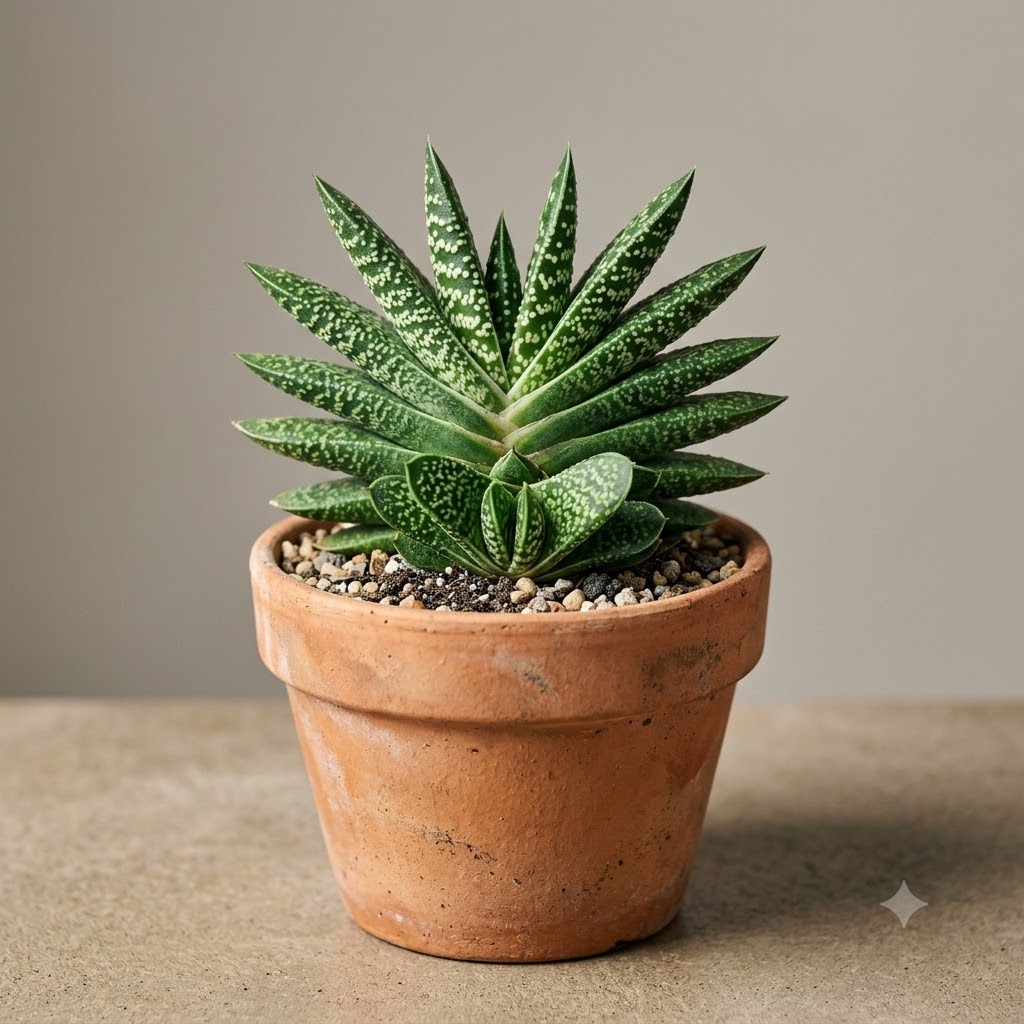
Overview
Gasteria is a small, tough, slow-growing succulent from South Africa, best known for its thick, tongue-shaped leaves that stack up in neat rows. Nicknamed "ox tongue" or "cow tongue" for the rough, textured surface of those leaves, it is one of the most low-maintenance succulents you can own. What sets Gasteria apart from most of its succulent cousins is a surprising tolerance for lower light - it is happy on a shelf or a north-facing sill where an Aloe or Echeveria would stretch and sulk. Compact, sculptural, and genuinely hard to kill, it is a superb desk plant and a great choice for beginners who want a succulent that forgives a shadier corner.
Origin & Natural Habitat
Gasteria is native to South Africa, where the roughly two dozen species grow across the Eastern Cape and the arid, rocky scrubland of the region. In the wild many species grow tucked into the shade of rocks, shrubs, or taller grasses rather than out in full blazing sun. This habit is the key to the plant's character: it evolved to handle bright but partly shaded conditions, which is exactly why it copes better indoors, in less-than-perfect light, than most desert succulents.
The name Gasteria comes from the Latin gaster, meaning "stomach," a reference to the rounded, pot-bellied shape of its small flowers. Those flowers appear on tall, arching stems and are typically curved and tubular in shades of pink, red, orange, and green - a favourite of sunbirds in habitat. Gasteria is closely related to Aloe and Haworthia, and the three genera hybridise freely, which is why nursery plants are sometimes sold under confusing or overlapping names.
Appearance
The signature feature of Gasteria is its foliage. The leaves are thick, firm, and shaped like a flattened tongue - hence "ox tongue" - and in most species they are arranged in two opposite rows, stacked flat like a fan, at least when young. Older or larger plants often spiral the leaves into a loose rosette.
- Leaf texture: the surface is usually rough and bumpy, often covered in raised white or pale speckles and tubercles, giving a pebbled, warty feel. Some species are smoother and glossier.
- Colour: deep green to grey-green, frequently marbled, banded, or spotted with cream and white.
- Size: most house-grown Gasteria stay small and compact, commonly 10-20 cm across, though some species and clumps get larger over years.
- Growth habit: slow and clumping. Mature plants produce offsets ("pups") around the base, gradually forming a tight cluster.
- Flowers: curved tubular blooms on a slender arching stalk, appearing on established plants, usually in the cooler months.
Because it stays small and grows slowly, a Gasteria rarely outgrows its spot - a real advantage on a crowded windowsill.
Why People Love It - Qualities & Benefits
- Tolerates lower light: the standout quality. Unlike most succulents, it does not demand a scorching south window, so it works in shadier rooms and offices.
- Almost indestructible: it shrugs off neglect and irregular watering better than nearly any other succulent.
- Compact and tidy: stays small and sculptural, ideal for desks, shelves, and small spaces.
- Interesting texture: the speckled, tongue-shaped leaves are genuinely distinctive and pleasing to touch.
- Pet-safe: it is non-toxic, a relief for homes with cats and dogs.
- Easy to multiply: offsets and even single leaves propagate readily, so one plant becomes many.
Care
Light
Bright, indirect light is ideal, but Gasteria is unusually flexible. It happily takes an east or north window and tolerates medium, partly shaded spots where other succulents fail. It can handle some gentle direct sun, but strong, hot midday sun through glass can scorch or bleach the leaves - if the leaves turn red, brown, or washed-out, it is getting too much. If the plant stretches or leans hard toward the window, it wants a bit more light.
Watering
Water like a true succulent: soak the soil thoroughly, then let it dry out completely before watering again. In practice that is roughly every 2-3 weeks in the growing season and much less - perhaps monthly or less - in winter. Overwatering and soggy soil are the main killers, causing soft, translucent, rotting leaves at the base. When in doubt, wait. The thick leaves store water, so the plant handles a missed watering far better than a drenching.
Soil & Potting
Use a gritty, fast-draining cactus and succulent mix, ideally cut with extra perlite, pumice, or coarse sand. The roots must never sit wet. Always use a pot with a drainage hole; terracotta helps wick away excess moisture.
Humidity & Temperature
Normal, dry room air suits it perfectly - no misting or humidity trays needed. It prefers 15-27 °C and dislikes cold. Protect it from frost and keep it above about 5-10 °C in winter.
Feeding
Feed lightly - a diluted cactus or succulent fertiliser once or twice through spring and summer is plenty. It is a slow grower and does not need much. Do not feed in winter.
Repotting
Repot only every few years, when the pot fills with offsets or roots. Gasteria actually flowers and clumps better when slightly pot-bound, so there is no rush. Spring is the best time.
Propagation
Gasteria is easy to propagate two ways. The simplest is by offsets: gently separate a rooted pup from the base of the parent, let the cut surface dry (callus) for a day or two, then pot it in dry succulent mix and water sparingly.
You can also propagate from leaves, though it is slower and less reliable than with some succulents. Twist off a whole healthy leaf cleanly at the base, let it callus for several days, then lay it on or barely into dry gritty mix. Keep it in bright indirect light and mist the soil very lightly only occasionally. Roots and a tiny new plantlet form at the base over several weeks to months. Patience is essential - Gasteria does everything slowly.
Common Problems & Pests
- Soft, mushy, translucent leaves: overwatering and rot. Stop watering, and if the base is rotting, cut above the damage and re-root a healthy top.
- Red, brown, or bleached leaves: too much direct sun. Move it to gentler light.
- Stretching / leaning: not enough light. Move it brighter.
- Shrivelled, wrinkled leaves: underwatering - give it a thorough soak.
- Pests: mealybugs (white cottony fluff in leaf crevices) are the most common; wipe them off and treat with insecticidal soap or dilute rubbing alcohol on a cotton bud. Watch also for root mealybugs and the occasional scale.
- Brown corky patches: often harmless scarring from old damage; not a disease.
Toxicity & Safety
Gasteria is non-toxic to cats, dogs, and humans. It is one of the safer succulents to keep in a home with curious pets or small children. As with any plant, eating it is not advisable and could cause mild stomach upset, but it contains no dangerous compounds.
Pros & Cons
Pros
- Tolerates lower light than almost any other succulent.
- Extremely hardy and forgiving of neglect.
- Stays small and compact - great for desks and shelves.
- Non-toxic and pet-safe.
- Easy to propagate from offsets.
Cons
- Very slow-growing - little visible change month to month.
- Rots quickly if overwatered.
- Not a big, dramatic statement plant.
- Leaf propagation is slow and hit-or-miss.
- Sensitive to hot direct sun through glass.
Best Suited For
- Beginners who want a genuinely easy succulent.
- People with shadier rooms or offices where other succulents struggle.
- Small spaces, desks, and windowsills.
- Homes with pets and children, thanks to its non-toxic nature.
Not ideal for anyone wanting fast growth or a large, showy plant, or people who tend to overwater.
FAQ
Why is my Gasteria growing so slowly? That is completely normal - Gasteria is naturally a very slow grower. As long as the leaves are firm and healthy, it is fine. More light within reason will speed it up slightly.
Can Gasteria really handle low light? It tolerates lower light better than most succulents, but "low light" has limits. It still wants a bright spot out of direct sun; a truly dark corner will make it stretch and weaken over time.
How often should I water it? Only when the soil has dried out completely - roughly every 2-3 weeks in summer and much less in winter. Always err on the side of underwatering.
Is Gasteria the same as Aloe or Haworthia? No, but they are close relatives and hybridise easily, which is why they are sometimes confused or mislabelled. Gasteria's stacked, tongue-shaped, heavily speckled leaves are its telltale sign.
Is it safe for my cat and dog? Yes. Gasteria is non-toxic, making it one of the safer succulent choices for pet owners.