Lipstick Plant (Aeschynanthus radicans)
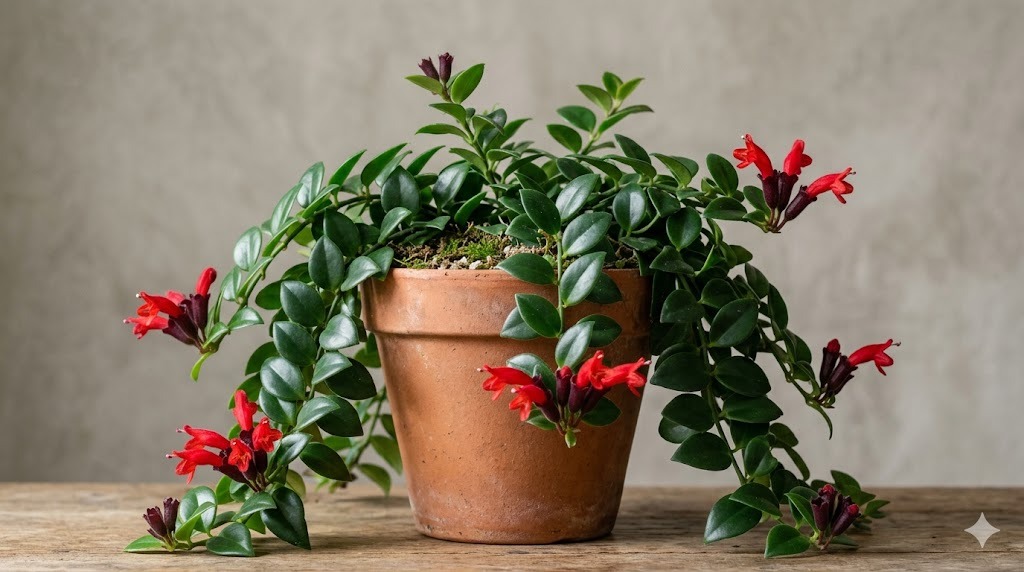
The Lipstick Plant - Aeschynanthus radicans - is a trailing tropical epiphyte grown for two things: its rows of thick, glossy, waxy dark-green leaves, and above all its vivid red tubular flowers.
🗓️ Last reviewed: June 2026
Overview
The Lipstick Plant - Aeschynanthus radicans - is a trailing tropical epiphyte grown for two things: its rows of thick, glossy, waxy dark-green leaves, and above all its vivid red tubular flowers. Each bloom pushes out of a dark maroon bud in a way that looks uncannily like a lipstick rising from its tube, which is exactly where the common name comes from. That trick makes it one of the few genuinely showy flowering plants you can grow in a hanging basket, and it is the reason the plant has a devoted following. It suits anyone who wants colour and movement rather than another upright green foliage plant. Be honest with yourself before you buy: it is a rewarding bloomer, but it has a few preferences. Give it enough light and a cooler winter rest, and it will flower for you year after year.
Origin & Natural Habitat
Aeschynanthus radicans is native to the humid tropical rainforests of Southeast Asia, across the Malay Peninsula and the surrounding region. In the wild it is an epiphyte: rather than rooting in soil, it perches on tree branches and trunks, trailing its stems down toward the forest floor and catching moisture and leaf litter where it sits. It belongs to the Gesneriad family (Gesneriaceae), which makes it a relative of the African violet and the goldfish plant. The botanical name carries a little story of its own. Aeschynanthus comes from the Greek "aischyne," meaning shame, joined to "anthos," meaning flower - so, roughly, the "shy" or "blushing" flower. The species name radicans means "rooting," a reference to the way its stems put out roots along their length where they touch bark, anchoring the trailing plant as it grows.
Appearance
Picture long, trailing, cascading stems lined with pairs of thick, glossy, waxy, pointed dark-green leaves, and then, at the tips and along the stems, clusters of bright tubular flowers. The blooms are usually a brilliant red (some forms lean orange or coral) and they emerge from a darker, almost maroon calyx or bud, producing the classic "lipstick" effect that gives the plant its name. There is plenty of variety to collect, too: some cultivars have twisted, curled foliage ('Curly' and 'Rasta'), while others are grown for patterned leaves ('Variegata', 'Mona Lisa', and 'Black Pagoda' with its mottled, marbled undersides).
- Flowers: bright red tubular blooms that push out of a dark maroon bud, creating the unmistakable lipstick effect; some cultivars run orange or coral.
- Leaves: thick, waxy, glossy, and pointed, in neat opposite pairs along the stem, holding a little moisture like a semi-succulent.
- Stems: long and trailing, and able to root along their length where they make contact with a surface.
- Growth habit: a trailing epiphyte rather than an upright plant, which makes it ideal for hanging baskets and high shelves.
Indoors the trailing stems commonly reach around 45-90 cm, spilling attractively over the edge of a basket.
Why People Love It - Qualities & Benefits
- Showy, long-lasting flowers: few trailing plants flower at all, let alone with bright red tubular blooms that last well - this is the headline reason to grow it.
- Attractive foliage out of bloom: even between flushes, the thick, glossy, waxy leaves keep it looking lush and healthy on a shelf.
- Pet-safe and non-toxic: it is listed as non-toxic to cats and dogs, which is a real selling point for homes with curious animals.
- Perfect for hanging baskets: the natural trailing habit means it does the styling work for you in a basket or a high spot.
- Reblooms for years: with a little seasonal care it will come back into flower again and again, rather than being a one-season plant.
- Atmosphere: like most leafy tropicals it adds a little humidity and a lot of life to a room. (The popular "air-purifying" claims are real but modest in a normal home; the bigger benefit is psychological, since greenery measurably lifts mood and lowers stress.)
Care
Light
Bright, indirect light is essential, and it is the single biggest factor in whether your plant flowers. A spot near an east window, or back from a bright south or west window, is ideal. The plant will tolerate medium light, but it blooms far less generously there - you will get a healthy green plant and very few lipsticks. Avoid harsh direct midday sun, which scorches the waxy leaves, though a little gentle morning sun is welcome. The classic sign of too little light is lots of leaf growth and almost no flowers.
Watering
During the growing season keep the mix lightly and evenly moist, letting just the top 2-3 cm dry out between waterings. The thick leaves store a little water, so the plant does not want to sit soggy - constant wetness is the fast route to root rot. Cut watering right back in winter, when growth slows and the plant is resting. Learn to read it: wrinkled, deflating leaves or sudden leaf drop can signal that you have gone too far in either direction, under-watering or over-watering, so check the soil before you reach for the can.
Soil & Potting
Use a light, well-draining, airy mix that respects its epiphytic roots: a peat or coco base loosened with plenty of perlite and some orchid bark works well. The roots need air around them and must never stay waterlogged. Always plant into a container with drainage holes.
Humidity & Temperature
Coming from a rainforest, it likes higher humidity - aim for 50% or more. Regular misting, a pebble tray, or a small humidifier all help, especially in dry, heated rooms. It is happiest warm, around 18-27 C through the growing season, and dislikes cold drafts near doors and windows. If it gets too cold it will sulk and may drop leaves.
Feeding
Feed every 2-4 weeks through spring and summer to fuel flowering, using a balanced or bloom-boosting (higher-phosphorus) liquid fertilizer at half strength. Stop feeding in winter while the plant is resting and growth has slowed.
Repotting
Repot infrequently. This plant actually flowers best when it is slightly pot-bound, so only move it up every 2-3 years, and only when it is genuinely crowded and roots fill the pot. Do it in spring, and resist the urge to jump to a much bigger container.
How to make it bloom - light, a snug pot, and a cool winter rest
This is the one thing most people get wrong, so it deserves its own section. A Lipstick Plant flowers when several things line up. First, give it abundant bright indirect light - this is non-negotiable for buds. Second, keep it slightly root-bound rather than over-potting it; a snug pot encourages flowering. Third, feed it through the growing season. And fourth, give it a slightly cooler, drier rest in winter, around 15-18 C, with less water - this rest period is what triggers a strong flush of buds when spring returns. Finally, prune or pinch the stems back after a round of flowering: it keeps the plant bushy rather than leggy and pushes out the next flush of blooms.
Propagation
The Lipstick Plant is easy and satisfying to propagate. Take stem-tip cuttings a few inches long, strip the lower leaves, and root them either in a glass of water or directly in a moist, well-draining mix - they root readily, which is no surprise given that the species roots along its own stems in the wild. You will usually see roots forming within a few weeks. For the fullest, most impressive result, pot up several rooted cuttings together in one basket so it fills out quickly into a lush trailing plant.
Common Problems & Pests
- No flowers or very few flowers: the most common complaint, usually down to not enough light, too much repotting (or too big a pot), or no cool winter rest.
- Leaf drop: typically caused by cold drafts, a sudden change in conditions, or watering errors in either direction.
- Yellowing leaves: most often a sign of overwatering and soggy roots - let the mix dry more between waterings.
- Brown, crispy leaf tips: low humidity and dry air; mist more or add a pebble tray or humidifier.
- Leggy, bare stems: a symptom of low light - move it brighter and prune to encourage a bushier shape.
- Bud drop: buds forming and then dropping before opening usually points to inconsistent watering, low humidity, or a draft.
- Pests: watch for aphids, mealybugs, and spider mites, and occasionally thrips on the flowers. Isolate the plant and treat with insecticidal soap or neem oil.
Toxicity & Safety
Non-toxic and pet-safe. The Lipstick Plant (Aeschynanthus radicans) is listed as non-toxic to cats, dogs, and humans, which makes it a genuinely reassuring choice for homes with curious pets and small children. This is a care note rather than an invitation to eat it - it is an ornamental plant, not food - but a nibbling cat or dog will not be poisoned by it, and that peace of mind is one of its quiet strengths.
Pros & Cons
Pros
- Showy red tubular flowers - a rare flowering trailing plant.
- Non-toxic and pet-safe for homes with animals and children.
- Thick, glossy foliage that looks good even out of bloom.
- Ideal habit for hanging baskets and high shelves.
- Very easy to propagate from cuttings.
Cons
- Needs bright light and a bit of effort to bloom well.
- Likes higher humidity than many homes naturally provide.
- Can drop leaves if stressed, drafted, or kept too cold.
- May go through a leggy phase that needs pruning.
- Blooms seasonally in flushes rather than constantly all year.
Best Suited For
- People who want a flowering trailing plant rather than another upright green one.
- Homes with curious pets, thanks to its non-toxic status.
- Bright spots and hanging baskets where the stems can cascade.
- Gardeners willing to give it a cooler winter rest to earn the flowers.
Not ideal for dark rooms, very dry homes, or anyone who wants a completely no-effort plant or year-round, non-stop bloom.
FAQ
Why won't my lipstick plant bloom? Almost always too little light, a pot that is too big, or no cool winter rest. Move it somewhere brighter, keep it slightly root-bound, and give it a cooler, drier spell in winter to set buds.
Why is my lipstick plant dropping leaves? Usually cold drafts, a watering problem in either direction, or a sudden change in its environment. Keep it warm and away from drafty doors and windows, and water consistently.
Is the lipstick plant safe for cats and dogs? Yes. Aeschynanthus radicans is listed as non-toxic to cats and dogs, so it is a safe choice for pet households - though it is still an ornamental plant, not something to be eaten.
How do I keep it bushy instead of long and bare? Prune or pinch the stem tips, especially after flowering. Regular trimming encourages branching, keeps the foliage full, and promotes the next flush of blooms.
How often should I water it? Keep it lightly moist in the growing season, letting the top 2-3 cm dry between waterings, and water much less in winter. Check the soil rather than following a fixed schedule, since the thick leaves dislike sitting wet.