Lithops (Living Stones)
Lithops are among the strangest and most fascinating plants you can keep on a windowsill.
🗓️ Last reviewed: July 2026
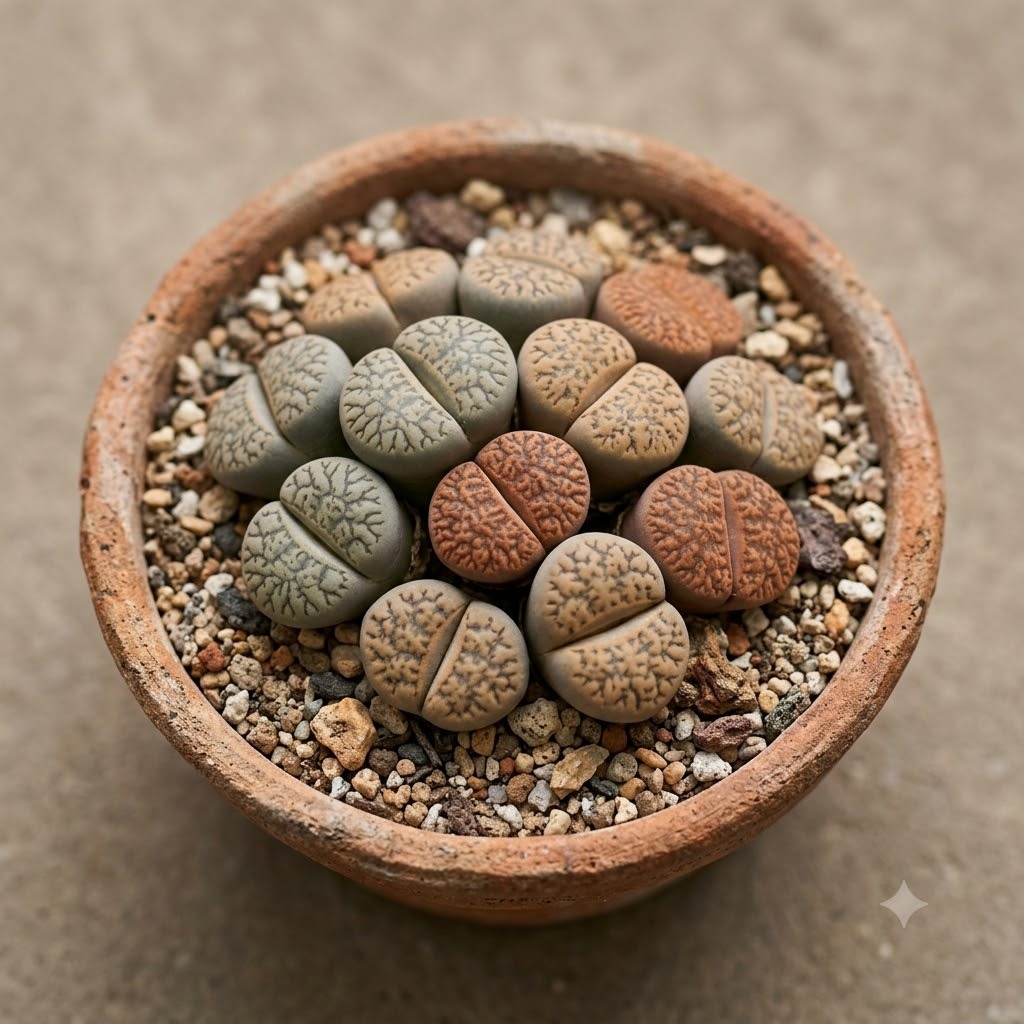
Overview
Lithops are among the strangest and most fascinating plants you can keep on a windowsill. Often called "Living Stones," each plant is a pair of fused, fleshy leaves that swell up from the soil looking exactly like a small pebble - a disguise so convincing that in the wild they vanish among the rocks. They are tiny, slow, and extraordinary, and they ask for a kind of care that runs opposite to nearly every other houseplant: almost no water, blazing light, and long stretches where the correct action is to do absolutely nothing. Get the rhythm right and a Lithops can live for decades, splitting to reveal a fresh pair of leaves each year and, in autumn, pushing a surprisingly large daisy-like flower from the crack between them. This is a plant for the patient and the curious.
Origin & Natural Habitat
Lithops come from the arid deserts and rocky scrublands of southern Africa - chiefly South Africa and Namibia - where rainfall is scarce and sunlight is intense. They grow packed into gravel, stone, and cracked ground, often with only their flat tops showing above the surface.
Their whole strange design is a survival strategy. The pebble mimicry (called crypsis) is camouflage: by looking like the surrounding stones, they hide from grazing animals in a landscape with little else to eat. Their fleshy bodies store precious water to ride out months of drought, and many draw down below the soil line in dry spells. Crucially, in habitat they receive most of their moisture in specific seasons and stay bone-dry the rest of the year. Understanding that natural wet-dry rhythm is the single key to keeping them alive indoors - watering them like an ordinary plant is the fastest way to kill them.
Appearance
A Lithops is deceptively simple and endlessly varied.
- Body: a single pair of thick, fused leaves forming a rounded or slightly conical shape with a flat top, split by a central fissure - the whole thing resembling a smooth stone.
- Coloring: an astonishing range across species and forms - grey, brown, tan, greenish, rusty, pinkish - patterned with dots, dashes, windows, and marbled "faces" on the top surface that mimic local stone.
- Flowers: in autumn, mature plants push a single daisy-like flower - white or yellow, sometimes scented - up through the central fissure, often nearly as wide as the plant itself.
- Size: small - individual bodies are typically only 1-4 cm across, though clumps of several heads build up slowly over many years.
Why People Love It - Qualities & Benefits
- Living curiosity: the stone mimicry is genuinely astonishing and a constant conversation piece.
- Tiny footprint: an entire collection fits on a single sunny windowsill.
- Very long-lived: with the right care a Lithops can live for decades, far outlasting most houseplants.
- Fascinating annual cycle: the once-a-year leaf renewal and the surprise autumn flower give it a slow, rewarding rhythm to follow.
- Minimal watering: for the right owner, its extreme drought tolerance is a feature, not a chore.
Care
Light
Lithops need the strongest light you can give them - direct sun for several hours a day, ideally at a bright south-facing window. Insufficient light is a very common cause of failure: it makes them stretch tall, go pale, lose their patterning, and become soft and elongated instead of staying flat and compact. A grow light is often necessary in dimmer homes.
Watering - the make-or-break skill
Watering Lithops is unlike any other houseplant, and getting the timing right matters more than anything else.
- Water only during their active growth seasons - generally a modest amount in late summer and autumn (and lightly in spring for many types), when you give a thorough soak and then let the soil dry out completely before the next.
- Keep them completely dry in winter, when they are largely dormant.
- Do NOT water during the leaf-swap dormancy. This is the critical rule. In late winter and spring the plant renews itself by growing a new pair of leaves inside the old ones, drawing entirely on the moisture in the old body. Watering during this period causes the old leaves to fail to shrivel properly, leads to bloating, stacking, and rot, and can kill the plant. Wait until the old leaves have dried to papery husks before you consider watering again.
When in serious doubt, do not water. Lithops die far more often from too much water than too little.
Soil & Potting
Use an extremely gritty, fast-draining mineral mix - even grittier than standard cactus soil, with a high proportion of pumice, coarse sand, grit, or perlite. Drainage holes are essential. A deeper pot suits their surprisingly long taproot.
Humidity & Temperature
They want dry air and excellent ventilation - never mist them. They tolerate a wide range of warm temperatures and enjoy strong warmth in the growing season; keep them above freezing and protect from frost.
Feeding
Feeding is largely unnecessary. In gritty mineral soil they grow slowly by design; at most a very dilute low-nitrogen succulent feed once in the growing season is plenty.
Propagation
Lithops are usually propagated from seed, which is slow but rewarding - seedlings take several years to reach a good size, so patience is essential. Sow seed on the surface of gritty mix, keep it lightly moist and warm until germination, then gradually harden the seedlings toward drier, brighter conditions. Established plants also multiply naturally over years by dividing into clumps of multiple heads, and a mature clump can be carefully split at repotting. Because seed-grown plants and division are both slow, most growers simply enjoy watching a single plant develop over time.
Common Problems & Pests
- Stretched, pale, elongated bodies: too little light - the most common problem. Move to the strongest sun or add a grow light.
- Bloated, splitting, or rotting bodies: overwatering, especially watering during dormancy or the leaf-swap. Stop watering entirely and let it dry.
- Stacked or doubled leaves that won't shed: usually watering during the leaf-renewal period - let the old pair fully dry down.
- Wrinkled, shrinking bodies in the growing season: genuine thirst - a careful soak is due.
- Failure to flower: often too little light or a plant not yet mature (they can take a few years).
- Pests: mealybugs (including root mealybugs in the soil), and occasional fungus gnats or scale. Inspect roots at repotting and treat with insecticidal soap.
Toxicity & Safety
Considered non-toxic. Lithops are generally regarded as safe and non-poisonous to cats, dogs, and humans, with no significant toxicity reported. Their pebble-like camouflage makes them unappealing to chew in any case. As with any plant, eating them could cause mild stomach upset, so nibbling is still best discouraged.
Pros & Cons
Pros
- Astonishing living-stone appearance.
- Tiny - a whole collection fits on one windowsill.
- Extremely long-lived with the right care.
- Non-toxic and pet-safe.
- Minimal watering suits very hands-off owners.
Cons
- Unforgiving watering timing - easy to kill by overwatering.
- Needs very strong, direct light.
- Extremely slow-growing; not for the impatient.
- The strict dormancy and leaf-swap rules confuse beginners.
- Little to see for long stretches of the year.
Best Suited For
- Patient hobbyists fascinated by unusual plants.
- Very bright, sunny south-facing windows or grow-light setups.
- Collectors who enjoy a slow, seasonal rhythm.
- People who will happily leave a plant unwatered for months.
Not ideal for beginners who tend to overwater, dim rooms, or anyone wanting fast, showy growth.
FAQ
How often do I water Lithops? Rarely, and only in their growing seasons (mainly late summer and autumn, lightly in spring for many). Soak, then let the soil dry fully. Keep them dry in winter, and crucially do not water during the spring leaf-swap - wait until the old leaves are papery husks.
Why is my Lithops growing tall and pale? Not enough light. Lithops need hours of strong direct sun; without it they stretch and lose their color and pattern. Move to the brightest window or use a grow light.
What is happening when it splits open? That is the natural annual renewal: a new pair of leaves grows inside and pushes out the old, which shrivels to a husk. Let the old leaves dry down completely on the plant's own moisture - do not water to "help" it.
Why does it only have one flower once a year? That is normal. Mature Lithops flower once, usually in autumn, pushing a single daisy-like bloom from the central fissure. Young plants may take a few years before they flower at all.
Are Lithops poisonous to pets? No - they are considered non-toxic to cats, dogs, and people, and their stony look makes them unappealing to chew anyway.