Ludisia discolor (Jewel Orchid)
The Ludisia discolor - the Jewel Orchid - is an orchid grown for the one thing most orchids are not known for: its leaves.
🗓️ Last reviewed: July 2026
Overview
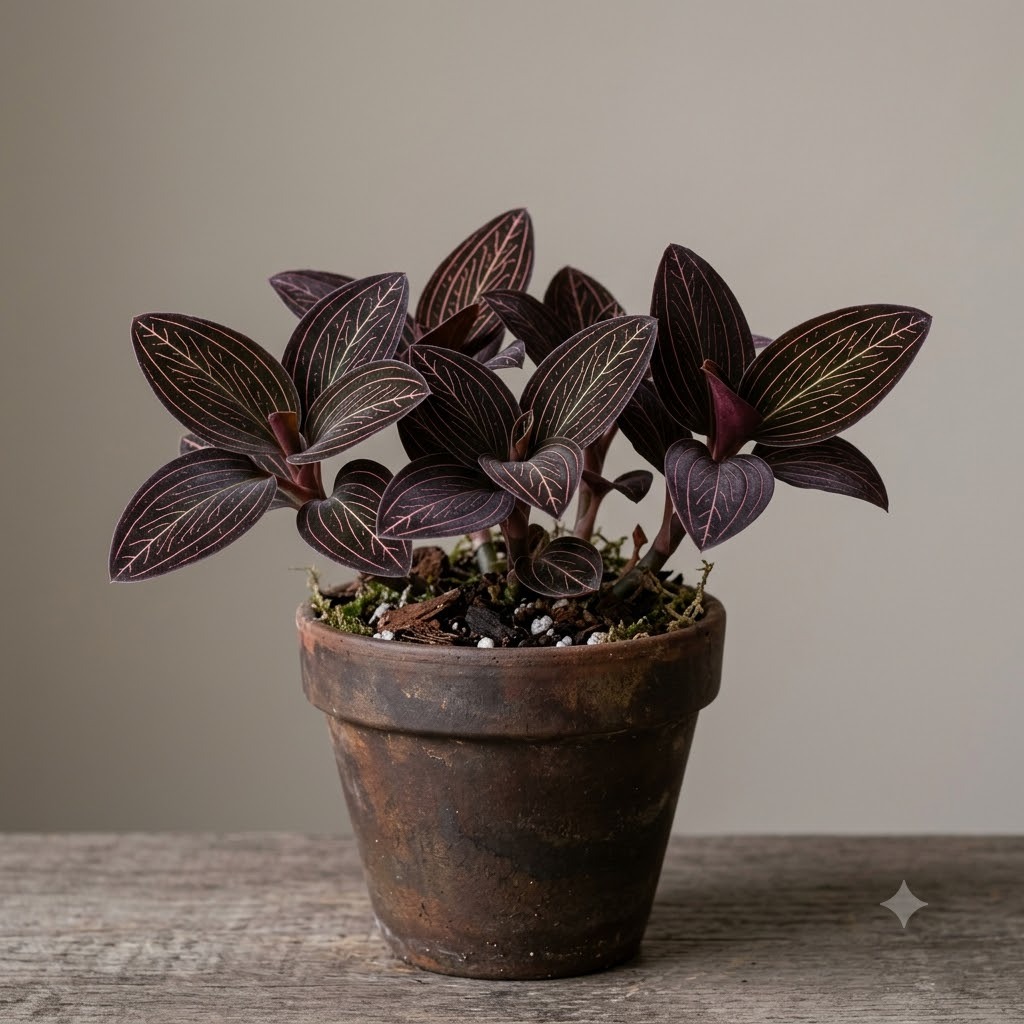
The Ludisia discolor - the Jewel Orchid - is an orchid grown for the one thing most orchids are not known for: its leaves. Forget dramatic flower spikes. This is a plant you buy for its foliage, which is deep velvety maroon to near-black, threaded with fine glowing pink or coppery veins that catch the light like woven silk. It is also, refreshingly, one of the easiest orchids you can own. Unlike the fussy epiphytic orchids that demand bark and special watering, the Jewel Orchid grows in soil like an ordinary houseplant, spreads happily along the pot, and asks for very little. It is the perfect first orchid for someone who is intimidated by orchids.
Origin & Natural Habitat
Ludisia discolor is native to the forests of Southeast Asia and southern China, growing across a range that includes parts of Indonesia, Malaysia, Thailand, and Vietnam. Unlike the tree-dwelling orchids most people picture, it is a terrestrial orchid: it grows on the ground, rooting into the leaf litter and rich, moist soil of the shaded forest floor.
This habitat is the key to its care. Living low under a dense canopy, it is adapted to low, dappled light rather than bright sun, and to the constant humidity and moist, well-draining leaf mold of the forest floor. It creeps along the ground on fleshy stems, rooting as it goes, forming spreading clumps. Understanding that it is a low-light, humidity-loving ground orchid explains why it thrives in spots where flashier plants sulk.
Appearance
The whole appeal of the Jewel Orchid is its foliage. The leaves are oval, thick, and soft to the touch with a velvety texture. Their base color is a rich, dark reddish-brown to blackish-green, and across each leaf run several fine, precise veins in bright pink, red, or coppery gold that shimmer when the light hits them. The underside of the leaf is often a deep wine red. The overall effect is jewel-like, which is exactly how the plant earned its name.
The plant grows on thick, fleshy, creeping stems that trail and root along the soil surface, forming a low, spreading clump rather than an upright shape. It stays relatively compact, making it a good tabletop or terrarium plant.
It does flower, and unusually for a "leaf orchid" the blooms are genuinely pretty: tall spikes of small white flowers with little yellow accents, usually appearing in the cooler months. But the flowers are a bonus. Most growers value this plant entirely for its extraordinary leaves.
Why People Love It - Qualities & Benefits
- Stunning foliage: the velvety dark leaves with glowing veins are unlike anything else, adding a jewel-box richness to a plant shelf.
- An easy orchid: it grows in soil and behaves like a normal houseplant, removing the intimidation factor of specialist orchid care.
- Thrives in low light: it actually prefers the shadier spots where many plants struggle, making it ideal for rooms without strong sun.
- Compact and spreading: it stays small and fills its pot attractively, perfect for tabletops, shelves, and terrariums.
- Bonus flowers: the dainty white blooms are a welcome surprise on top of the foliage.
- Easy to propagate: stem cuttings root readily, so it is simple to multiply and share.
Care
Light
Low to medium indirect light is ideal. This is a forest-floor plant, so it does not want bright, direct sun, which can scorch and fade the beautiful leaves. A spot a little away from a window, in gentle indirect light, suits it perfectly. It tolerates lower light better than most houseplants, which is part of its charm.
Watering
Keep the soil lightly and evenly moist during active growth, but never waterlogged. Water when the surface begins to dry, using room-temperature water, and let excess drain away. The fleshy stems and roots can rot in soggy conditions, so good drainage matters. Ease back a little in winter.
Soil & Potting
Use a rich but well-draining mix. A good recipe is a peat- or coir-based potting mix loosened with fine bark, perlite, and a little sphagnum moss to mimic the moist forest floor. It does not need the coarse bark mix that epiphytic orchids require. A shallow, wide pot suits its creeping habit.
Humidity & Temperature
Humidity is important - it loves 50% and above, which is why it does so well in terrariums and grouped with other plants. It enjoys comfortable warmth, roughly 18-27 °C, and dislikes cold drafts and sudden chills. Low humidity often shows as browning leaf edges.
Feeding
Feed lightly during the growing season with a diluted balanced fertilizer, roughly monthly. It is not a heavy feeder, so weak and occasional is better than strong and frequent.
Habit
Left alone, the creeping stems will spread across the pot and can be trained or trimmed. Removing spent flower spikes after blooming keeps the plant tidy and directs energy back into the foliage.
Propagation
The Jewel Orchid is delightfully easy to propagate, which is unusual and welcome for an orchid. Take a stem cutting several centimeters long that includes a couple of nodes, and lay or plant it into moist soil or moss so that the nodes make contact with the surface. Roots and new shoots emerge from the nodes within a few weeks. You can also simply divide a mature spreading clump. Keep cuttings warm, humid, and out of direct sun while they establish.
Common Problems & Pests
- Browning leaf edges or tips: usually low humidity. Raise humidity or group with other plants.
- Faded, dull leaves losing their color: too much light. Move it to a shadier spot to restore the deep tones and vivid veins.
- Mushy, rotting stems: overwatering or poor drainage. Cut away affected parts and let the mix dry more between waterings.
- Leggy, stretched growth: occasionally too little light even for this shade lover, though this is less common than the opposite.
- Pests: spider mites, mealybugs, and aphids can appear, especially in dry air. Isolate the plant, wipe leaves gently, and treat with insecticidal soap. Handle the soft leaves carefully.
Toxicity & Safety
Ludisia discolor is generally considered non-toxic to cats, dogs, and humans, and orchids as a group are not among the plants known to poison pets. This makes it a safe, reassuring choice for households with animals and children. As always, discourage pets from chewing on any houseplant, since ingesting plant material can still cause mild stomach upset.
Pros & Cons
Pros
- Extraordinary velvety, vein-patterned foliage.
- The easiest orchid for beginners - grows in soil.
- Thrives in low light where other plants struggle.
- Compact, terrarium-friendly, and pet-safe.
- Very easy to propagate and divide.
- Pretty white flowers as a bonus.
Cons
- Needs decent humidity to look its best.
- Soft leaves scorch and fade in bright sun.
- Fleshy stems rot easily if overwatered.
- Not a plant grown for showy flowers.
- Foliage bruises easily if handled roughly.
Best Suited For
- Beginners who want to try an orchid without the usual fuss.
- Low-light rooms and shaded corners.
- Terrarium and closed-case growers.
- Collectors of dramatic, unusual foliage.
- Pet owners wanting a safe, compact plant.
Not ideal for very dry rooms without any humidity help, bright sunny windowsills, or anyone hoping mainly for spectacular flowers.
FAQ
Is the Jewel Orchid hard to grow like other orchids? No - it is one of the easiest. It grows in soil like a normal houseplant, tolerates low light, and does not need the specialist bark and watering routine of epiphytic orchids.
Why is my Jewel Orchid losing its dark color? Usually too much light. The rich maroon and glowing veins are deepest in shade, so move it somewhere gentler and the color should return in new growth.
Do I grow it in bark like a Phalaenopsis? No. Being a terrestrial orchid, it wants a rich, moist, well-draining potting soil, not the coarse bark mix used for tree-dwelling orchids.
Why are the leaf edges turning brown? Almost always dry air. Raise the humidity, group it with other plants, or move it to a more humid room or terrarium.
Does it flower, and should I keep the flowers? Yes, it sends up spikes of small white flowers, usually in cooler months. They are pretty, but some growers remove the spikes to keep the plant's energy focused on the prized foliage.