Make a dried-flower wreath.
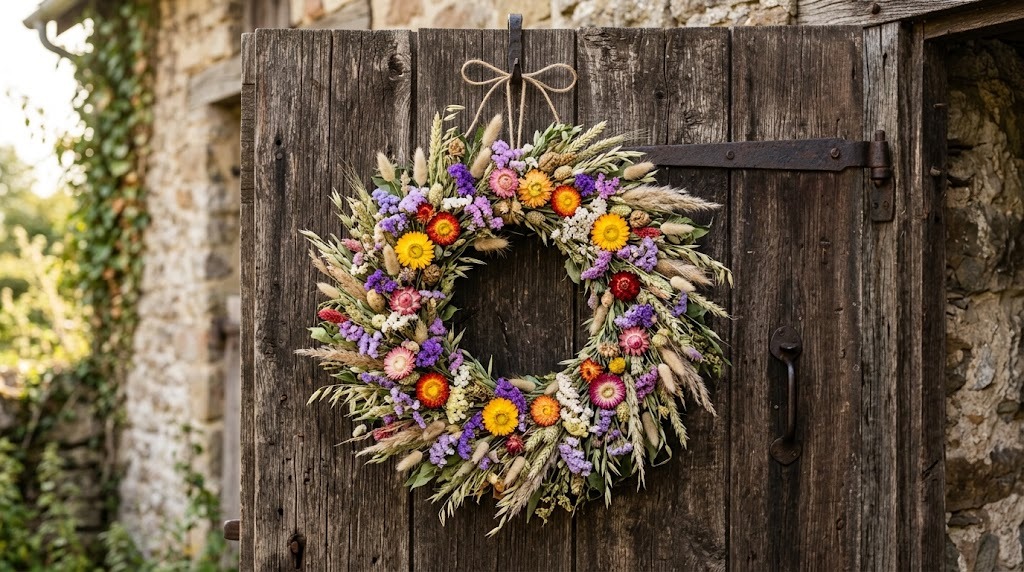
This is what the drying rack was for. A wreath is the classic way to spend a summer's worth of everlastings in one satisfying afternoon, and the technique - little wired bundles, bound on in a spiral - is the same one florists use, unchanged for generations.
This page assumes you already have dried material. For what to sow and the two ways of drying it - air and silica - start at the everlastings page; the wreath is the reward at the end of that pipeline.
What you need
💐 Materials
- Dried flowers, a generous armful. Strawflowers, statice, lunaria, poppy seed heads, grasses, yarrow, hydrangea - three times more than looks necessary. A full wreath eats material.
- A wreath base. Woven willow or vine ring, 10-14 in for a first one. You can weave your own from garden prunings - grapevine, wisteria, birch twigs - wound and tucked into a circle.
- Florist wire. Fine paddle wire (24-26 gauge) for binding bundles, plus a loop for hanging.
🧰 Tools
- Secateurs or snips. Dried stems cut cleanly; crushing them shatters flowers.
- Wire cutters. Scissors used on wire become bad scissors.
The build, step by step
1Take stock and sort
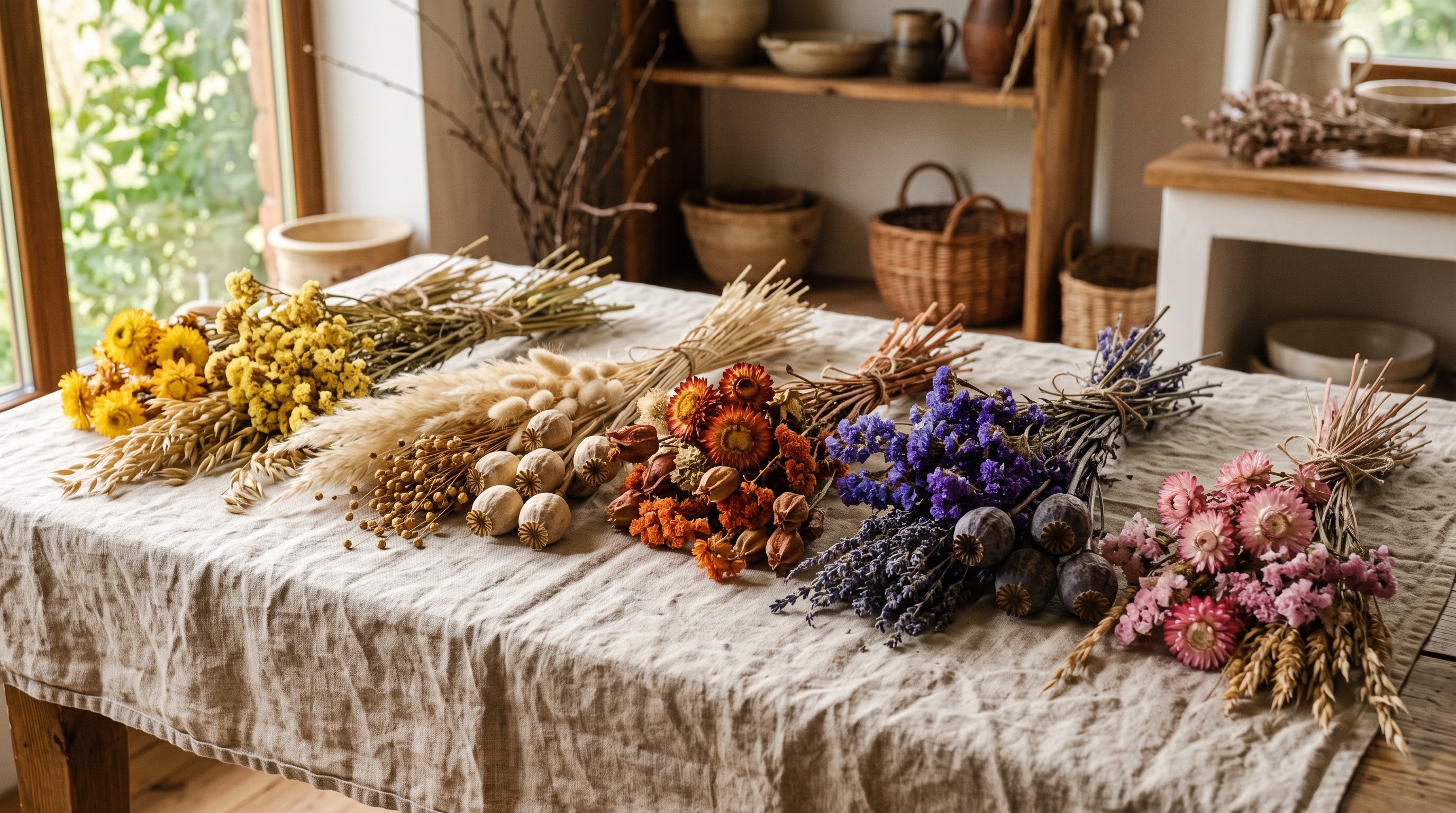
Lay everything out and sort into three piles by job. Filler: the bulk material that covers the base - grasses, hydrangea florets, sea lavender, gypsophila. Feature: the flowers with a face - strawflowers, helipterum, small zinnias dried in silica. Accent: the odd and the pointy - poppy heads, lunaria discs, nigella pods, oat and barley heads. A wreath that is all feature looks like a bad hat; a wreath that is all filler looks unfinished. Roughly 60/25/15 by volume is a proportion that keeps working.
2Make small bundles
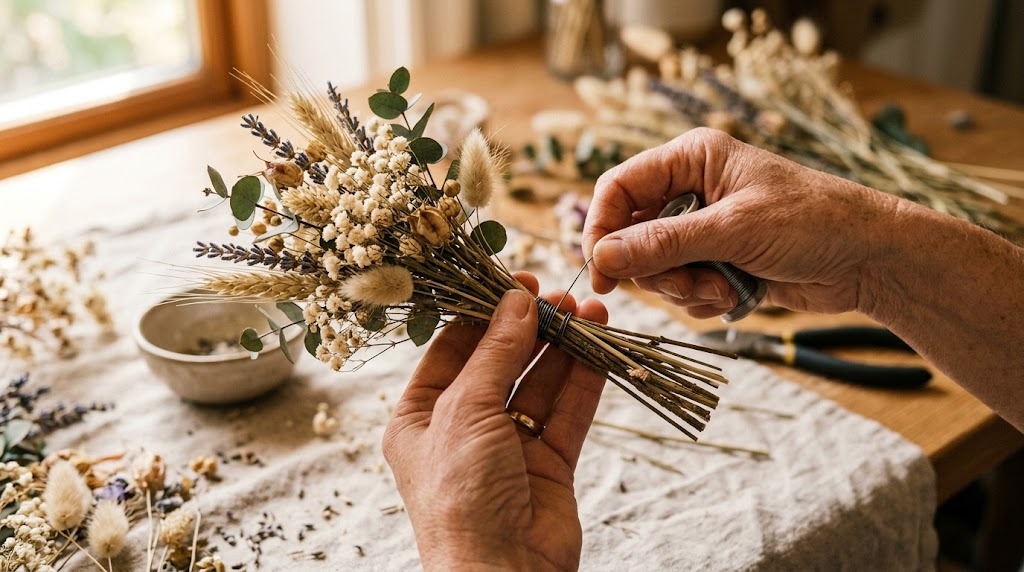
The unit of wreath-making is not the flower, it is the bundle. Take three to five stems - some filler, one feature, maybe an accent - and bind the stems together with a few tight turns of wire, leaving 2-3 in of stem below the binding. Make a pile of these little bouquets, twenty or more for a 12-inch ring, before you touch the base at all. Consistency of bundle size is what makes the finished wreath read as calm rather than lumpy, and building them all first means your best combinations get spread around the circle instead of clumping where you started.
3Bind them on, all one way
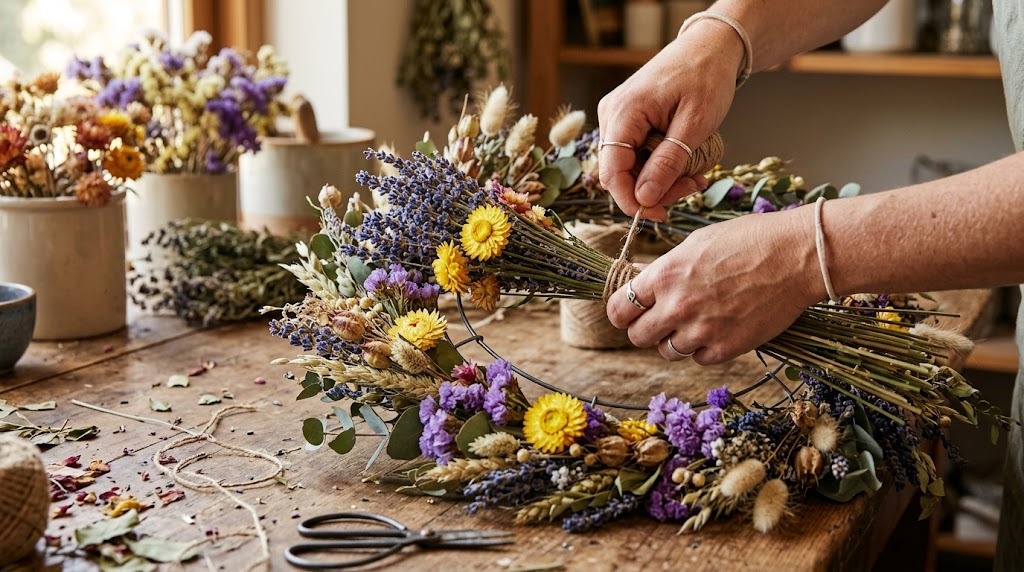
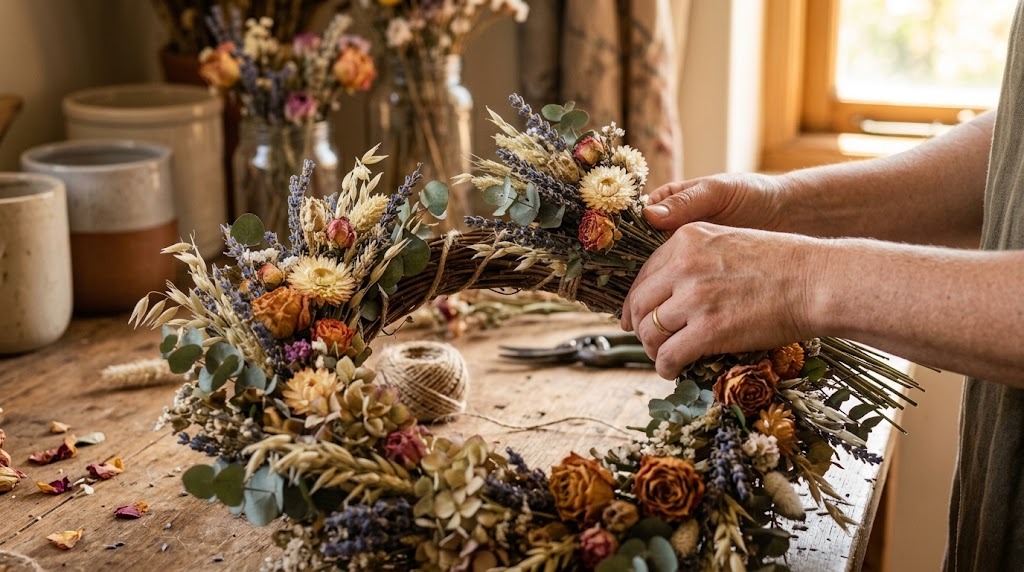
Tie the paddle wire to the base and do not cut it again until the end - a wreath is bound with one continuous wire. Lay the first bundle on the ring at a slight angle, flowers pointing along the circle, and bind its stems down with two or three firm wraps. Lay the second bundle so its flower heads cover the stems and wire of the first; wrap. Repeat, always the same direction, always overlapping the mechanics of the previous bundle. Dried stems are brittle: wrap firmly over the stems, never across the flower heads, and let the wire bite into the base rather than the material.
4Close the circle
The last bundle is the only hard one: its stems have nowhere to hide. Lift the flower heads of the very first bundle gently, tuck the final stems underneath them, and bind low and tight so the wire vanishes into the overlap. Wrap the wire twice around the base, knot it through itself, and cut. Hang the wreath up and look at it from across the room - gaps that were invisible at arm's length appear at distance. Fill them by wiring or simply gluing single flower heads into the low spots; every wreath maker's last ten minutes is spot-filling.
5Hang it where it will last
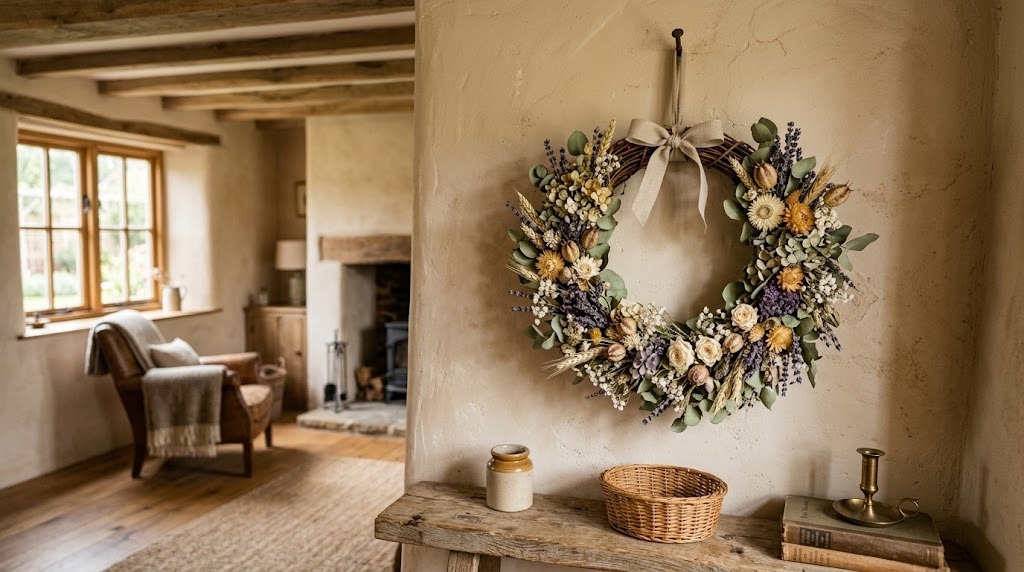
Dried flowers have two enemies: direct sun, which bleaches strawflowers to pale straw in a season, and damp, which turns everything sad and then mouldy. An inside door, a hallway, a wall out of the light - years. A sunny window - months. Outside on a sheltered porch works in dry climates and autumn; a front door that catches rain does not. Dust it twice a year with a hairdryer on cold, held at a respectful distance. When it finally fades - they all fade - the ring underneath is reusable, and next summer's cutting garden is already growing the refill.