A better lawn.
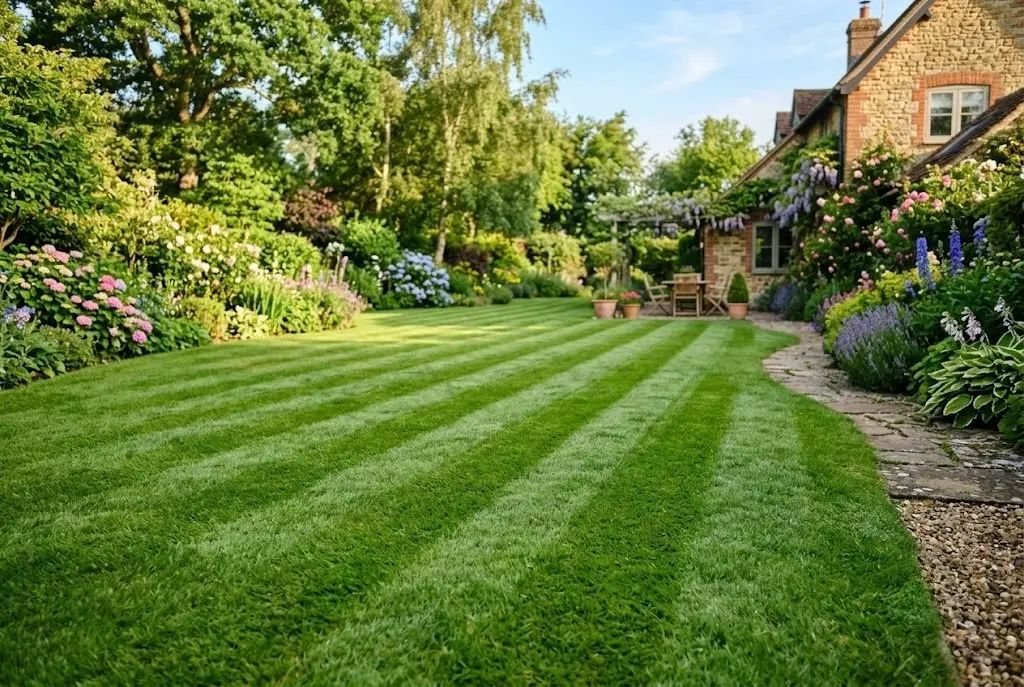
A good lawn is less about products and more about a few habits done right: the correct grass for your climate, mown high, watered deeply but rarely, and fed in the right season. Get those and the lawn largely looks after itself, crowding out weeds and moss on its own. Here's the version without gimmicks.
Cool-season grasses
Best where winters are cold and summers mild - they grow most in spring and autumn. Sow in early autumn (or spring).
The all-rounder: deep roots make it the most drought- and heat-tolerant cool-season grass, it takes some shade, and it shrugs off foot traffic. The safe default for most cool and transition-zone lawns.
Germinates fast (great for quick repairs and overseeding), hard-wearing and glossy green - but shallow-rooted, so it needs more water and doesn't love deep shade or hard winters alone.
The classic lush, fine, self-repairing lawn - it spreads to knit bare patches shut. Slow to establish from seed and thirstier, so it's often mixed with fescue and rye rather than grown alone.
Warm-season grasses
Best where summers are hot - they thrive in the heat and go brown/dormant in winter. Sow or lay in late spring/early summer.
Loves heat and full sun, extremely wear- and drought-tolerant, and spreads aggressively to fill in - the go-to for hot, sunny lawns and sports turf. Needs sun (poor in shade) and goes brown/dormant in winter.
Dense, cushiony and slow-growing (less mowing), good heat and decent shade tolerance, and it crowds out weeds once established. Slow to fill in, and also browns off in winter.
The best warm-season grass for shade, with broad blue-green blades that make a lush carpet in hot, humid climates. Not very wear-tolerant and usually laid as sod, not seed.
A tough, native, very low-water, low-mow option for hot dry regions - soft and fine, but thin under heavy traffic and slow to establish.
Match the grass to your climate, sun and traffic with the grass type selector, then work out how much seed you need with the seed calculator. Check your climate with our hardiness zones.
Keeping it green - the four habits
Cut to the top of the grass's ideal range (roughly 6-9 cm for most lawns), and never remove more than a third of the blade at once. Tall grass shades out weeds and grows deeper roots; scalping does the opposite. Keep the blade sharp.
One good soak a week that wets the soil several centimetres down beats a daily sprinkle - it drives roots deep and drought-proofs the lawn. Water early morning to cut evaporation and disease. Most lawns want roughly 2-3 cm a week including rain.
Feed cool-season grass mainly in autumn (and lightly in spring); feed warm-season grass through its summer growth. Don't feed a dormant or drought-stressed lawn. Less, more often, beats one heavy hit that surges soft growth and disease.
Compacted soil and a thick thatch layer choke a lawn. Once a year, pull soil cores (aerate) to let air, water and roots move, and rake out excess thatch. Do it in the grass's main growing season so it recovers fast.
Common problems
Usually a symptom, not the disease - thin, mown-too-short or hungry grass lets weeds in. Mow higher, feed and overseed to thicken the turf, and most weeds get crowded out. Dig or spot-treat the persistent ones.
Moss moves in where grass struggles: shade, damp, compacted or acidic soil, and scalped turf. Fix the cause (improve drainage and light, aerate, raise the cut, lime acidic soil) rather than just killing the moss, which returns.
Could be drought, dog urine, dormancy (normal in summer for cool-season, winter for warm-season grass), a fungal disease, or fertiliser burn. Rule out the simple ones first - and remember dormant is not dead; it greens up when conditions ease.
Rake the area, loosen the surface, sow fresh seed of a matching type, keep it lightly moist until it germinates, and stay off it. Spring or early autumn is best for cool-season; late spring for warm-season.
A good fertilizer for grass, and how much to use
Nitrogen is the nutrient a lawn uses most, and the one that burns it when applied at excessive rates, says Clemson Extension; the rate should come from a soil test. Lawn rates are given in pounds of actual nitrogen per 1,000 square feet. To turn a label into a dose, divide 100 by the nitrogen percentage: for a 16-4-8 that is about 6 pounds of product for 1 pound of nitrogen. Clemson uses 1 pound of nitrogen per 1,000 square feet at each feeding for a high-maintenance lawn and half a pound for a low-maintenance one, spread as evenly as possible with a push spreader.
How much in a year. Clemson's South Carolina schedule gives yearly totals per 1,000 square feet of 1-3 pounds of nitrogen for tall fescue and Kentucky bluegrass, 1-4 for St. Augustine, ½-2 for centipede and 3-5 for bermuda and zoysia. Sandy soils and long growing seasons may need the higher end; heavy clay may do fine with less. The first nitrogen of the year goes on once the grass has greened up and is growing in spring. Feeding at the high end means more mowing and can bring more insect and disease problems in warm, wet weather, and an established centipede lawn should get no extra phosphorus unless a soil test calls for it.
| Product | Type | What the maker states | Links |
|---|---|---|---|
| Espoma Lawn Food | Granular, organic with synthetic | Natural organic ingredients fortified with synthetic ones, slow-release nitrogen and non-staining iron; 3.3 lb per 1,000 sq ft; cool-season grass 3-4 times a year, warm-season 4-5; 20 and 40 lb bags | See on Amazon · Maker's page |
| Espoma Turf-tone All Season Lawn Food | Organic granular | Natural and organic ingredients with beneficial microbes, for all lawns including new seed and sod; 5.6 lb per 1,000 sq ft, up to 4 times a year; 14 and 28 lb bags | See on Amazon · Maker's page |
| Dr. Earth Super Natural Liquid Lawn Food | Organic liquid, 3-0-1 | Lawn fertilizer with no phosphorus in its 3-0-1 analysis | See on Amazon · Maker's page |
| Push broadcast spreader | Spreader | The tool Clemson uses to spread lawn fertilizer evenly | See on Amazon |
How we put this together. The rates and schedule are Clemson Extension's fact sheet HGIC 1201, Fertilizing Lawns, written for South Carolina; other regions should check their own extension service. The products are compared on what each maker states on its own product page, checked on 26 October 2026; we have not trialed them. Espoma's pages give no nitrogen analysis in their text, so work out the nitrogen from the bag's label before using Clemson's rates. There are no prices here: the Amazon links search for the exact product, and we may earn a commission if you buy through them.
General guidance - the right grass, timing and mowing height depend on your exact climate and grass species, so treat local advice and the seed label as the final word. Keep fertilisers and any lawn treatments away from children, pets and ponds, and follow the label.
Lawn gear
Links go to Amazon or a partner store (such as Adagio Teas) and may earn us a commission at no extra cost to you. As an Amazon Associate we earn from qualifying purchases. We link gear types, not sponsors' picks: you choose the exact product.