Oncidium Orchid (Dancing Lady Orchid)
The Oncidium, affectionately known as the "Dancing Lady" orchid, is one of the most joyful plants you can grow indoors.
🗓️ Last reviewed: July 2026
Overview
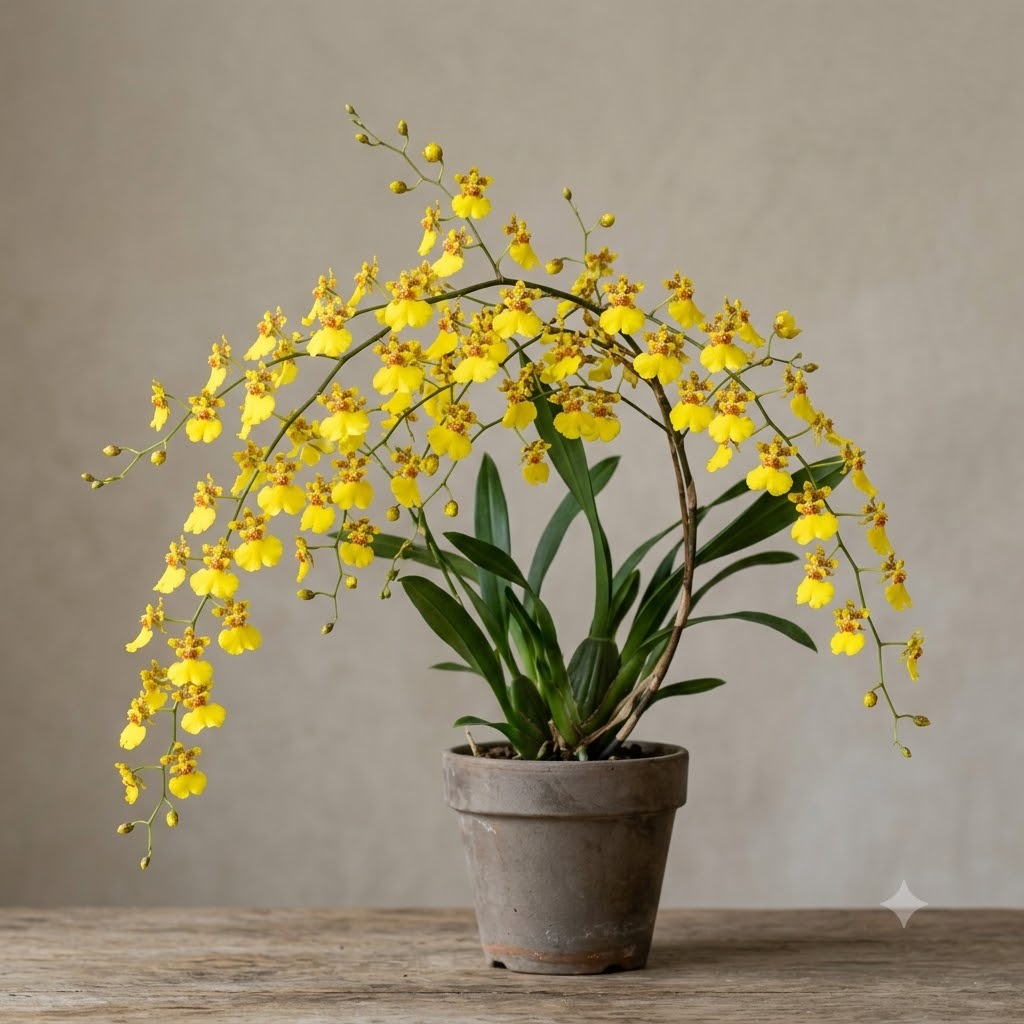
The Oncidium, affectionately known as the "Dancing Lady" orchid, is one of the most joyful plants you can grow indoors. When it blooms it throws out arching sprays branched with dozens - sometimes hundreds - of small flowers, each shaped a little like a woman in a full skirt caught mid-dance. Many are bright yellow with reddish markings, and some, like the popular "Sharry Baby," are famously scented of chocolate or vanilla. Oncidiums are a step up from the beginner-friendly Phalaenopsis: they have fine roots that dry out fast and a firm love of bright light. But get the light and watering rhythm right and they are generous, reliable bloomers that put on a genuinely spectacular show.
Origin & Natural Habitat
Oncidium is a large and varied group of orchids native to the Americas, ranging from Florida and Mexico through Central America and down into South America. Most grow as epiphytes, perched on tree branches in warm, humid forests, from steamy lowlands to cooler cloud forests high in the mountains. Because the genus spans so many climates, different Oncidiums prefer slightly different temperatures - but they share a rhythm of moisture followed by drying that comes from clinging to bark rather than growing in soil.
In the wild their roots are exposed to air, gripping bark and drinking rain and mist, then drying quickly in the breeze. This fast wet-then-dry cycle is the single most important thing to understand about caring for them at home.
Appearance
An Oncidium has a distinctive structure typical of many orchids in its group:
- Pseudobulbs: plump, oval storage organs at the base that hold water and energy. Wrinkled pseudobulbs signal a thirsty plant.
- Leaves: long, thin, and strappy, emerging from the pseudobulbs, usually a fresh mid-green.
- Roots: fine and numerous, much thinner than a Phalaenopsis's fat roots, which is why the plant dries out faster.
- Flowers: the star of the show - tall, arching, often branched flower spikes carrying many small blooms, commonly in yellow, brown, red, white, or pink, each with the "dancing lady" skirt shape.
Depending on the type, a flowering Oncidium can range from a compact plant to a large one with spikes rising well above the foliage in a cloud of small flowers.
Why People Love It - Qualities & Benefits
- Spectacular bloom: few orchids match the sheer number of flowers on a well-grown Oncidium spray.
- Fragrance: several varieties, especially "Sharry Baby," carry a strong sweet scent of chocolate or vanilla.
- Cheerful color: the bright yellows and warm tones feel sunny and uplifting.
- Long-lasting display: a spike in full bloom can look wonderful for weeks.
- Rewarding challenge: a small step beyond the supermarket Phalaenopsis, satisfying for anyone ready to learn a little more about orchids.
Care
Light
Oncidiums want bright light - brighter than a Phalaenopsis. A spot with lots of bright indirect light, or gentle direct sun in the morning, is ideal, such as an east or lightly shaded south window. Healthy foliage is a light grassy green; very dark green leaves mean too little light and often no flowers, while yellowed, bleached leaves mean too much harsh sun. Good light is usually the key to getting them to bloom.
Watering
This is where Oncidiums differ most from other orchids. Their fine roots dry fast, so they generally need watering more often than a Phalaenopsis. Water thoroughly, letting water run right through the pot, then let the medium approach dryness before watering again - but do not let it stay bone dry for long. In practice this often means watering every few days in warmth and light, less in winter. Wrinkled pseudobulbs and limp leaves mean it is too dry; blackened, rotting roots mean it stayed too wet. The rhythm is generous water, then good drying.
Medium & Potting
Grow in a proper orchid medium, not soil - typically medium-grade orchid bark, sometimes with sphagnum moss, perlite, or charcoal, in a pot with plenty of drainage. Finer-rooted Oncidiums sometimes do well with a bit of moss to hold moisture, but airflow to the roots remains essential. Repot every couple of years when the medium breaks down, ideally after flowering as new growth begins.
Humidity & Temperature
Oncidiums like humidity of around 40-60% or higher. In dry homes a humidity tray or humidifier and good airflow help. Temperatures depend on the type, but most common hybrids are comfortable in normal home warmth of roughly 18-27 °C by day and a little cooler at night. That slight night drop can encourage blooming.
Feeding
Feed regularly but weakly during active growth - a balanced orchid fertilizer at quarter to half strength every week or two ("weakly, weekly") works well. Flush the pot with plain water occasionally to prevent salt buildup on the fine roots. Ease off in winter.
Encouraging Blooms
The main levers are enough bright light and a slightly cooler night temperature as new growth matures. A well-grown, well-lit plant with plump pseudobulbs is far more likely to send up those famous branching sprays.
Propagation
Oncidiums are propagated by division rather than cuttings. When a plant has grown into a clump with several pseudobulbs, you can divide it at repotting time, making sure each division keeps at least three or four healthy pseudobulbs plus roots so it has the reserves to establish and eventually flower again. Do this gently after blooming, and pot each division into fresh orchid medium. Older, leafless "back bulbs" can sometimes be coaxed into new growth, but divisions with active growth are far more reliable.
Common Problems & Pests
- Wrinkled pseudobulbs: underwatering, or roots too damaged to take up water - check roots and adjust watering.
- No flowers: almost always not enough light; move it brighter.
- Black, mushy roots and yellowing leaves: overwatering and a medium that stayed too wet.
- Accordion-pleated new leaves: inconsistent watering while the leaf was forming, often too dry at that stage.
- Pests: scale, mealybugs, and spider mites are the usual culprits, especially in dry air. Isolate and treat with insecticidal soap or by wiping the plant.
Toxicity & Safety
Oncidium orchids, like orchids generally, are considered non-toxic to cats, dogs, and humans and are not known to cause poisoning. They are a safe choice for pet-owning households, though it is still sensible to discourage pets from chewing on the flower spikes or foliage.
Pros & Cons
Pros
- Spectacular, generous flower sprays with many blooms.
- Some varieties are strongly and pleasantly fragrant.
- Cheerful, sunny colors.
- Non-toxic and pet-safe.
- Rewarding next step for a keen orchid grower.
Cons
- Fine roots dry fast, so it needs more frequent watering than a Phalaenopsis.
- Fussier about light - needs bright conditions to bloom.
- Blooming can be tricky to trigger without enough light or a night temperature drop.
- Grown in bark, not soil, which some beginners find unfamiliar.
- Prefers decent humidity.
Best Suited For
- Orchid growers ready to move beyond the beginner Phalaenopsis.
- Anyone with a bright windowsill who wants a dramatic, fragrant bloom.
- Pet-owning households wanting a safe flowering plant.
- People who enjoy learning a plant's rhythm rather than a fixed routine.
Not ideal for dark rooms, anyone who forgets to water for long stretches, or those who want an effortless plant that blooms with no attention to light.
FAQ
Why won't my Oncidium bloom? The most common reason is not enough light. Oncidiums need bright conditions to flower. Give it a brighter spot and, if possible, a slightly cooler night, and make sure the pseudobulbs are staying plump.
How is it different from a supermarket Phalaenopsis? Oncidiums have fine roots that dry out faster (so water more often), want more light, and grow from pseudobulbs. They are a little more demanding but reward you with far more flowers per spike.
The pseudobulbs are getting wrinkly - what's wrong? That is usually a sign the plant is too dry or its roots are damaged and cannot take up water. Check the roots, and water more consistently so the pseudobulbs can plump back up.
Do all Oncidiums smell like chocolate? No - that famous scent belongs mainly to "Sharry Baby" and a few relatives. Many Oncidiums are lightly scented or unscented; the fragrance depends on the variety.
How often should I water it? More often than most orchids because of the fine roots - frequently in warmth and light, less in winter - always watering thoroughly and then letting the medium approach dryness before the next watering.