Prayer Plant (Maranta leuconeura)
The Prayer Plant - Maranta leuconeura - is one of the most captivating houseplants you can own, and not just because of its looks.
🗓️ Last reviewed: June 2026
Overview
The Prayer Plant - Maranta leuconeura - is one of the most captivating houseplants you can own, and not just because of its looks. Every evening its leaves fold upward and press together like a pair of praying hands, then relax flat again by morning. This nightly ritual, combined with some of the most beautifully patterned foliage in the plant world, makes it feel almost like a living pet. It is honest to say it asks a little more of you than an easygoing Monstera: it loves humidity and clean water, and it will sulk if those needs go unmet. But for someone who enjoys paying attention to a plant, the Prayer Plant is endlessly rewarding.
Origin & Natural Habitat
The Prayer Plant is native to the tropical rainforests of Brazil, where it lives as a low-growing groundcover on the warm, humid, shaded forest floor. It never climbs toward the canopy; instead it spreads quietly through the understory, sheltered from direct sun by the trees above and bathed in constant moisture. Understanding that origin explains almost everything about its care at home.
The name carries its history. The genus Maranta honours Bartolomeo Maranta, a 16th-century Italian physician and botanist. The species name leuconeura means "white-nerved" or "white-veined," a reference to the pale veins that trace across the leaves of some forms. And the common name - "prayer plant" - comes from that famous nightly movement, when the leaves rise and fold together as if in prayer.
Appearance
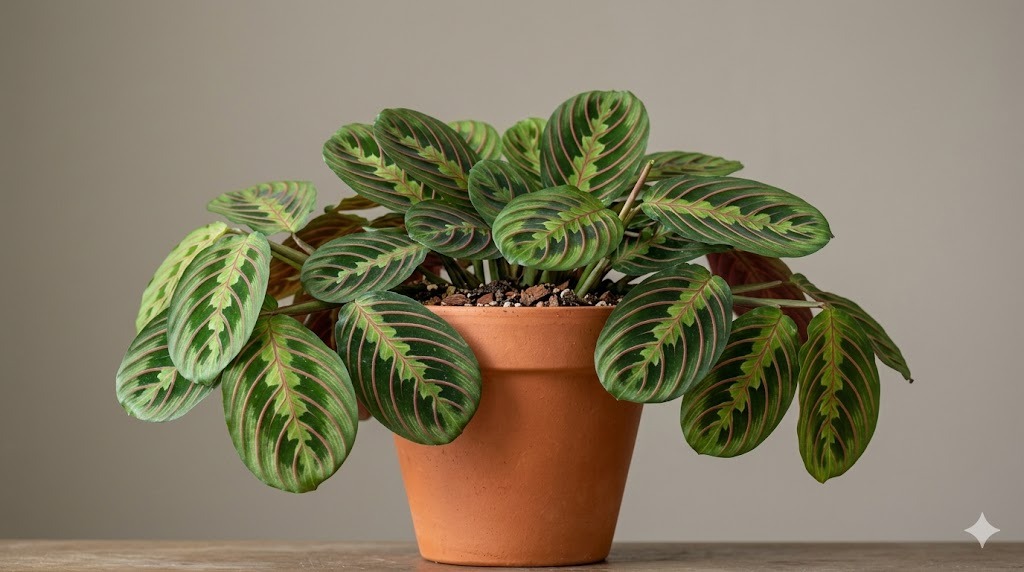
The Prayer Plant is grown entirely for its foliage, and the oval, slightly rounded leaves are a showcase of natural pattern. Most plants are a deep, velvety green overlaid with lighter feather-like markings, and the most popular forms add bold colour to that base:
- Leaf pattern: deep green leaves with striking feather-like or herringbone markings; the celebrated var. erythroneura ("Herringbone Plant") has vivid red or pink veins fanning out across the blade, while var. kerchoveana ("Rabbit's Foot" or "Rabbit Tracks") carries rows of dark green blotches on a paler ground.
- Nyctinasty (the praying movement): the leaves lie open and flat by day to catch light, then fold upward and inward at night - a genuine daily movement driven by changes in light, not a trick of growth.
- Leaf underside: often a beautiful reddish or purple flush, revealed each evening as the leaves rise and fold.
- Growth habit: low, spreading, and gently trailing rather than upright - it sprawls outward and cascades over the edge of a pot.
Indoors the Prayer Plant stays small and compact, typically reaching only 20-30 cm tall while spreading and trailing wider, which makes it perfect for a shelf, a tabletop, or a hanging planter.
Why People Love It - Qualities & Benefits
- Living-art foliage: the patterned leaves, especially the red-veined herringbone form, look hand-painted and bring colour to a collection without a single flower.
- The daily prayer movement: watching the leaves rise and fold each evening, then open again at dawn, is mesmerizing and makes the plant feel alive in a way few others do.
- Compact size: it stays small and spreading, ideal for small spaces, shelves, desks, and hanging baskets where a big floor plant would never fit.
- Pet-safe and non-toxic: this is a real selling point - the Prayer Plant is non-toxic to cats and dogs, so it is a genuinely worry-free choice for homes with curious animals or children.
- Easy to propagate: a single healthy plant readily becomes several, so it is simple to share with friends or fill out a planter.
Like most leafy tropicals it adds a little humidity to a room through transpiration and contributes to a calmer, greener space. (The well-known "air-purifying" claims are real but modest in a normal home - the main benefit is psychological, as greenery measurably lowers stress and lifts mood.)
Care
Light
Medium to bright indirect light is ideal. The Prayer Plant is an understory plant, so it is well adapted to gentler light and will even tolerate a lower-light corner, though its patterns are richest in bright indirect light. The one thing you must avoid is direct sun: harsh rays fade those beautiful markings and scorch the delicate leaves. A spot near an east or north window, or set back from a brighter one, is perfect.
Watering
Keep the soil consistently lightly moist - never soggy, but never bone dry. This is a plant that dislikes extremes in both directions. It is also notably sensitive to the chemicals in tap water: fluoride and chlorine build up and cause the leaf tips and edges to brown and burn. Whenever you can, water with distilled water, collected rainwater, or filtered water - or simply leave tap water out overnight before using it. As always, read the plant rather than following a rigid schedule: check the top of the soil and water before it dries out completely.
Soil & Potting
Use a mix that drains well but still holds some moisture, since this plant likes to stay evenly damp. A peat- or coco-based potting mix loosened with perlite gives the right balance of moisture retention and aeration. Always use a pot with drainage holes so excess water can escape and the roots never sit in standing water.
Humidity & Temperature
High humidity is the single biggest key to a happy Prayer Plant - aim for 50-60% or more. In dry air the leaf edges turn crispy and brown, which is the most common complaint owners have. A pebble tray, a small humidifier, or grouping it with other plants all help raise the moisture around it. It is comfortable at roughly 18-27 °C and is very sensitive to cold drafts and anything below about 15 °C, so keep it away from chilly windows, doors, and air-conditioning vents.
Feeding
Feed with a balanced liquid fertilizer well diluted - half strength or weaker - about once a month during the spring and summer growing season, and stop entirely in winter when growth slows. The Prayer Plant is sensitive to over-fertilizing, and salt build-up will scorch its leaf tips, so when in doubt, feed less rather than more.
Repotting
Repot every 1-2 years in spring, moving up only one size when the roots fill the pot. Because its roots are shallow and spreading, a wide, shallow pot suits it better than a deep one and gives the spreading root system room without holding a large volume of soggy soil.
Humidity - the key to a thriving Prayer Plant
This is the single most important tip. More than light, more than feeding, the Prayer Plant's happiness comes down to high humidity and clean water. In the rainforest it lives in constant moisture, so dry indoor air is its natural enemy. Combine humidity below 50% with mineral-heavy tap water and you get the dreaded crispy brown edges that frustrate so many owners. Give it 50-60%+ humidity with a humidifier or pebble tray, water it with distilled or rainwater, and those edges stay soft, green, and perfect - and the whole plant thrives.
Propagation
The Prayer Plant is satisfying and easy to propagate, in two reliable ways. The first is by stem cuttings: find a healthy stem and cut just below a node (the point where leaves emerge), making sure your cutting includes at least one node, then root it in a glass of water or directly in a moist potting mix. The second is by division at repotting time: gently tease the plant into two or more clumps, each with its own roots and leaves, and pot them up separately. Cuttings usually root in 3-6 weeks; once the new roots are a few centimeters long, pot the cutting into normal mix. A leaf without a node will never grow into a plant, so always include that node.
Common Problems & Pests
- Crispy brown leaf edges and tips: the number-one complaint - caused by low humidity, dry air, or the minerals in tap water. Raise humidity and switch to distilled or rainwater.
- Yellowing leaves: usually a sign of overwatering or soggy soil. Let the mix dry slightly more between waterings and check the drainage.
- Faded or washed-out patterns: too much light, especially direct sun. Move the plant to a gentler, indirect spot to restore the colour.
- Leaves not moving or staying folded: a sign of stress - often too dark, or the plant is thirsty. Improve the light and check whether it needs water.
- Curling leaves: typically underwatering or low humidity. Keep the soil evenly moist and raise the humidity around the plant.
- Pests: spider mites are the main threat, as they thrive on the dry-air stress this plant hates (look for fine webbing and stippled leaves); mealybugs (white fluff in the leaf joints) can also appear. Isolate the plant, wipe the leaves, and treat with insecticidal soap or neem oil.
Toxicity & Safety
Non-toxic and pet-safe. This is one of the most reassuring things about the Prayer Plant: it is considered non-toxic to cats, dogs, and humans, and the ASPCA lists Maranta leuconeura as non-toxic. That makes it an excellent choice for homes with curious pets and small children, where a nibbled leaf would otherwise be a worry. As with any houseplant, it is not meant to be eaten in quantity and may cause a mild tummy upset if a pet makes a meal of it - but this plant will not poison an animal that takes a curious bite, which sets it apart from many popular houseplants.
Pros & Cons
Pros
- Pet-safe and non-toxic - worry-free around cats, dogs, and children.
- Stunning patterned foliage, especially the red-veined herringbone form.
- Compact and trailing - perfect for small spaces, shelves, and hanging planters.
- The fascinating daily prayer movement makes it feel alive.
- Easy to propagate by cuttings or division.
Cons
- Fussy about humidity and water quality.
- Prone to crispy brown edges if the air is dry or the water is hard.
- Not the most beginner-proof - it needs attentive care.
- Sensitive to cold drafts and over-fertilizing.
- Patterns fade in too much light, yet it sulks if too dark.
Best Suited For
- Homes with pets, where a non-toxic plant brings peace of mind.
- People who enjoy attentive, hands-on care and watching a plant respond.
- Terrariums, bathrooms, and other naturally humid spots.
- Small spaces, shelves, and desktops where a compact plant fits.
Not ideal for very dry homes without a humidifier, total beginners who tend to forget watering, or hot, sunny windowsills where the leaves will scorch and fade.
FAQ
Why are the edges of my prayer plant turning brown and crispy? Almost always low humidity, dry air, or the minerals in tap water. Raise the humidity to 50-60%+ with a humidifier or pebble tray, and water with distilled water, rainwater, or filtered water rather than straight from the tap.
Why isn't my prayer plant moving or folding at night? The daily movement responds to light, so if the leaves stay open and flat it is usually too dark, or the plant is stressed or thirsty. Give it brighter indirect light and check whether it needs water, and the nightly folding should return.
Is the prayer plant safe for cats and dogs? Yes. The Prayer Plant is non-toxic and pet-safe, listed by the ASPCA as non-toxic to both cats and dogs, which makes it one of the best choices for homes with curious animals.
How often should I water it? Keep the soil consistently lightly moist - water before the top dries out completely, but never let it get soggy. Light, pot size, and humidity all change the timing, so check the soil rather than following a fixed schedule.
Why are the patterns on my prayer plant fading? Too much light, especially direct sun, washes out the markings and can scorch the leaves. Move it to a gentler indirect spot and the rich colour will gradually come back.