Sago Palm (Cycas revoluta)
The Sago Palm - Cycas revoluta - is one of the most striking architectural houseplants you can grow, and one of the most misunderstood.
🗓️ Last reviewed: June 2026
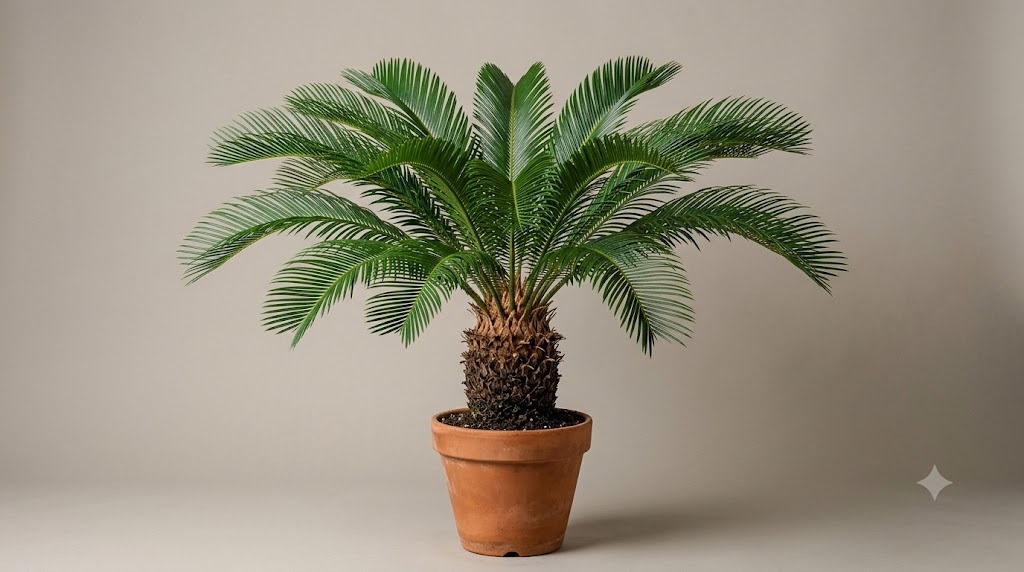
Overview
The Sago Palm - Cycas revoluta - is one of the most striking architectural houseplants you can grow, and one of the most misunderstood. Despite the name, it is not a palm at all. It is a cycad, a survivor from an ancient lineage of plants that predates the dinosaurs, and that prehistoric pedigree shows in its build: a stout, shaggy trunk topped by a perfectly symmetrical rosette of stiff, glossy, deep-green fronds that arch out like the spokes of a wheel. It is slow, sculptural, and almost ornamental in its precision, which is exactly why people love it as a statement plant and as a subject for bonsai. But there is one thing you must know before anything else, and it is not a footnote: every part of this plant is highly toxic to pets and people, and it can kill a dog. If you have animals or small children, please read the safety section first - it should decide whether this plant belongs in your home at all.
Origin & Natural Habitat
Cycas revoluta is native to the warm subtropical islands of southern Japan, including the Ryukyu Islands, and parts of southern China. It grows on rocky slopes and hillsides in bright, open conditions, which tells you a great deal about how to care for it indoors: it is built for strong light and sharp drainage, not for a dim, soggy corner. Cycads as a group are extraordinarily old - they flourished in the age of the dinosaurs and are sometimes called living fossils, having changed remarkably little over many millions of years. They are not flowering plants and they are not conifers; they are their own ancient branch of seed plants, reproducing with cones rather than flowers, and individual plants are either male or female. The species name revoluta refers to the way the edges of the leaflets roll under, or "revolute," a small botanical detail that comes from the Latin for "rolled back." Understanding that this is a tough, slow, sun-loving relic rather than a true tropical palm is the key to keeping it happy.
Appearance
Picture a thick, rough, shaggy brown trunk - really a stem covered in the persistent bases of old leaves - crowned by a tight, even rosette of long fronds radiating out in a near-perfect circle. Each frond is a stiff, leathery, glossy dark-green blade made up of many narrow, pointed leaflets arranged like a feather, and those leaflets are firm to the touch with edges that roll under. New growth emerges in a single dramatic flush: a ring of soft, pale, almost fern-like fronds unfurls all at once, then hardens off over weeks into the rigid, deep-green crown. The overall effect is bold and symmetrical, more like a piece of living sculpture than a soft leafy houseplant.
- Fronds: stiff, glossy, leathery, and arching, each made of many narrow pointed leaflets in a feather-like (pinnate) arrangement, with edges that curl under.
- Trunk: stout, rough, and shaggy, formed from the bases of old fronds; thickens very slowly over many years into a palm-like caudex.
- Crown: a strikingly symmetrical rosette, with new fronds emerging in a single ring around the centre.
- Growth habit: extremely slow and architectural, typically producing just one flush of new fronds per year.
Indoors a Sago Palm usually stays a manageable size for a long time, commonly reaching around 60-150 cm in a pot over many years, since it grows so slowly.
Why People Love It - Qualities & Benefits
- Bold architectural form: the symmetrical rosette of stiff, glossy fronds makes it a genuine statement plant that anchors a room.
- Long-lived and low-fuss: once settled in the right spot it is remarkably tough and undemanding, and individual plants can live for decades.
- Slow growth means low maintenance: because it grows so slowly, it rarely needs repotting and never outgrows its space in a hurry.
- A classic bonsai subject: that thick caudex and tidy crown make it a favourite for bonsai and for sculptural container displays.
- Evergreen and consistent: it holds its deep-green fronds year-round, looking the same in January as in July.
- Atmosphere: like most leafy houseplants it adds a little greenery and life to a room. (The popular "air-purifying" claims are real but modest in a normal home; the bigger benefit is psychological, since greenery measurably lifts mood and lowers stress.)
Care
Light
Give it as much bright light as you can. The Sago Palm wants a bright spot and genuinely appreciates some direct sun, which sets it apart from many softer houseplants. A position right by a bright south, east, or west window is ideal, and a few hours of direct sun helps it grow dense and healthy. It will tolerate bright indirect light, but in dim conditions it sulks, grows weakly, and produces sparse, stretched fronds. If you move it outdoors for summer or to a much brighter window, do it gradually - going straight from low light to harsh sun can scorch the fronds before they adjust.
Watering
This is where most Sago Palms die, so read it twice. The plant is very rot-prone and must never sit wet. Water thoroughly, then wait until roughly the top half of the soil has dried out before watering again - this plant likes to dry out well between drinks. In winter, when growth essentially stops, cut back further and keep it on the dry side. When you do water, water properly until it runs from the drainage holes, then empty the saucer completely; never let the pot stand in water. Soggy soil and a wet crown lead straight to root and trunk rot, which is usually fatal. When in doubt, wait - this plant forgives underwatering far more readily than overwatering.
Soil & Potting
Use a very free-draining, gritty mix - a cactus or palm soil amended with extra perlite, coarse sand, or pumice is ideal. The goal is a medium that holds a little moisture but drains fast and never stays waterlogged around the trunk and roots. Always plant into a container with drainage holes; a terracotta pot helps by letting the rootball breathe and dry out.
Humidity & Temperature
The Sago Palm is not fussy about humidity and copes well with normal household air. It likes warmth, ideally somewhere around 18-26 C through the growing season, and prefers to stay above roughly 10-15 C. It can take a little cool in winter but dislikes hard cold and frost, and it resents cold drafts. Average room conditions suit it perfectly well, which is one less thing to worry about.
Feeding
Because it grows so slowly, it is a light feeder. Feed sparingly during the growing season - roughly once a month through spring and summer - with a balanced or palm fertilizer at half strength. Do not overfeed in the hope of speeding it up; it simply will not be rushed, and excess fertilizer does more harm than good. Stop feeding altogether in autumn and winter while it rests.
Repotting
Repot rarely. This is a slow plant with a slow root system, so it is happy to stay in the same pot for several years, and it does not mind being a little snug. Only move it up a single pot size when it is genuinely crowded, and do it in spring. Take care with the roots, use fresh gritty mix, and wear gloves whenever you handle it (see the safety section).
A note on new growth - one flush a year
It helps to know what normal looks like, because this plant tests your patience. A healthy Sago Palm typically pushes out just one flush of new fronds per year, usually in spring or summer. When it happens, a whole ring of soft, pale, feathery new leaves emerges at once around the centre, then slowly stiffens and darkens over several weeks into the mature crown. During that flush the new fronds are tender and easily damaged, so resist the urge to touch, move, or fuss over them. Outside that single annual push, do not expect much visible change - this is one of the slowest-growing plants you can own, and that is entirely normal.
Propagation
The usual home method is to remove offsets, often called "pups," that form around the base of the trunk and sometimes on the sides of older plants. In spring, carefully detach a firm pup from the parent, let the cut surface dry and callous for a few days, then pot it into a gritty, free-draining mix and keep it barely moist and warm while it slowly roots. Be patient: rooting and establishment can take many months, in keeping with how slowly the whole plant moves. Plants can also be grown from seed, but that is a much slower, specialist route. Whatever method you use, wear gloves and wash your hands afterwards - the plant is toxic, and the cut tissue and seeds are no exception.
Common Problems & Pests
- Yellowing fronds: overwatering and soggy soil are the usual culprits; let the mix dry out much more between waterings and check drainage. Persistent yellowing can also point to a nutrient issue in long-unfed plants.
- Brown, crispy fronds: often underwatering, very dry conditions, or sun scorch after a sudden move to harsh light.
- Rot at the base or trunk: soft, mushy, or foul-smelling tissue at the crown or trunk means rot from staying too wet - frequently fatal, and a reason to be strict about drying out.
- No new growth: usually just the plant being its slow self, but very poor light or cold can stall it further; make sure it is bright and warm.
- Stretched, sparse fronds: a sign of too little light - move it to the brightest spot you have.
- Scale insects: the most common pest by far, especially cycad scale, appearing as small bumps or a white crust on the fronds and stems; treat promptly by wiping off, isolating the plant, and using horticultural oil or insecticidal soap. Mealybugs and spider mites can also appear.
Toxicity & Safety
Highly toxic - one of the most dangerous common houseplants. This is the most important section in this guide, and it is not an exaggeration. Every part of the Sago Palm (Cycas revoluta) is poisonous to pets and people - the fronds, the trunk, the roots, and especially the seeds, which are the single most toxic part of the plant. The plant contains a potent toxin (cycasin) that attacks the liver. In dogs, eating even a small amount - and the seeds in particular - can cause severe, rapidly progressing liver failure that is frequently fatal, even with aggressive emergency veterinary treatment. Cats and other animals are at serious risk too, and the plant is toxic to humans as well, with ingestion capable of causing severe vomiting, diarrhoea, and liver damage.
Because of this, treat the plant with real caution:
- If you have dogs, cats, or small children, the safest choice is not to keep this plant at all. The risk is genuinely life-threatening, not a mild stomach upset, and pets are sometimes drawn to chew the fronds or dig at fallen seeds.
- If you do keep one, place it completely out of reach of any pet or child, clean up any dropped leaflets or seeds immediately, and never leave it where an animal could get to it.
- Wear gloves whenever you prune, repot, or handle it, and wash your hands thoroughly afterwards - especially around the seeds and any cut tissue.
- If ingestion is even suspected, treat it as an emergency. Contact a veterinarian or doctor (or a poison control line) immediately; do not wait for symptoms, because early treatment matters and the toxin acts on the liver.
This is a beautiful plant, but it is a dangerous one. Respect it accordingly.
Pros & Cons
Pros
- Bold, symmetrical, architectural form - a true statement plant.
- Extremely long-lived and, once settled, very low-fuss.
- Slow growth means minimal repotting and no outgrowing its space.
- A classic, rewarding subject for bonsai and sculptural displays.
- Evergreen and consistent, looking good all year round.
Cons
- Highly toxic to pets and people - potentially fatal to dogs - and unsuitable for many households.
- Very rot-prone; unforgiving of overwatering and poor drainage.
- Painfully slow, with just one flush of new fronds a year.
- Stiff, sharp-tipped fronds can prick, so it needs careful placement.
- Prone to scale insects, which can be stubborn to clear.
Best Suited For
- People who want a bold, sculptural statement plant or a bonsai project.
- Bright spots, including windows that get some direct sun.
- Patient growers who are happy with a plant that changes very slowly.
- Homes with NO pets and NO young children, given how toxic it is.
Not ideal for households with dogs, cats, or small children, dim rooms, anyone who tends to overwater, or anyone who wants fast, visible growth.
FAQ
Is the Sago Palm a real palm? No. Despite the name and the palm-like look, it is not a palm at all - it is a cycad, an ancient group of cone-bearing plants that long predates true palms and even the dinosaurs.
Is the Sago Palm poisonous to dogs and cats? Yes, dangerously so. Every part is toxic, and the seeds are the most poisonous of all. In dogs especially, ingestion can cause severe, often fatal liver failure. If you have pets, the safest option is not to keep this plant; if you do, keep it completely out of reach and treat any ingestion as an emergency.
Why are my Sago Palm's fronds turning yellow? Most often overwatering and soggy soil. Let the top half of the mix dry out before watering again, make sure the pot drains freely, and never let it stand in water. In long-unfed plants, yellowing can also signal a nutrient shortfall.
Why isn't my Sago Palm growing? It is almost certainly just being itself. This is one of the slowest houseplants there is, typically producing a single flush of new fronds per year. Give it bright light and warmth and be patient - very slow growth is completely normal here.
How often should I water it? Let roughly the top half of the soil dry out, then water thoroughly and empty the saucer. Water much less in winter. This plant is very rot-prone, so always err on the dry side - it tolerates underwatering far better than sitting wet.