Home Hydroponic Systems: DIY Guide
Hydroponic systems for the home compared honestly - DIY Kratky and deep-water culture against ready-made Click & Grow, AeroGarden, and Gardyn. What grows fastest, what's cheapest.
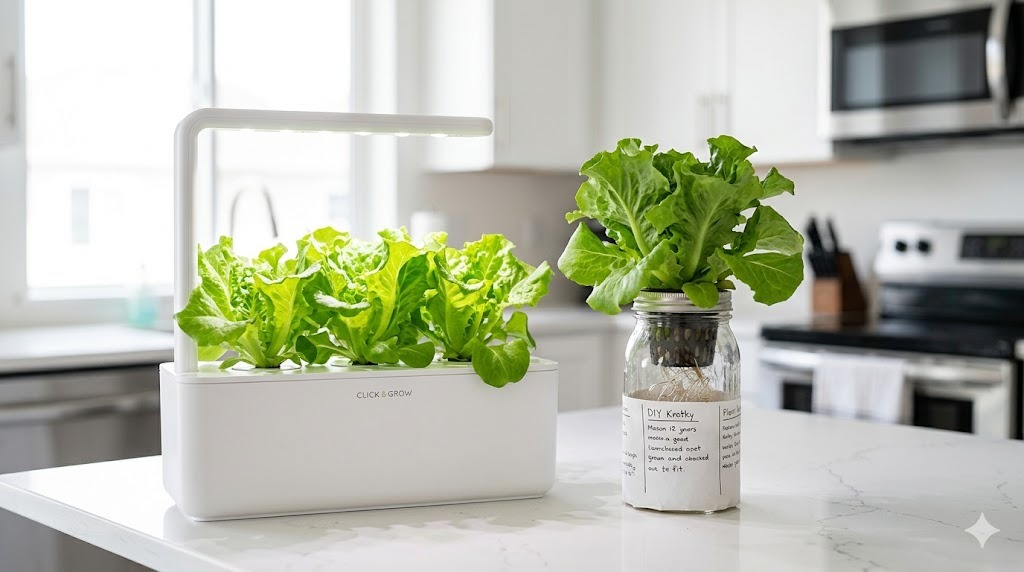
Home hydroponics has crossed from a hobbyist niche into a mainstream kitchen appliance category. You can now spend £30 on a glass jar and a net pot or £600 on a wall-mounted vertical system with an app - and both will grow lettuce successfully. The hard part isn’t whether hydroponics works at home. It’s choosing which type fits your kitchen, budget, and patience for tinkering.
This comparison breaks down the four main options - DIY Kratky, DIY deep-water culture, all-in-one countertop systems (Click & Grow, AeroGarden), and vertical wall systems (Gardyn, Lettuce Grow) - on the metrics that actually matter: total first-year cost, weekly time commitment, what it can grow, and where it fails. We’ll skip the marketing claims and the YouTuber affiliate links.
What “Hydroponics” Actually Means
Hydroponics is growing plants without soil - roots sit in water enriched with mineral nutrients. The reasons it works well indoors:
- No soil mess. No fungus gnats, no spilled potting mix, no repotting.
- Faster growth. Lettuce in 4-5 weeks instead of 6-8. Roots get easy access to water and nutrients.
- Tighter spacing. Plants don’t compete for nutrients via roots, so you can pack more in.
What it’s bad at: anything large, heavy-fruiting, or long-season (tomatoes, peppers, melons). Hydroponics shines for leafy greens, herbs, microgreens, and small fruiting plants like cherry tomatoes if you have a tall enough system.
The Four Options At A Glance
| System | Up-front cost | Time/week | Best for | Worst for |
|---|---|---|---|---|
| DIY Kratky | £30-80 | 5 min | Lettuce, herbs | Anything tall |
| DIY Deep-Water Culture | £80-200 | 15 min | Larger leafy greens | Setup haters |
| Click & Grow | £150-250 | 2 min | Hands-off cooks | Custom growers |
| AeroGarden | £150-350 | 10 min | Herbs, cherry tomatoes | Visual minimalists |
| Gardyn / Lettuce Grow | £600-1000 | 15 min | High-volume harvests | Tight kitchens |
Option 1: DIY Kratky Method (Cheapest)
The Kratky method is hydroponics distilled to its simplest form: a jar of nutrient solution, a net pot, a seedling. No pump, no electricity, no air stone. The water level drops as the plant drinks, leaving an air gap above the roots.
Cost: £30-80 for jars, net pots, hydroton clay pellets, nutrient solution, a pH meter.
What it grows well: Lettuce, basil, mint, chives, small herbs.
What it can’t do: Larger plants run out of water mid-cycle. Anything fruiting needs constant nutrient top-ups.
Time: Mix nutrients once at planting; check pH weekly; harvest in 4-6 weeks. Total: under 5 minutes a week.
Verdict: The best value in home hydroponics. Start here if you’re curious.
Option 2: DIY Deep-Water Culture (DWC)
A bigger water reservoir, often a black plastic tote, with an air pump bubbling oxygen into the nutrient solution. Roots dangle into the water; the pump prevents stagnation and rot.
Cost: £80-200 - reservoir, air pump, air stones, net pots, lid with cut holes, nutrient solution, pH meter, EC meter, grow light (often essential).
What it grows well: Multiple lettuce heads or large basil plants in one tote, leafy greens at scale, even small chillies if you switch to flowering nutrients.
Time: 10-15 minutes weekly - top up water, check pH and EC (electrical conductivity, a proxy for nutrient strength), rinse the air stone occasionally.
Verdict: The best volume-to-cost ratio. Worth the setup if you eat salad regularly.
Option 3: Click & Grow
The Apple of home hydroponics - a sealed plastic unit with proprietary “Smart Soil” pods, an LED grow light, an internal pump, and a water tank. Drop in a pod, fill the tank, plug in. App pings you when water is low.
Cost: £150 (Smart Garden 3) to £250 (Smart Garden 9). Pods are £8-15 per pack of three and last one growing cycle (~5-6 weeks). You’re locked into their pod ecosystem.
What it grows well: Lettuce, basil, mini tomatoes, chillies, strawberries - whatever they sell pods for. About 80 varieties.
Time: 2 minutes weekly - refill water tank. Genuinely hands-off.
What it can’t do: Grow your own seeds (only their pods). Total yield is modest - three lettuce plants is dinner-sized, not week-sized.
Verdict: The convenience champion. Worst cost-per-harvest, best fit for someone who wants kitchen herbs without thinking about it.
Option 4: AeroGarden
Similar concept to Click & Grow but with an open water reservoir and seed pods you can DIY (sponge plus seed) instead of buying proprietary ones. Larger lights, taller frames, fruits better.
Cost: £150-350 depending on model size.
What it grows well: Herbs, lettuce, cherry tomatoes (the taller models clear 50 cm), peppers, even small strawberries.
Time: Weekly nutrient and water top-up, monthly cleaning. Around 10 minutes a week.
Verdict: Better grower’s machine than Click & Grow if you tolerate a slightly less polished design. The “Bounty” model can actually produce a meaningful tomato harvest.
Option 5: Gardyn / Lettuce Grow / iHarvest (Vertical Wall Systems)
Tall hexagonal towers or wall-mounted vertical systems that hold 20-30 plants. App-driven, with built-in cameras on some models (Gardyn). Designed to be a meaningful share of a household’s leafy-green consumption.
Cost: £600-1000 up front, plus pod subscriptions or DIY pods.
What it grows well: A continuous rolling salad bar of 20+ lettuces, herbs, and small fruits. Can genuinely replace supermarket greens.
Time: 15 minutes a week plus monthly deep cleaning.
Footprint: Significant. A vertical tower takes a square metre of floor and 1.8 m of height.
Verdict: If you eat 3+ salads a week and have space, the cost amortises fast. Otherwise overkill.
Which One Should You Buy?
- You want to try hydroponics for £40 to see if it sticks → DIY Kratky in a jar.
- You eat salads constantly and have a balcony or basement → DIY Deep-Water Culture or a Gardyn tower.
- You want kitchen herbs to magically refill themselves → Click & Grow Smart Garden 3.
- You want to grow cherry tomatoes and basil under one light → AeroGarden Bounty.
- You’re trying to feed a family of four from indoor growing → Vertical wall system, plus realistic expectations.
What Hydroponics Won’t Do
It won’t replace soil for root vegetables (carrots, potatoes). It won’t outperform a sunny garden bed in summer. It won’t grow large tomato plants without a substantial frame and weekly attention. It also won’t pay for itself quickly with pod-based systems - the pods cost roughly £3 per lettuce, similar to supermarket.
The value of home hydroponics is not strictly economic. It’s the convenience, the freshness, the year-round harvest, and the fun.
Frequently Asked Questions
Is home hydroponics cheaper than buying greens at the supermarket?
DIY Kratky and DWC, yes - a £40 setup grows £100+ of greens per year. Pod-based systems (Click & Grow) usually break even or stay slightly more expensive, but you get freshness and convenience.
Do I need a grow light for hydroponics?
For Click & Grow, AeroGarden, and Gardyn, the light is built in. For DIY systems indoors, yes - a 20-40 W full-spectrum LED grow light for 12-16 hours/day. By a sunny window without a grow light, results are inconsistent.
How often do I change the water?
DIY Kratky: once per crop (~5 weeks). DWC: top up weekly, fully refresh monthly. Click & Grow / AeroGarden: top up weekly, full clean and refill every 1-2 crops.
What grows best hydroponically for beginners?
Lettuce and basil are the slam dunks - fast (4-5 weeks), reliable, and forgiving of beginner nutrient mistakes. Add mint, chives, and parsley once you’re confident.
Can I grow tomatoes hydroponically indoors?
Cherry tomatoes, yes - in tall systems (AeroGarden Bounty, large DWC). Full-size beefsteak tomatoes, no - they need more root volume, height, and light than home indoor setups deliver.
🛒 Recommended Gear on Amazon
- Countertop hydroponic garden - browse current options and reviews on Amazon.
- Hydroponic nutrients - browse current options and reviews on Amazon.
- Net pots - browse current options and reviews on Amazon.
As an Amazon Associate, we earn from qualifying purchases - at no extra cost to you. This helps us keep producing free, in-depth guides.