Winter Frost Protection for Plants
How to protect plants from winter frost - fleece and covers, when to move tender plants indoors, mulching strategies, and the species most at risk in cold snaps.
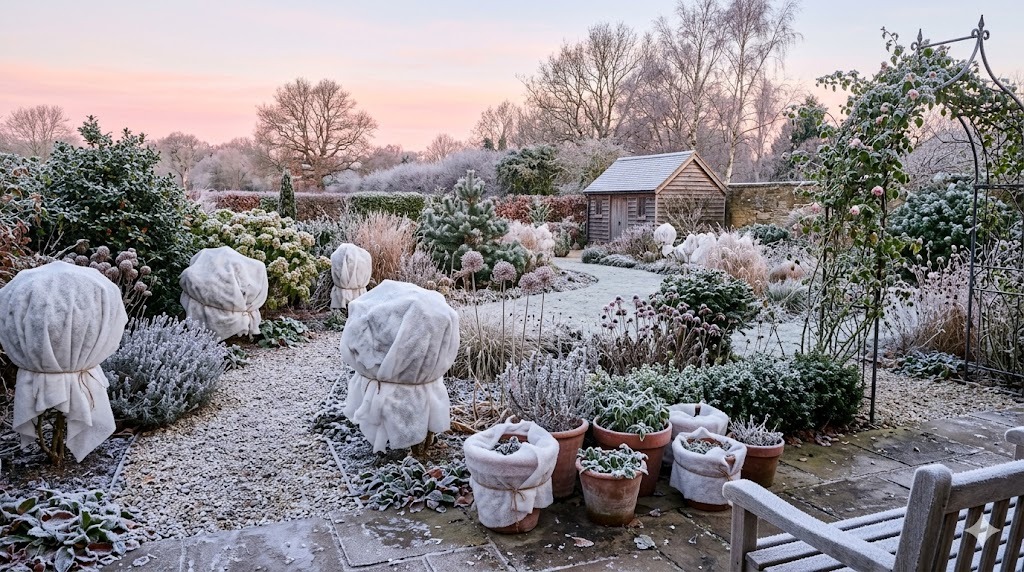
Winter kills more garden plants in one bad week than the rest of the year combined. A clear November night with the temperature dropping to -3°C can write off a year of careful summer growth - citrus trees turning black overnight, dahlias mushy by morning, the bay tree on your patio stripped of every leaf. None of that needs to happen. Most frost damage is preventable with cheap, simple techniques applied at the right moment.
This guide covers the three lines of defence - covers, repositioning, and mulching - plus the question of when to give up and bring the plant indoors for winter. We’ll also list the species most at risk in temperate climates and the ones beginners often think are tender when they aren’t.
How Frost Actually Damages Plants
Cold air doesn’t directly kill plants; ice crystals inside the cells do. When the temperature drops below freezing, water in plant tissue freezes, expands, and ruptures cell walls. By dawn the plant looks blackened or translucent - that’s burst cells leaking.
Three factors determine whether a given plant dies:
- Plant hardiness - some plants survive -15°C, others die at +2°C.
- The temperature reached and duration - a brief dip is survivable; a 6-hour deep freeze isn’t.
- The plant’s water status - water-saturated plants freeze faster than slightly dry ones. Wet feet in winter is a death sentence.
Wind makes everything worse. A windy frost penetrates further into plant tissue than a still one.
Line 1: Covers (Frost Cloth, Fleece, Bubble Wrap)
The first and most accessible defence. A horticultural fleece (white woven cloth, 17-30 gsm weight) draped over a plant traps ground-radiated heat overnight and holds the air around the plant a couple of degrees warmer.
How to use
- Drape the fleece over the whole plant, anchored to the ground at the edges with stones, pegs, or bricks. Don’t let the fleece touch the leaves directly where possible - use stakes or a small frame as a tent.
- Cover at dusk, before the temperature drops. Uncover by mid-morning so the plant gets light and air.
- Use double layers for harder frosts (below -5°C). One layer gains 2°C; two layers gain 3-4°C.
- Don’t use plastic sheets directly on the plant. Plastic traps moisture against leaves and freezes onto them, causing more damage than no cover.
When fleece isn’t enough
Below -8°C, fleece alone doesn’t save tender plants. You need additional measures (mulching, wrapping the pot, moving to shelter).
Cost
A 1.5 m × 10 m roll of horticultural fleece costs £10-15 and lasts several winters.
Line 2: Reposition & Wrap
Sometimes the simplest protection is moving the plant somewhere less exposed.
For potted plants
- Move pots against a south-facing wall. The wall radiates daytime heat all night, adding 2-4°C of frost protection.
- Cluster pots together. A cluster of pots traps shared heat better than scattered single ones.
- Lift pots off cold ground. Cold rises from concrete and stone in winter. Use bricks, pot feet, or a wooden plank.
- Wrap pots themselves. Roots are more vulnerable than tops because the pot doesn’t insulate them like ground does. Wrap pots in hessian, bubble wrap, or old jumpers.
For tender plants in ground
- Build a windbreak. A panel or screen on the windward side often makes the difference.
- Mound straw or leaves around the base. Insulates the crown and root zone.
- Hard-prune nothing in autumn. Spent foliage and old stems protect the crown through winter; cut them off in spring.
Line 3: Mulch
A 5-10 cm layer of organic mulch (bark chips, straw, leaf mould, well-rotted compost) over the root zone insulates the soil, reducing how deep frost penetrates. This is essential for:
- Newly planted perennials and shrubs in their first winter.
- Borderline-hardy plants (agapanthus, hardy fuchsia, some salvias).
- Bulbs planted shallowly.
When to mulch
After the first hard frost but before sustained freezing - late November in most temperate climates. Mulching too early in autumn keeps the soil warm and prevents proper dormancy.
Where to mulch
Spread evenly over the root zone but keep mulch a few centimetres clear of woody stems and tree trunks - direct contact with damp mulch invites rot.
When to Bring Plants Indoors
Some plants are simply too tender to overwinter outdoors in most temperate climates. Bring them inside (or to a frost-free shelter - a porch, garage, conservatory, greenhouse) before the first frost:
- Citrus - lemon, lime, calamondin, kumquat. Move to a cool bright room (5-12°C).
- Olive trees in pots - hardy down to about -5°C if dry, but safer indoors in deep winter.
- Tender succulents - most aren’t frost-hardy. Bring in by late October.
- Pelargonium (“geraniums”) - overwinter in a cool bright room or take cuttings to save genetics.
- Dahlias - lift tubers after first frost, store in dry vermiculite at 5-10°C.
- Bay laurel in pots - hardy in ground but pots freeze through faster; shelter them.
- Fuchsia (non-hardy) - bring in or take cuttings.
Plants You Don’t Need to Worry About
Many “tender-looking” plants are far hardier than beginners assume:
- Lavender - hardy to -20°C once established.
- Rosemary - hardy to -15°C in well-drained soil. Wet feet kills it, not cold.
- Most ornamental grasses - hardy and look beautiful in winter.
- Salvia nemorosa and S. × sylvestris - fully hardy.
- Sedum, sempervivum, hardy succulents - perfectly happy at -15°C.
- Heuchera, hellebore, bergenia - evergreen through winter.
Cover or move them only if your local minimum is more extreme than their hardiness rating.
Reading Hardiness Ratings
USDA Hardiness Zones describe the average minimum winter temperature an area experiences:
- Zone 5: -28°C to -23°C
- Zone 6: -23°C to -18°C
- Zone 7: -18°C to -12°C
- Zone 8: -12°C to -7°C
- Zone 9: -7°C to -1°C
A plant rated hardy to Zone 7 means it survives down to -18°C. If you’re in Zone 6 (-23°C), it’ll die in a bad winter without protection.
The UK is mostly Zone 8-9. North-eastern US ranges Zone 4-7. Mediterranean Europe is Zone 9-10. Look up your zone and match plant ratings to it; never trust “should be hardy in your area” generic labels.
The Frost-Protection Checklist (Late Autumn)
- Stockpile fleece, stakes, and bricks before the first forecast frost.
- Mulch new plantings 5-10 cm deep.
- Move all tender pots indoors or into a frost-free shelter.
- Wrap pots staying outdoors with hessian or bubble wrap.
- Position remaining tender plants against south-facing walls.
- Drain and store outdoor irrigation lines, garden hoses, and water features.
- Lift dahlia tubers, store cool and dry.
- Take cuttings of fuchsia and pelargonium as insurance.
Frequently Asked Questions
What temperature do I need to cover plants for frost?
Cover when night-time forecasts drop below 0°C for tender plants and below -3°C for borderline-hardy plants. Hardy plants typically need no protection above -10°C. Always check the forecast specifically - “freezing” can mean -1°C or -10°C depending on the night.
Can I use bedsheets or blankets instead of horticultural fleece?
Yes, in a pinch. Old cotton sheets or blankets work - heavier than fleece, so use stakes to keep weight off the plant. Avoid plastic, which traps freezing moisture against the leaves.
Should I water plants before a frost?
Slightly damp soil holds heat better than dry soil and releases it overnight, protecting roots. But waterlogged soil freezes solid and damages roots. Water lightly the day before a frost if the soil is bone dry; otherwise leave it.
Is mulching better than covering?
They protect different parts. Mulch protects the roots and crown; covers protect the above-ground stems and leaves. Both together for tender plants; just one for hardy ones in a harsh climate.
My plant looks dead after frost - should I cut it back?
Wait until spring. Frost-damaged growth can look black and crisp but often resprouts from below ground. Cutting in winter exposes lower tissues to further frost. Tidy the damage in spring once new growth appears.
🛒 Recommended Gear on Amazon
- Frost protection cloth - browse current options and reviews on Amazon.
- Garden cloches - browse current options and reviews on Amazon.
- Bagged garden mulch - browse current options and reviews on Amazon.
As an Amazon Associate, we earn from qualifying purchases - at no extra cost to you. This helps us keep producing free, in-depth guides.
