Hoya Retusa
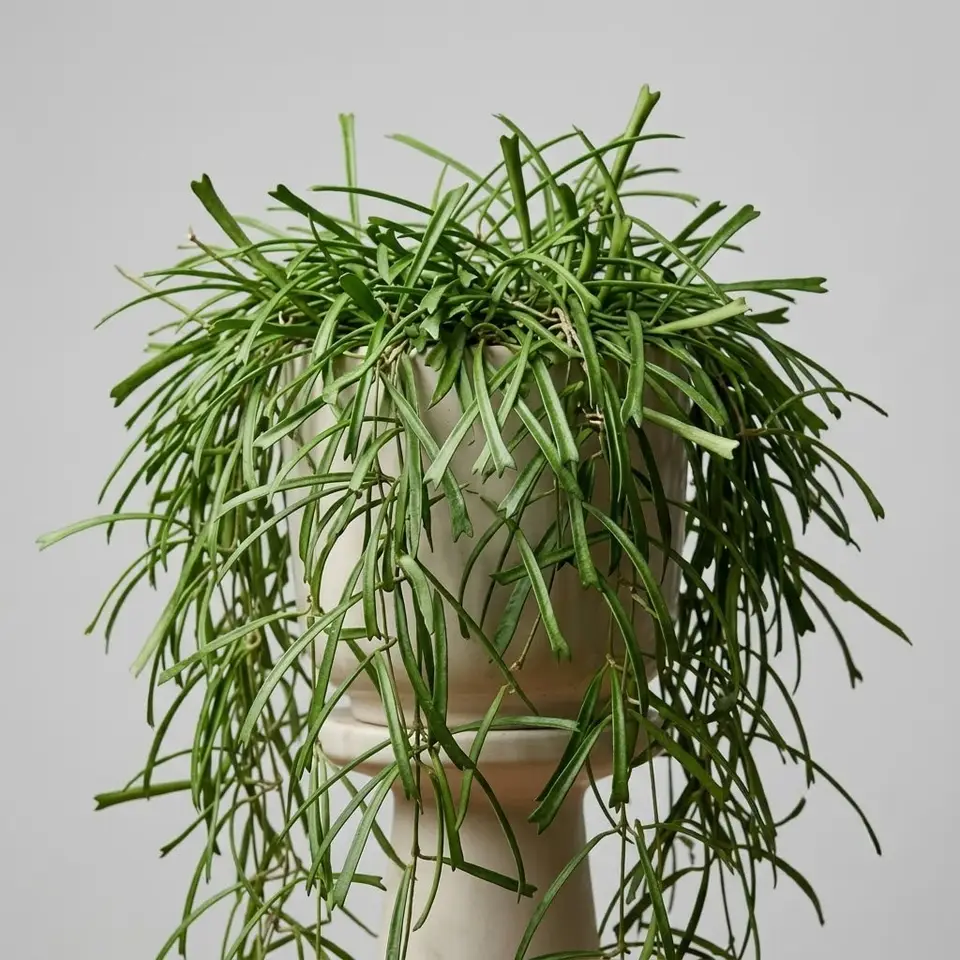
Hoya retusa is the grass hoya - flat, ribbon-thin leaves notched at the tip, tumbling from the pot like a head of green hair.
Last reviewed: October 2026
 AI illustration
Overview
Hoya retusa is the grass hoya - flat, ribbon-thin leaves notched at the tip, tumbling from the pot like a head of green hair. Nothing about it says 'hoya' until the perfect white-and-maroon stars appear, singly, all over the mop. The genus's best double-take. (Hoya retusa.)
Origin & Natural Habitat
India and the eastern Himalayas - a fine-leaved epiphyte, adapted to bright light and seasonal moisture rhythms.
Appearance
Flat linear leaves 5-7 cm ending in a notch, densely tufted on thin stems to 60 cm; flowers come mostly SINGLE (not in umbels) - crisp white stars with maroon coronas dotted through the foliage.
Why People Grow It - Qualities & Benefits
- Grass-mop look unique in the genus
- Single scattered flowers: a different bloom style
- Denser and easier than linearis
- Compact, curious, conversation-starting
Care
Light: Bright indirect with gentle sun; more light = denser mop and more stars.
Water: Even moisture with brief dry-downs - finer leaves than the succulent set, tougher than linearis; weekly checks.
Soil: Airy epiphyte mix, modest pot.
Temperature & Humidity: 17-28°C; more heat-tolerant than its Himalayan lookalike.
Feeding: Dilute monthly in growth.
Extra: Often confused with linearis: retusa's leaves are FLAT with notched tips (linearis = rounded/grooved, fuzzy) and it's the more forgiving plant. Buy retusa for the look with fewer tears.
Propagation
Bundle a few stems as one cutting into sphagnum - they root in weeks and instantly look intentional. Singles look like stray grass.
Common Problems & Pests
- Drying to crisp in neglect (finer margins than thick-leaf hoyas)
- Rot in heavy wet soil
- Tangling: purely cosmetic
Toxicity & Safety
Not on the ASPCA lists. The ASPCA Animal Poison Control Center's plant lists for cats and dogs have no entry for this plant (they do have entries for relatives, such as Hoya carnosa and Hoya publcalyx), and we have no other checked source either way. If a pet chews it and seems unwell, call your vet or a pet poison helpline.
Pros & Cons
Pros
- Unmistakable texture
- Freckled-with-stars bloom habit
- Easier than it looks
- Small-space friendly
Cons
- Middling drought buffer
- Can look scruffy unstyled
- Flowers lack umbel drama
Best Suited For
- Hanging pots at eye level
- Texture contrast in plant walls
- Linearis admirers wanting easier
- Collectors of oddities
FAQ
Retusa or linearis?
Same vibe, different difficulty: retusa is flatter-leaved, denser, warmth-tolerant and forgiving; linearis is fuzzier, cool-loving and touchy. Start retusa.
Why are flowers appearing one by one, not in balls?
Species habit - retusa blooms mostly solitary stars scattered through the mop rather than umbels. It reads like the plant put on polka dots.
How do I thicken the mop?
Root bundles of cuttings back into the same pot each spring - the hairdo doubles every season.
Gear for growing hoya retusa
Links go to Amazon or a partner store (such as Adagio Teas) and may earn us a commission at no extra cost to you. As an Amazon Associate we earn from qualifying purchases. We link gear types, not sponsors' picks: you choose the exact product.