Succulent Propagation: Leaf vs Stem Step-by-Step
A complete beginner guide to propagating succulents from leaves or stem cuttings - what to do, what to wait for, why most leaves fail, and how to grow a free collection.
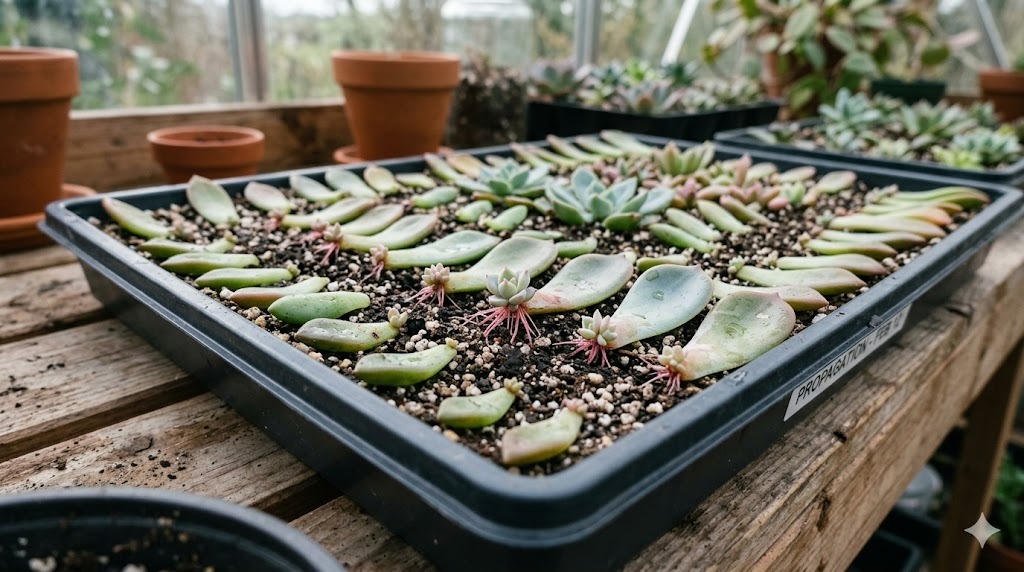
Succulent propagation is the closest thing the plant world offers to magic. You twist off a single leaf, set it on dry soil, and weeks later a tiny pink rosette and a thread of roots appear from the broken end. Or you behead an etiolated stem, let it scab over, and stick it in a new pot - and both halves grow.
The catch: most beginners try once, see nothing happen, and assume they did it wrong. They didn’t. Succulent propagation is slow (4-12 weeks before visible babies) and not every leaf works (the failure rate is 30-60% even with perfect technique). The trick is to start with many leaves, set them up correctly, and ignore them for a month.
This guide covers both methods - leaf propagation and stem cuttings - with the small details that separate a thriving tray from a tray of dried-out leaves.
Which Method, Which Plant?
| Method | Best For | Speed | Success Rate |
|---|---|---|---|
| Leaf propagation | Echeveria, Graptopetalum, Sedum, Kalanchoe | Slow (8-12 weeks to small plant) | ~50% |
| Stem cuttings | Aeonium, Crassula (jade), Sedum trailing types, Echeveria | Faster (2-6 weeks to roots) | ~85% |
| Offsets (pups) | Haworthia, Aloe, Sempervivum, hen-and-chicks | Immediate | ~95% |
A few succulents (Echeveria, Sedum) propagate well from any method - choose based on what your parent plant looks like and how much patience you have.
Method 1: Leaf Propagation, Step by Step
Step 1 - Pick the right leaves
- Choose plump, mature leaves from the lower part of the rosette.
- Twist gently side to side until the leaf pops off cleanly. A torn leaf with no base will not propagate.
- The whole base of the leaf must come away - if you see a clean, even break with no stem fragment attached, you have a good leaf.
- Skip leaves that are bruised, wrinkled, or already showing roots; pick fresh ones.
Step 2 - Let them callus
- Lay the leaves on a dry tray (no soil) in a bright spot out of direct sun.
- Wait 3-7 days for the broken end to dry and scab over.
- Don’t skip this step - a fresh wet break in soil will rot before it roots.
Step 3 - Set on soil
- Use a shallow tray of well-draining cactus/succulent mix.
- Lay each leaf flat on the soil surface, broken end touching but not buried.
- Bright indirect light, no direct sun yet, no plastic dome.
Step 4 - Mist, don’t water
- For the first 4-8 weeks, mist the soil surface every 3-5 days. Just enough to dampen, never soak.
- Roots will appear first - pink threads reaching down from the broken end - then a tiny rosette.
- The roots will often crawl across dry soil before going in; that’s normal.
Step 5 - Switch to real watering
- Once the baby rosette has 3-5 small leaves (typically 6-10 weeks), start watering as you would a small succulent - soak when dry.
- The mother leaf will shrivel and eventually fall off. That’s success, not failure: it’s spent itself feeding the baby.
Step 6 - Pot up
- When the baby is roughly the size of a coin, pot it individually in a small pot with cactus mix.
- Treat as a normal small succulent from there.
Method 2: Stem Cuttings, Step by Step
Stem cuttings are faster and more reliable. They’re how you rescue an etiolated (stretched, pale) succulent - and you end up with two plants from one.
Step 1 - Take the cutting
- With a sharp, clean knife or scissors, cut 5-10 cm of stem with a rosette or several leaves at the top.
- Cut cleanly at the angle of natural growth.
Step 2 - Strip lower leaves
- Gently twist off the bottom few leaves so you have a clean stem to plant.
- These removed leaves can themselves be set aside for leaf propagation.
Step 3 - Callus the cut
- Set the cutting on a dry tray, cut end up, in bright indirect light.
- Wait 3-7 days until the cut end is dry and slightly hardened.
Step 4 - Plant
- Stick the cut end into dry succulent mix, deep enough to stand (usually 2-3 cm).
- Don’t water for the first week.
Step 5 - Begin watering
- After a week, mist the soil lightly every 4-5 days.
- Roots form within 2-4 weeks. Tug gently - resistance means roots have anchored.
- Switch to normal succulent watering.
What happens to the original plant?
The decapitated parent will often sprout new rosettes from the cut stem within weeks. One stem becomes two or three plants.
Method 3: Offsets (Pups)
The easiest method, applicable to clustering succulents like haworthia, aloe, sempervivum, and some echeverias.
- Wait until the offset has a few leaves and ideally some roots of its own.
- Gently work it free from the parent with your fingers or a clean knife.
- Let any cut surface callus 1-2 days.
- Pot up in succulent mix and treat as a small adult.
- Success rate is near 100%.
Why So Many Leaves Fail
If half your leaves shrivel and die before producing a baby, you didn’t do anything wrong - that’s the normal rate. Common reasons:
- Leaf wasn’t twisted off cleanly - partial leaf bases don’t have meristem cells and can’t grow.
- Skipped the callus stage - fresh wet leaves rot in soil.
- Too much water - soggy soil rots leaves faster than dry soil starves them.
- Direct sun - scorches the small leaves before they can root.
- Old or stressed leaves - pick plump, healthy leaves only.
Start with more leaves than you need (10-20 at a time) and accept that 5-10 will succeed.
Best Succulents for Beginner Propagation
- Echeveria - rosette-forming, leaves pop off cleanly, classic propagators.
- Graptopetalum paraguayense (ghost plant) - drops its own leaves, which root spontaneously.
- Sedum morganianum (burro’s tail) - leaves practically fall on the table and root.
- Crassula ovata (jade plant) - both leaves and stem cuttings work well.
- Kalanchoe - fast and reliable from leaf.
Avoid for first attempts: Aeonium (leaves rarely propagate), Lithops (very slow and tricky), variegated forms (often revert to plain).
Frequently Asked Questions
How long does succulent propagation take?
From leaf: 4 weeks for first roots, 8-12 weeks for a visible baby, 4-6 months for a coin-sized plant. From stem cutting: 2-4 weeks for roots, 6-10 weeks for new growth. Offsets are immediate.
Why are my succulent leaves shrivelling instead of growing babies?
Most likely they weren’t twisted off cleanly (no meristem base), or they’re in too much sun, or you’ve watered too much and they rotted before rooting. Normal success rate is 40-70%, so some failures are inevitable.
Do I need rooting hormone for succulents?
No. Rooting hormone is for woody cuttings. Succulent leaves and stems root without it.
Can I propagate succulents in water?
Stem cuttings - yes, you can root in water (and many trailing sedums root spectacularly that way), then transfer to soil. Leaves - no, they rot.
Why isn’t my mother leaf falling off?
It will, eventually. The mother leaf feeds the baby and slowly shrivels. Don’t pull it off - let it detach naturally so the baby keeps drawing nutrients. Once it’s papery and lifts away with no resistance, it’s spent.
🛒 Recommended Gear on Amazon
- Assorted succulent cuttings - browse current options and reviews on Amazon.
- Succulent potting soil - browse current options and reviews on Amazon.
- Propagation trays - browse current options and reviews on Amazon.
As an Amazon Associate, we earn from qualifying purchases - at no extra cost to you. This helps us keep producing free, in-depth guides.