String of Bananas (Curio radicans)
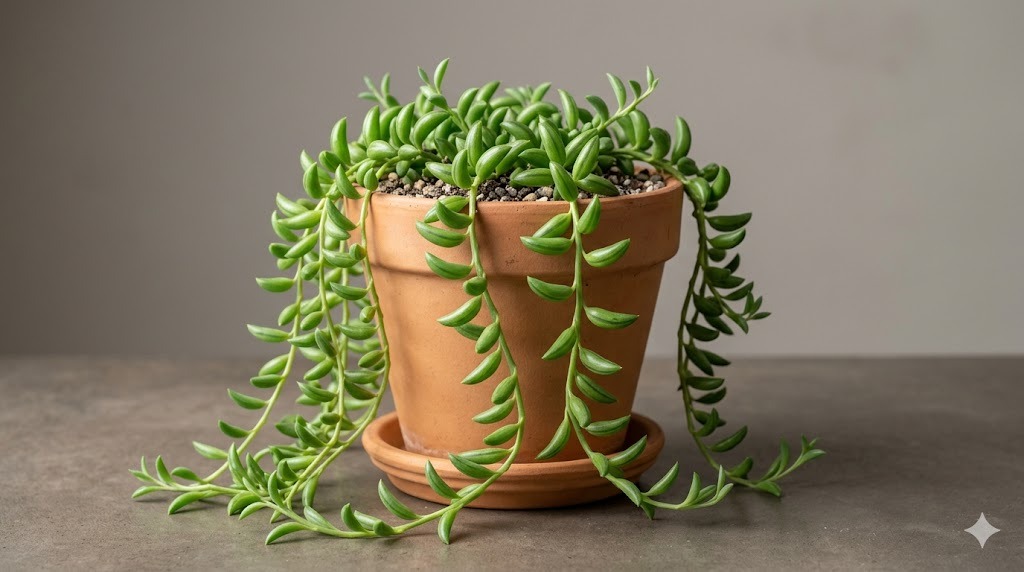
The String of Bananas - sometimes still sold under its older name Senecio radicans - is one of the most cheerful trailing succulents you can grow.
🗓️ Last reviewed: June 2026
Overview
The String of Bananas - sometimes still sold under its older name Senecio radicans - is one of the most cheerful trailing succulents you can grow. Long, slender stems spill over the pot edge lined with plump, glossy, banana- or crescent-shaped leaves, making a living curtain of little green bananas. It is the easygoing cousin of the more famous String of Pearls: faster-growing, hardier, and far more forgiving of the odd mistake. Because it is a true succulent, the care logic is succulent-style - it stores water in those fleshy leaves and would much rather be too dry than too wet. That makes it a wonderful pick for a bright windowsill, a high shelf, or a hanging basket, and a great fit for busy or forgetful owners who want a dramatic trailing look without fussy demands.
Origin & Natural Habitat
String of Bananas is native to the dry, arid regions of South Africa, where it grows as a trailing, creeping succulent groundcover. In the wild its stems sprawl across rocky ground and root wherever they touch the soil, slowly knitting together into a low mat - which is exactly what the name describes. It belongs to the daisy family (Asteraceae), alongside its many Curio and Senecio relatives, and yes, those small puff flowers really are tiny daisies in disguise.
The name tells its story. Radicans comes from the Latin for "with rooting stems," a nod to the way every stem that meets the ground sends down new roots. The plant was for a long time classified as Senecio radicans, but botanists have since moved many of these succulent senecios into the genus Curio - so you will see it labelled both ways in shops and books, and both names refer to the same plant.
Appearance
String of Bananas is all about its trailing stems. Each one is long and slender and densely lined with fleshy, curved leaves shaped like miniature bananas or crescents, in a fresh glossy green. Look closely and you will often see a faint translucent stripe or "window" running along each leaf - a clever adaptation that lets light reach deeper into the water-storing tissue. The plant grows quickly for a succulent and trails generously, and when it is happy it can throw up small brush-like puff flowers.
- Leaves: plump, banana- or crescent-shaped, glossy green and firm, each with a small translucent "window" line along its length.
- Stems: long and trailing, rooting readily wherever they touch soil.
- Flowers: small white-to-cream puff flowers, lightly cinnamon- or spice-scented, appearing occasionally indoors.
- Growth habit: a fast-trailing succulent, perfect for hanging baskets and high shelves.
Indoors the strings commonly reach around 60-90 cm or more over time, cascading down in a lush green waterfall if you give them room to hang.
Why People Love It - Qualities & Benefits
- A cascading curtain of bananas: few plants give you such a striking trailing display, and the chubby leaf shape makes people smile.
- Fast and hardy: it grows noticeably faster and shrugs off mistakes better than the temperamental String of Pearls.
- Very low-water, low-maintenance: as a succulent it is genuinely drought-tolerant, which makes it ideal for forgetful or busy owners.
- Super easy to propagate: the stems root so readily that one plant quickly becomes many, for free.
- Made for height: it looks its best on a high shelf, a plant hanger, or a basket where the strings can spill down.
Like most foliage plants, it adds a little greenery and calm to a room. (The famous "air-purifying" claims are real but modest in a normal home - the main benefit is psychological: living greenery measurably lowers stress and lifts mood.)
Care
Light
String of Bananas wants bright light - it is the spot where it truly thrives. Indoors that means bright, indirect light, and unlike many houseplants it can also take some gentle direct morning sun, which helps keep the strings full and the leaves plump. Give it the brightest spot you have: right by a sunny window is usually perfect. Too little light is the most common reason the strings turn stretched and sparse, with long bare gaps between the leaves, so when in doubt, move it brighter.
Watering
Water this plant like the succulent it is: soak the soil thoroughly, then let it dry out almost completely before you water again. This "soak and dry" rhythm is exactly what those water-storing leaves are built for. In winter, when growth slows, cut back sharply and water only occasionally. Overwatering, and the root rot it causes, is the number-one killer of String of Bananas - far more plants die from kindness than from neglect. Read the plant: plump, firm leaves mean it is happy; shriveled or flat leaves mean it is thirsty; mushy, translucent, yellowing leaves mean you have overwatered. When in doubt, wait.
Soil & Potting
Use a gritty, fast-draining cactus or succulent mix, and lighten it further with extra perlite, pumice, or coarse sand so water rushes straight through. The one non-negotiable is drainage: the pot must have drainage holes. A terracotta pot helps too, because the porous clay wicks moisture away and makes overwatering much harder.
Humidity & Temperature
This is a desert succulent, so it is perfectly content in normal-to-low household humidity and does not want a humid, steamy environment - skip the misting and the bathroom shelf. It enjoys warm, ordinary room temperatures of about 18-27 °C. Protect it from frost and anything below roughly 10 °C, which it cannot tolerate. In a mild climate it is happy to spend the summer outdoors in a bright, sheltered spot, just bring it back in before the cold arrives.
Feeding
String of Bananas is a light feeder. A dilute succulent or balanced fertilizer at half strength, applied just a couple of times across spring and summer, is plenty. Do not feed at all in autumn and winter while the plant is resting.
Repotting
Repotting is infrequent - every 2-3 years is usually enough, and the plant actually likes being a bit snug in its pot. Do it in spring if at all, and handle the brittle strings gently, as they snap easily when you lift and settle the rootball.
The secret to full, lush strings - light and the lay-and-root trick
Here is the tip that separates a thin, gappy plant from a thick, overflowing one. The first key is light: bright light keeps the leaves packed tightly along the stems, while too little light makes the strings stretch and grow leggy with big bare gaps. The second key is a clever propagation trick - take any trimmed or overly long strings and simply lay them back on top of the soil in the same pot, pinning them down with a hairpin or a small stone if needed. Where each stem touches the soil it will root, sending up fresh growth and filling the pot from within. Bright light plus this lay-and-root habit is how you turn a sparse plant into a lush, full cascade.
Propagation
String of Bananas is one of the easiest plants you will ever propagate. Snip a healthy length of stem, then let the cut end callous over for a day so it can heal. Next, lay the cutting on top of, or shallowly into, well-draining soil - the stems root readily, especially at the nodes where the leaves meet the stem. Keep the soil barely moist, not wet, until you see new roots and fresh growth taking hold. Better still, you can lay cuttings right back into the parent pot to thicken it up, turning one plant into a fuller plant with zero extra pots.
Common Problems & Pests
- Shriveled, flat leaves: usually underwatering - but sometimes root rot prevents the plant from drinking, so check the soil and roots before you reach for the watering can.
- Mushy, translucent yellowing leaves and stems: overwatering and root rot, the main killer of this plant. Let the soil dry, cut away any rotten roots, and repot into fresh dry mix.
- Sparse, leggy strings with big gaps: not enough light. Move it to your brightest spot and the new growth will come in tighter.
- Strings dying back: often a sign of rot at the base or chronically soggy soil; salvage healthy cuttings and start fresh in gritty mix.
- Pests: mealybugs are the classic problem, hiding as white fluff tucked into the leaf joints, along with aphids and root mealybugs. Treat with insecticidal soap or neem oil, or dab individual mealybugs with a cotton swab dipped in rubbing alcohol.
Toxicity & Safety
Toxic to cats, dogs, and humans if eaten. Curio and Senecio species are considered toxic, and ingesting the leaves or stems can cause mouth and stomach irritation, drooling, vomiting, and lethargy. The sap may also irritate sensitive skin, so it is worth washing your hands after taking cuttings. Keep this plant out of reach of pets and small children, and remember that the "banana" in its name refers only to the leaf shape - it is decorative, not a food.
Pros & Cons
Pros
- Fast-growing and hardy for a trailing succulent.
- Genuinely easy and low-maintenance.
- Drought-tolerant - forgives a missed watering.
- Extremely easy to propagate and thicken up.
- Beautiful cascading, trailing look.
Cons
- Needs lots of bright light to stay full.
- Rots quickly if overwatered.
- Brittle strings break and snap easily when handled.
- Toxic to pets and people if eaten.
- Goes leggy and sparse in low light.
Best Suited For
- Bright, sunny spots and sunny windowsills.
- Hanging baskets, plant hangers, and high shelves.
- Forgetful or busy owners who want a low-effort plant.
- Succulent lovers building a drought-tolerant collection.
Not ideal for dark rooms, chronic overwaterers, homes with pets that like to chew on trailing plants, or spots that only suit high-humidity tropicals.
FAQ
Why is my string of bananas leggy / why are there gaps between the leaves? It needs more light. When the plant is too dim, the stems stretch and the leaves space out with bare gaps. Move it to your brightest spot - some gentle direct morning sun is fine - and new growth will fill in much tighter.
How is it different from string of pearls? String of Bananas is generally faster-growing, hardier, and more forgiving. The clearest difference is leaf shape: String of Bananas has curved, banana- or crescent-shaped leaves, while String of Pearls has round, pea-like beads. If you have struggled with pearls, bananas are usually the easier plant.
How often should I water it? Treat it like any succulent: soak the soil thoroughly, then wait until it has dried out almost completely before watering again. That might be every couple of weeks in bright summer growth and far less in winter, so always check the soil rather than following a fixed schedule.
Why are the leaves shriveling and going flat? Most often it is thirsty - plump leaves are a sign of a well-watered succulent, and flat ones signal it has used up its stored water. But check the roots too, because rot from overwatering can also stop the plant from drinking and cause the same look.
Can I make my plant fuller? Yes. Give it bright light to keep growth compact, and lay trimmed strings back on top of the soil in the same pot. They root where they touch and send up new growth, thickening the plant from the inside.