String of Turtles (Peperomia prostrata)
The String of Turtles - Peperomia prostrata - is a delicate, slow-growing trailing plant grown almost entirely for its foliage.
🗓️ Last reviewed: June 2026
Overview
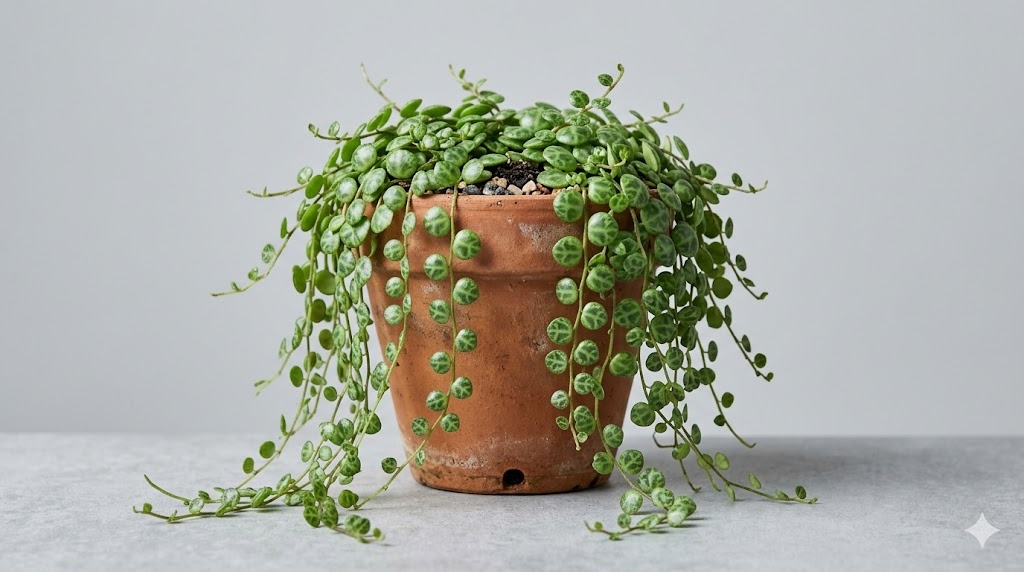
The String of Turtles - Peperomia prostrata - is a delicate, slow-growing trailing plant grown almost entirely for its foliage. Each stem is threadlike and wiry, lined with tiny round leaves no bigger than a fingernail, and every leaf carries a fine pattern of veins that looks uncannily like the shell of a miniature turtle. That is exactly where the common name comes from, and it is the whole appeal of the plant: it is charming, intricate, and small in scale rather than big and showy. It suits anyone who wants a detailed little plant for a shelf, a small pot, or a terrarium, not someone after a dramatic statement piece. Be honest with yourself before you buy: it is genuinely easy to keep alive, but it is slow, and it does not like to be fussed over or overwatered. Give it bright indirect light, a free-draining pot, and a hands-off watering habit, and it will quietly cascade for years.
Origin & Natural Habitat
Peperomia prostrata is native to the warm, humid tropical rainforests of South America, particularly the forests of Brazil. In the wild it is a creeping, semi-epiphytic plant: rather than growing as an upright bush, it trails and crawls across the forest floor, over rocks, and along mossy tree roots and bark, putting out roots wherever its stems make contact with a damp surface. It belongs to the Peperomia genus in the pepper family (Piperaceae), which makes it a relative of the table-pepper plant and of the many other popular Peperomias kept as houseplants. The botanical name is plain-spoken once you unpack it. Peperomia comes from the Greek "peperi," meaning pepper, joined to "homoios," meaning resembling - so, the "pepper-like" plant, a nod to its family. The species name prostrata simply means lying flat or trailing along the ground, which is precisely how this little plant grows in the wild.
Appearance
Picture fine, threadlike trailing stems, and strung along them, dozens of tiny, fleshy, rounded leaves about the size of a small button. Each leaf is the real attraction: a deep green base traced with paler silvery or blue-green veins in a pattern that genuinely resembles a tiny tortoise shell. The leaves are slightly thickened and succulent to the touch, holding a little water, and new growth often emerges with a reddish or bronze tint before settling to green. This is a small, fine-textured plant - there are no big leaves and no flowers worth mentioning (it can produce slim, insignificant pepper-like flower spikes, but nobody grows it for those). The charm is entirely in the detail and the delicate cascade.
- Leaves: tiny, round, fleshy, semi-succulent leaves patterned with pale veins like a miniature turtle shell - the entire reason to grow it.
- Stems: very fine, threadlike, and trailing, rooting along their length where they touch a moist surface.
- Flowers: thin, pale, insignificant pepper-style spikes; ornamentally unimportant.
- Growth habit: a low, creeping, trailing plant rather than an upright one, slow to grow and small in overall scale.
Indoors the trailing stems typically reach around 20-30 cm at most, spilling gently over the edge of a small pot.
Why People Love It - Qualities & Benefits
- Beautiful patterned leaves: the tiny turtle-shell foliage is intricate and genuinely unusual - this is the headline reason to grow it.
- Compact and small-scale: it stays small, which makes it perfect for tight spots, small pots, shelf edges, and crowded plant collections.
- Pet-safe and non-toxic: like other Peperomias it is listed as non-toxic to cats and dogs, a real plus for homes with curious animals.
- Great for terrariums: its love of humidity and its small, trailing habit make it a natural fit for closed terrariums and bottle gardens.
- Easy-going and forgiving: as a semi-succulent it tolerates a little neglect far better than fussier trailers, as long as you do not overwater it.
- Easy to propagate: stem cuttings root readily, so one plant quickly becomes several or fills out a pot.
Care
Light
Bright, indirect light is ideal and brings out the best leaf colour and pattern. A spot near an east or north window, or set back from a brighter south or west window, suits it well. It will tolerate medium light, but in a dim corner the stems stretch, the leaves space out, and the markings fade. Avoid harsh direct midday sun, which scorches and bleaches the small leaves and can dry the plant out fast - this is not a windowsill sun-lover. If the foliage starts looking pale or washed out, it is usually getting either too much harsh sun or too little light overall.
Watering
This is the part that matters most, because overwatering is what kills this plant. It is a semi-succulent, so let the top of the mix dry out before you water again - roughly the top 2-3 cm should feel dry to the touch. Then water thoroughly and let it drain completely. The fleshy leaves and stems store water, so the plant copes well with being a little dry but rots quickly if it sits wet. Cut back further in winter when growth slows. Learn to read it: limp, flat, or translucent-looking leaves and mushy stems usually mean overwatering and the start of rot, while shrivelled, deflated leaves mean it has gone too dry. When in doubt, wait - this plant forgives a missed watering far more easily than a soggy pot.
Soil & Potting
Use a light, airy, very well-draining mix - a peat or coco base loosened with plenty of perlite, and a little orchid bark or pumice, works well. Many growers do best with a mix made slightly grittier than standard houseplant soil, since the roots are fine and resent staying wet. Always plant into a container with drainage holes, and keep the pot on the small side - this plant likes to be a little snug rather than swimming in a big pot of damp soil.
Humidity & Temperature
Coming from a humid rainforest, it appreciates moderate to high humidity - around 50% or more is comfortable, and it positively thrives in the still, moist air of a terrarium. In a dry, heated room a pebble tray or small humidifier helps, though it is more tolerant of average humidity than many tropical trailers. It is happiest warm, around 18-26 C, and dislikes cold. Keep it away from cold drafts and never let it sit below about 10 C, as chilly conditions stress the plant and can cause leaf drop.
Feeding
Feed lightly. A balanced liquid houseplant fertilizer at half strength, roughly once a month through spring and summer, is plenty for this slow grower. Do not overfeed - it does not need much, and excess fertilizer does more harm than good. Stop feeding in autumn and winter while growth has slowed.
Repotting
Repot rarely. This is a slow-growing plant with a small, fine root system, and it is happiest slightly snug in its pot, so you will only need to move it up every 2-3 years, or when it has clearly outgrown its container. Do it in spring, choose a pot only one size larger, and use fresh free-draining mix. Resist the urge to over-pot it into something big, since a large volume of damp soil around those fine roots is exactly what causes rot.
Keeping it full and trailing
Because it grows slowly, a String of Turtles can take its time to look full. To get there faster, pinch or trim the stem tips now and then - this encourages the plant to branch and bush out rather than running thin. You can lay the trimmed cuttings back on top of the soil, where they will root and thicken the plant. Rotating the pot occasionally keeps growth even on all sides rather than leaning toward the light.
Propagation
The String of Turtles is easy and rewarding to propagate, which is the best way to build a fuller plant. Take stem cuttings a few centimeters long with several leaves on them, and either lay them flat on the surface of a moist, well-draining mix or root them in a little water. Where the leaf nodes meet damp soil, new roots form - just as the stems root along the ground in the wild. Rooting is steady rather than fast, so be patient and keep the mix lightly moist (not wet) and the humidity up while roots establish. For the fullest result, root several cuttings straight into the parent pot to thicken it up into a lush, trailing mat.
Common Problems & Pests
- Mushy, rotting stems or limp translucent leaves: the most common problem, and almost always overwatering - let the mix dry more between waterings and check that the pot drains freely.
- Shrivelled, deflated leaves: the opposite issue, underwatering, or very dry air - give it a thorough drink and raise the humidity a little.
- Faded markings or leggy, stretched stems: too little light; move it somewhere brighter (but still indirect) to bring back the pattern and tighten the growth.
- Scorched, bleached, or crispy leaves: too much harsh direct sun - pull it back from the window.
- Slow or no growth: often just the plant's nature, as it is genuinely slow, but very low light, cold, or the resting winter period can also pause it.
- Pests: watch for mealybugs tucked among the dense little leaves and stems, and occasionally fungus gnats in soil that is kept too wet. Isolate the plant and treat with insecticidal soap or neem oil, and let the soil dry out to discourage gnats.
Toxicity & Safety
Non-toxic and pet-safe. The String of Turtles (Peperomia prostrata) is listed as non-toxic to cats, dogs, and humans, which makes it a genuinely reassuring choice for homes with curious pets and small children. This is a care note rather than an invitation to eat it - it is an ornamental plant, not food - but a nibbling cat or dog will not be poisoned by it, and that peace of mind is one of its quiet strengths, shared across the wider Peperomia family.
Pros & Cons
Pros
- Intricate, unusual turtle-shell foliage that few other plants offer.
- Non-toxic and pet-safe for homes with animals and children.
- Stays small and compact - ideal for shelves, small pots, and terrariums.
- Forgiving and easy-going as long as you do not overwater.
- Very easy to propagate from cuttings.
Cons
- Slow-growing, so it takes time to look full and lush.
- Highly prone to rot if overwatered or left sitting wet.
- Small in scale - not a bold statement plant.
- Delicate, fine stems and leaves can be knocked or damaged easily.
- Markings fade and stems stretch in low light.
Best Suited For
- People who love detailed, intricate foliage over big showy flowers.
- Small spaces, shelf edges, and terrariums where a compact trailer fits.
- Homes with curious pets, thanks to its non-toxic status.
- Growers who prefer a hands-off, dry-side watering routine.
Not ideal for anyone who overwaters out of habit, wants a fast-growing or large statement plant, or has only a dark spot to offer.
FAQ
Why are my string of turtles leaves going mushy or falling off? Almost always overwatering. The fleshy leaves and stems store water, so the plant rots if it stays wet. Let the top few centimeters of mix dry out before watering, make sure the pot drains freely, and water less in winter.
Is the string of turtles safe for cats and dogs? Yes. Peperomia prostrata is listed as non-toxic to cats and dogs, so it is a safe choice for pet households - though it is still an ornamental plant, not something to be eaten.
Why is my string of turtles growing so slowly? This plant is naturally slow-growing, so a little patience is normal. That said, very low light, cold conditions, or the winter rest period will slow it further - give it bright indirect light and warmth in the growing season to keep it moving.
Why are the turtle-shell markings fading? Usually too little light, which also makes the stems stretch and the leaves space out. Move it to a brighter spot with indirect light to bring the pattern back - but avoid harsh direct sun, which bleaches the leaves instead.
How do I make my string of turtles fuller? Pinch or trim the stem tips to encourage branching, and lay the cuttings back on the soil surface to root and thicken the plant. Rooting several cuttings into the same pot is the fastest way to a full, trailing mat.