Watermelon Peperomia (Peperomia argyreia)
The Watermelon Peperomia - Peperomia argyreia - is a small, compact South American houseplant grown almost entirely for its remarkable leaves.
🗓️ Last reviewed: June 2026
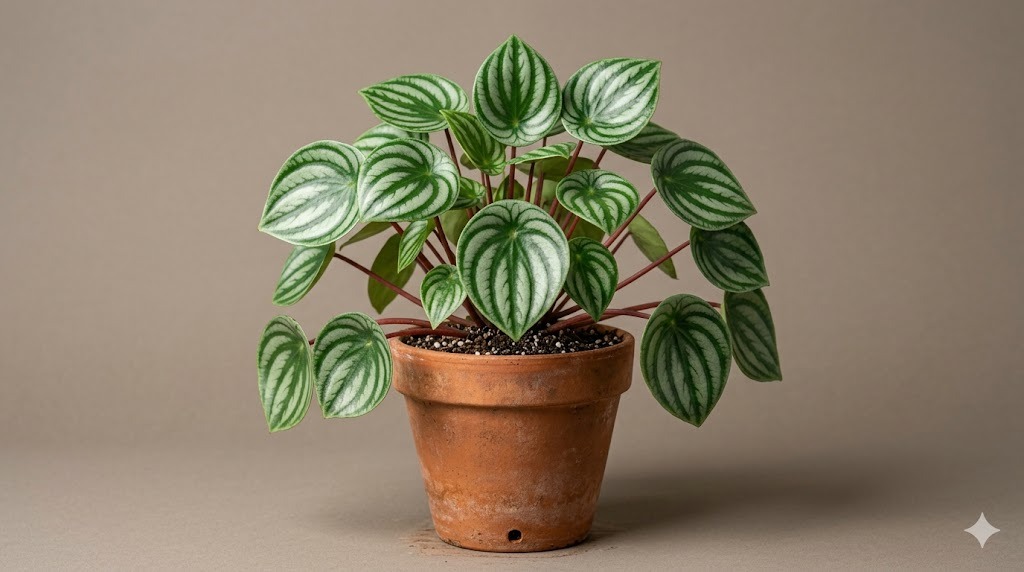
Overview
The Watermelon Peperomia - Peperomia argyreia - is a small, compact South American houseplant grown almost entirely for its remarkable leaves. Each rounded, teardrop leaf is striped in bands of silver and dark green that look uncannily like the rind of a watermelon, and the leaves sit on slender reddish stems that set the pattern off perfectly. It is a tidy tabletop plant rather than a sprawling one, which makes it ideal for a desk, a windowsill, or a shelf where you can actually see the markings up close. It suits anyone who wants something striking and unusual without committing to a large floor plant. Be honest with yourself before you buy, but the honest news here is good: this is an easy, forgiving plant. Its thick, semi-succulent leaves store water, so the single most important thing is simply not to overwater it. Get that right and it asks for very little.
Origin & Natural Habitat
Peperomia argyreia is native to the tropical rainforests of South America, particularly Brazil and the surrounding region. In the wild it grows on the shaded forest floor and among leaf litter, sheltered beneath the canopy rather than out in the open, which is exactly why it prefers bright but indirect light at home rather than harsh sun. It belongs to the Piperaceae family, the pepper family, making it a distant relative of the black pepper vine - and there are over a thousand Peperomia species, so it has a great many cousins. The botanical name carries a quiet clue. Argyreia comes from the Greek "argyros," meaning silver, a direct nod to the bright silvery bands that streak across its leaves. Despite the common name, it is not related to the watermelon at all - the resemblance is pure coincidence of pattern, and it is simply how the markings happened to turn out.
Appearance
Picture a low, rounded mound of leaves rather than a tall plant. Each leaf is broadly oval to teardrop-shaped, smooth and slightly fleshy, and carries that signature pattern: arcing bands of silver radiating out over a dark green base, fanning from the point where the leaf meets its stem. Turn a leaf over and the underside is often flushed reddish, and the stems themselves are a distinct red, which is part of the plant's charm and a useful way to tell it apart from look-alikes. The whole plant grows in a clumping rosette form, sending up new leaves on their own stalks from the base.
- Leaves: rounded, teardrop-shaped, smooth and semi-succulent, striped with silver and dark green like a watermelon rind.
- Stems: slender and red, holding each leaf up on its own stalk and giving the plant much of its character.
- Growth habit: a compact, clumping rosette that mounds up from the base rather than trailing or climbing.
- Flowers: insignificant - thin greenish-white spikes that look more like rat-tails than blooms, and are not the reason anyone grows it.
Indoors it stays small and well-behaved, typically reaching only around 15-30 cm tall, which is exactly why it is such a good tabletop and desk plant.
Why People Love It - Qualities & Benefits
- Striking patterned leaves: the watermelon-rind markings are the headline reason to grow it - few houseplants this size look this distinctive.
- Compact and tidy: it stays small and rounded, so it fits on a desk, a shelf, or a crowded windowsill without taking over.
- Pet-safe and non-toxic: Peperomias are listed as non-toxic to cats and dogs, a real reassurance in homes with curious animals.
- Easy and forgiving: the semi-succulent leaves store water, so it tolerates a missed watering far better than it tolerates being kept soggy - a low-stress plant for beginners.
- Easy to propagate: you can grow whole new plants from a single leaf, which makes it satisfying and cheap to multiply.
- Atmosphere: like most leafy houseplants it adds a little life and greenery to a room. (The popular "air-purifying" claims are real but modest in a normal home; the bigger benefit is psychological, since greenery measurably lifts mood and lowers stress.)
Care
Light
Bright, indirect light is ideal, and it brings out the strongest contrast in those silver-and-green markings. A spot near an east or north window, or set back from a brighter south or west window, suits it perfectly. It will tolerate medium light, but in a dim corner the leaves grow smaller, the stems stretch and lean toward the light, and the pattern fades. Avoid harsh direct midday sun, which scorches the leaves and can bleach the colour out of them. Remember it evolved on a shaded forest floor - it wants brightness without being blasted.
Watering
This is the one thing that matters most. The thick, semi-succulent leaves store water, so let the top 2-3 cm of soil dry out fully between waterings - and in practice, let it lean toward the drier side. This plant is far more likely to die from overwatering than from neglect. Soggy soil quickly leads to root rot and to the limp, mushy stems that are the classic sign a Peperomia has been kept too wet. When you do water, water thoroughly until it drains through, then empty the saucer so the roots never sit in standing water. Cut back further in winter, when growth slows. If in doubt, wait a day - this is a plant that prefers to be slightly too dry rather than slightly too wet.
Soil & Potting
Use a light, well-draining, airy mix - a standard houseplant or peat-based mix loosened with plenty of perlite, and a little orchid bark, works well. Good drainage is everything for this plant: the roots are fine and dislike sitting in dense, waterlogged soil. Always plant into a container with drainage holes.
Humidity & Temperature
It appreciates moderate to higher humidity, around 40-50% or more, but it is reasonably tolerant of average room humidity thanks to those moisture-holding leaves, so you usually do not need to fuss. A pebble tray or a nearby humidifier helps in very dry, heated rooms. It is happiest warm, around 18-26 C, and dislikes cold drafts and sudden chills - keep it away from drafty doors, cold windowpanes, and air-conditioning vents.
Feeding
Feed lightly. A balanced liquid fertilizer at half strength, roughly once a month through spring and summer, is plenty. Peperomias are light feeders and are easily overdone, so go gently and stop feeding altogether in autumn and winter while growth has slowed.
Repotting
Repot infrequently. This is a small plant with a modest root system that is quite happy being a little snug, so only move it up when it is genuinely crowded - usually every couple of years at most. When you do, choose a pot only one size larger; an oversized pot holds too much wet soil around the small roots and invites rot. Spring is the best time.
Keeping the markings strong - it's mostly about light
The patterned leaves are the whole point of this plant, so it is worth knowing how to keep them at their best. The contrast between the silver and green is driven chiefly by light: in good bright indirect light the bands stay crisp and the leaves grow to full size, while in a dim spot the colour dulls and the plant stretches. If your Watermelon Peperomia starts looking pale, leggy, or small-leaved, the answer is almost always more (indirect) light. Rotate the pot every week or two so it grows evenly and does not lean, and pinch off any tired or yellowing leaves at the base to keep the clump looking fresh and full.
Propagation
The Watermelon Peperomia is easy and genuinely fun to propagate, and the leaf-cutting method is the satisfying one. Take a healthy leaf with a bit of its stem (the petiole) attached, and either set the cut end in a glass of water or press it into a moist, well-draining mix. You can even cut a leaf in half across its width and lay the cut edges on damp soil. From the cut point, tiny new plantlets will slowly emerge over several weeks to a couple of months. It does take patience - this is not an overnight process - but watching a whole new plant form from a single leaf is one of the great small pleasures of growing Peperomias. Keep the cuttings warm and in bright indirect light while they root.
Common Problems & Pests
- Limp, wilting, or mushy stems: the most common complaint, and almost always overwatering and the onset of root or stem rot - let the soil dry out much more and check the roots.
- Yellowing leaves: usually a sign of soggy soil and overwatering; occasionally underwatering, so check which by feeling the soil before acting.
- Drooping leaves: can mean either extreme - too wet or bone dry - so always check the soil rather than assuming it is thirsty.
- Faded markings, leggy growth, small leaves: too little light; move it to a brighter (but still indirect) spot.
- Brown, crispy leaf edges: typically very dry air or, sometimes, sun scorch from harsh direct light.
- Curling or scorched leaves: usually too much direct sun - pull it back from the window.
- Pests: watch for mealybugs (white cottony spots in the leaf joints), spider mites, and fungus gnats, the last of which thrive in soil kept too wet. Isolate the plant and treat with insecticidal soap or neem oil, and let the soil dry to deter gnats.
Toxicity & Safety
Non-toxic and pet-safe. The Watermelon Peperomia (Peperomia argyreia), like other Peperomias, is listed as non-toxic to cats, dogs, and humans, which makes it a genuinely reassuring choice for homes with curious pets and small children. This is a care note rather than an invitation to eat it - it is an ornamental plant, not food - but a nibbling cat or dog will not be poisoned by it, and that peace of mind is one of its quiet strengths.
Pros & Cons
Pros
- Striking watermelon-patterned leaves on a small, tidy plant.
- Non-toxic and pet-safe for homes with animals and children.
- Compact size that fits a desk, shelf, or windowsill.
- Easy and forgiving - hard to kill as long as you do not overwater.
- Fun and rewarding to propagate from a single leaf.
Cons
- Very sensitive to overwatering and prone to rot if kept soggy.
- Markings fade and growth gets leggy in low light.
- Flowers are insignificant - this is a foliage plant only.
- Leaf propagation is slow and needs patience.
- Dislikes cold drafts and sudden temperature swings.
Best Suited For
- People who want a distinctive, decorative foliage plant that stays small.
- Beginners looking for an easy, forgiving plant - provided they go easy on the watering.
- Desks, shelves, and bright windowsills where the leaf pattern can be seen up close.
- Homes with curious pets, thanks to its non-toxic status.
Not ideal for dark corners, anyone with a heavy hand on the watering can, or those who want big showy flowers rather than patterned leaves.
FAQ
Why is my Watermelon Peperomia drooping or going limp? Most often overwatering. The thick leaves store water, so soggy soil quickly causes limp, mushy stems and root rot. Let the soil dry out well, check that the roots are firm and not brown, and water less often. Drooping can occasionally mean it is bone dry, so always feel the soil first.
Is the Watermelon Peperomia safe for cats and dogs? Yes. Peperomia argyreia is listed as non-toxic to cats and dogs, so it is a safe choice for pet households - though it is still an ornamental plant, not something to be eaten.
How often should I water it? Less than you think. Let the top 2-3 cm of soil dry out fully, and lean toward the drier side, then water thoroughly and empty the saucer. Water even less in winter. When in doubt, wait - it far prefers being slightly too dry to being too wet.
Why are the silver markings fading or the plant looking leggy? Too little light. The contrast in the leaves and the compact shape both depend on bright indirect light. Move it somewhere brighter (but out of harsh direct sun) and rotate the pot regularly so it grows evenly.
Can I grow a new plant from a single leaf? Yes - that is the classic way to propagate it. Set a leaf with a bit of stem in water or moist soil, or lay a halved leaf cut-side down on damp mix, keep it warm and bright, and small plantlets will form over several weeks. It is slow, but it works.