Pampas Grass (Cortaderia selloana)
Pampas grass is one of the most dramatic ornamental grasses you can grow - a huge clump of arching foliage topped with towering, feathery plumes that can reach 2-3 m or more.
🗓️ Last reviewed: July 2026
Overview
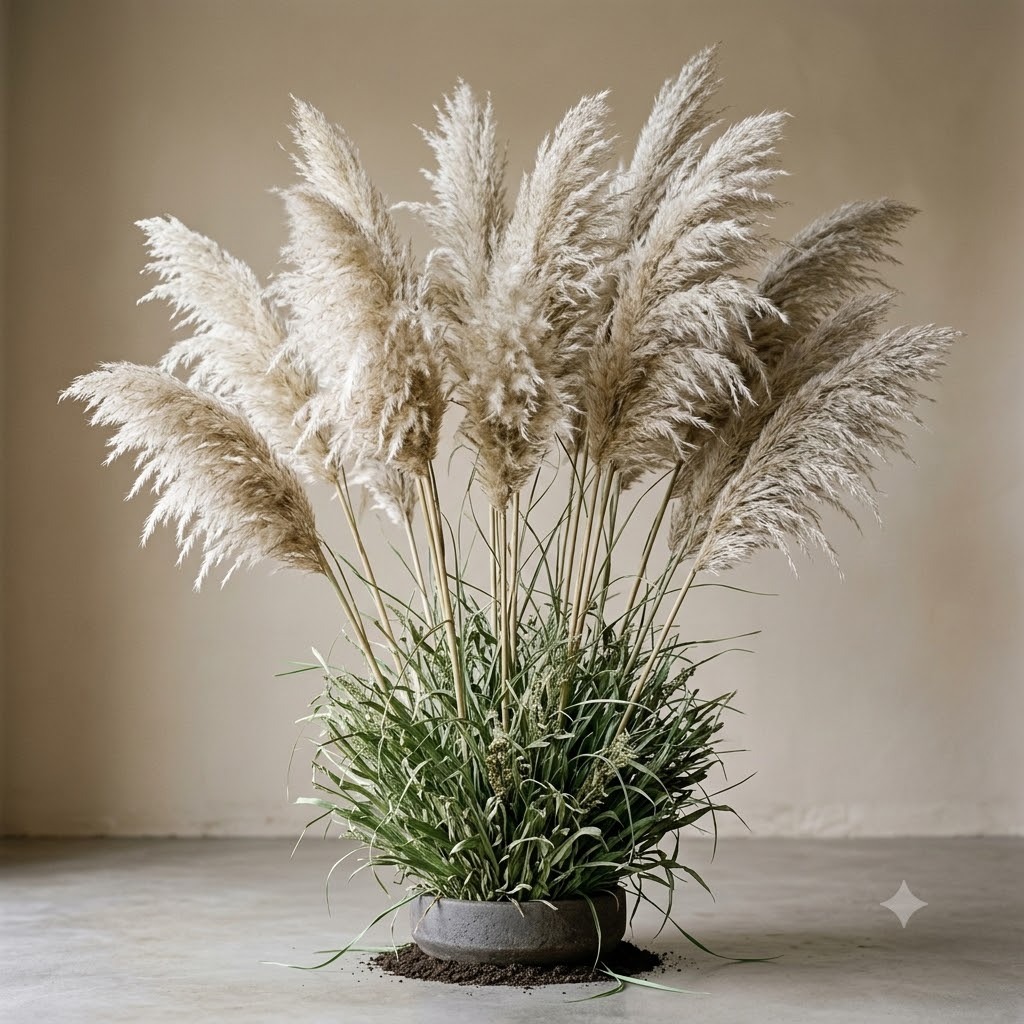
Pampas grass is one of the most dramatic ornamental grasses you can grow - a huge clump of arching foliage topped with towering, feathery plumes that can reach 2-3 m or more. In late summer and autumn those silvery-cream or pink plumes catch the light and sway in the wind, giving instant impact and a fashionable, architectural look. But pampas grass comes with two serious honest warnings: it is invasive in many regions, self-seeding aggressively into the wild, and its leaves have razor-sharp edges that can cut skin. It is a striking plant, but one to choose carefully and responsibly.
Origin & Natural Habitat
Pampas grass (Cortaderia selloana) is native to South America - the grasslands, or pampas, of Argentina, Brazil, and Chile, where it grows in open, sunny plains and damp ground. Its natural vigor and prolific seed production, which serve it well in the wild, are exactly what make it problematic when planted in other parts of the world. In many warm-temperate regions - including parts of the United States, Australia, New Zealand, South Africa, and southern Europe - it has escaped gardens and become a serious invasive weed, and its sale is restricted or banned in some places.
Appearance
Pampas grass forms a large, dense, fountain-like clump of long, narrow, arching leaves, typically blue-green to grey-green, with finely toothed, sharp cutting edges. In late summer and autumn it sends up tall, stiff flowering stems bearing large, plume-like flower heads - soft, feathery, and showy - in silvery white, cream, or shades of pink. These plumes persist into winter and are sometimes dried for indoor arrangements. Female plants produce the fullest, showiest plumes. A mature clump can be enormous - often 2-3 m tall and wide, with plumes rising well above the foliage.
Why People Grow It - Qualities & Benefits
- Dramatic plumes: tall, feathery flower heads with huge visual impact.
- Architectural presence: a bold focal point and screen.
- Autumn and winter interest: plumes last well into the colder months.
- Movement and light: foliage and plumes catch the wind and the low sun.
- Dried arrangements: plumes are popular cut and dried for the home.
- Fast, large screening: provides quick bulk and privacy in a sunny spot.
Care
Light & Position
Pampas grass needs full sun to look its best and flower well. Give it a large, open position with room to reach its full size - it is not a plant for a small border. Because of its sharp leaves, site it well away from paths, seating, and areas where children and pets play.
Soil
It is adaptable and tolerates a wide range of soils, but prefers fertile, moist but well-drained ground. It copes with poorer soils once established and is fairly drought-tolerant when mature, though it grows most lushly with reasonable moisture.
Watering
Water regularly while the clump establishes in its first year. Once established, mature pampas grass is quite drought-tolerant and generally needs little supplementary watering except in prolonged dry spells.
Feeding
Pampas grass is not a demanding feeder. On poor soils a light feed in spring can boost growth, but overfeeding is unnecessary and can encourage floppy foliage. A generally fertile soil is enough.
Pruning
Cut the whole clump back hard in late winter or early spring, before new growth begins, removing the old dead foliage and spent plumes to make way for fresh growth. Always wear thick gloves, long sleeves, and eye protection - the leaf edges are sharp enough to cause nasty cuts. Some gardeners burn off old growth in suitable conditions, but cutting back is safer and more controlled.
Hardiness & Winter Care
Pampas grass is reasonably hardy in temperate climates, though very cold or wet winters can damage or kill it, especially young plants. In colder areas it can help to tie the foliage up and leave the old growth in place over winter for protection, cutting back in spring instead. The plant is evergreen to semi-evergreen in mild climates.
Planting & Propagation
Plant pampas grass in spring so it has a full season to establish before winter, giving it plenty of space. It is propagated mainly by division of established clumps in spring - a heavy job, again requiring gloves and protection because of the sharp leaves. It also grows readily from seed, but this is exactly the trait that makes it invasive, so seed-raising and allowing self-seeding should be avoided where the plant is a known weed. Choosing sterile or non-seeding cultivars, where available and permitted, reduces the invasive risk.
Common Problems & Pests
- Invasiveness: the most serious issue - it self-seeds aggressively and has become a banned or restricted weed in many regions. Check whether it is legal and appropriate to plant in your area before buying.
- Sharp leaves: the edges cut skin easily; a genuine safety hazard near paths, children, and pets.
- Winter losses: young or poorly drained plants can die in cold, wet winters.
- Overgrowth: clumps can become very large and difficult to manage or remove.
- Few pests: pampas grass is largely untroubled by pests and diseases.
Its problems are more about behavior and safety than pests.
Toxicity & Safety
Not considered chemically toxic to cats, dogs, or humans. Pampas grass is not listed as a poisonous plant, and eating it is not a recognized poisoning risk. The real safety concern is physical: the leaf edges are sharp and can cause cuts to skin, and the fine plume fragments can be an irritant. Handle it with thick gloves and protective clothing, and keep the clump away from areas used by children and pets.
Pros & Cons
Pros
- Dramatic, showy plumes with big impact.
- Bold architectural focal point and screen.
- Autumn and winter interest; dried plumes for indoors.
- Adaptable and drought-tolerant once established.
- Largely pest-free.
Cons
- Invasive in many regions - sometimes banned or restricted.
- Sharp leaf edges are a genuine cutting hazard.
- Very large - unsuitable for small gardens.
- Hard, careful cutting back needed each year.
- Difficult to remove once well established.
Best Suited For
- Large, open, sunny gardens with room to spare.
- Bold focal points, screening, and modern planting schemes.
- Regions where it is not classed as invasive.
- Positions well away from paths, seating, and play areas.
- Gardeners willing to manage its size and cut it back safely.
Not ideal for small gardens, family areas near the clump, or any region where pampas grass is a known invasive weed.
FAQ
Is pampas grass invasive? Yes - in many warm-temperate regions it self-seeds aggressively and has escaped into the wild, becoming a serious invasive weed, and its sale is restricted or banned in some places. Always check whether it is legal and appropriate in your area, and avoid letting it self-seed. Sterile or non-seeding cultivars, where available, reduce the risk.
Are the leaves really dangerous? The leaf edges are finely toothed and sharp enough to cut skin. Always wear thick gloves, long sleeves, and eye protection when handling or cutting it back, and plant it away from paths, seating, and where children and pets play.
How and when do I cut pampas grass back? Cut the whole clump back hard in late winter or early spring, before new growth starts, removing old dead leaves and spent plumes. Wear protective clothing because of the sharp foliage.
Is pampas grass toxic to pets? It is not considered chemically poisonous to cats or dogs, but the sharp leaves can cut, so it is best kept away from areas where pets play.
How big does pampas grass get? A mature clump is large - commonly 2-3 m tall and wide, with plumes rising well above the foliage. It needs a big, open space and is not suited to small gardens.