How to Divide Perennials
The short answer: divide a perennial when it shows it needs it, in spring or autumn while it is not flowering, and replant the pieces straight away. The timing, the technique and the plants that are best left alone, following the RHS and university extension advice.
The short answer: dividing a perennial means lifting the clump, splitting it into pieces that each carry roots and shoots, and getting those pieces back in the ground fast. The Royal Horticultural Society says division is most successful when plants are not in active growth, and Penn State Extension’s Master Gardeners say to divide perennials when they are growing but not blooming. Most summer-flowering perennials are divided in spring or autumn; many spring-flowering plants, such as irises, are best divided in summer after flowering.
Get the season right, keep the pieces big enough and keep them watered, and the rest is forgiving.
Why bother dividing at all
The RHS says most perennials benefit from division every two to three years to keep them healthy and vigorous; the University of Illinois Extension notes there is no set rule, with some needing it every three to five years, some every eight to ten, and some that would rather not be disturbed at all. Either way, you end up with free plants.
The University of Illinois lists the signs a clump is ready:
- Fewer and smaller flowers
- A dead centre with all the growth around the edges
- Loss of vigour
- Stems that flop or open up and need staking
- A clump that has outgrown its space
These are the signs to look for, the University of Illinois says, not a date on the calendar.
Timing, by flowering season
- Summer-flowering plants - the RHS says to divide them in spring (March-May) or autumn (September-November), when the soil is dry enough to work. In a wet autumn, wait until spring. Spring also suits plants that are slightly tender.
- Spring- and early summer-flowering plants - Penn State suggests late summer to early autumn; the RHS says many spring-flowering plants, such as irises, are best divided in summer (June-August) after flowering, when they produce new roots.
- Midsummer to autumn bloomers - Penn State suggests early spring.
- Autumn division - the University of Illinois says autumn divisions are best done in September and October so the roots have time to establish before winter. Penn State notes that autumn planting lets plants establish while the soil is still warm enough for root growth, and that spring planting is better for perennials that are not fully hardy or dislike wet winters.
Specific plants, according to these sources: hostas in spring or late autumn (RHS); daylilies in spring or early autumn, and iris after flowering in July or August (Penn State); and the University of Illinois lists oriental poppy, peony and iris among the perennials to divide in late summer to very early autumn.
The plants that are best left alone
- Peony. The University of Illinois lists it among the perennials to divide in autumn, and notes each piece needs at least three eyes to flower the next season. See the peony profile for planting depth.
- Taprooted plants. The University of Illinois notes that some perennials do not need dividing at all, such as butterfly weed with its taproot, and baby’s breath.
- Plants that sulk. The RHS notes that dieramas resent disturbance and take time to flower again after division, and that crocosmias flower best when crowded, so every two or three years is enough for them.
The technique
- Make sure the ground is moist. The University of Illinois says this makes digging easier and is less stressful for the plant.
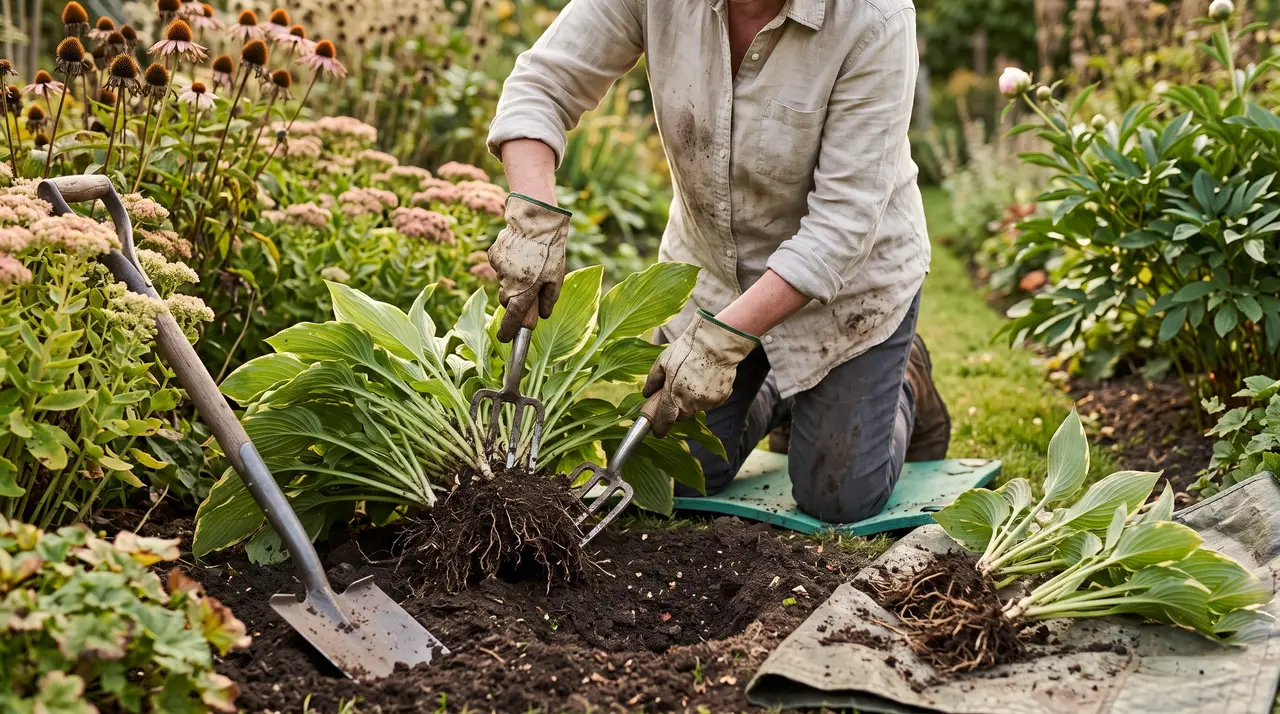
- Lift the clump. The RHS suggests lifting gently with a garden fork, working outwards from the centre of the crown to limit root damage, then shaking off the soil so the roots are visible. The University of Illinois suggests digging at least 7 inches (about 18cm) deep to get most of the root ball.
- Split it to suit the roots (RHS):
- Plants that make separate plantlets, such as bugle, can be teased apart and replanted.
- Small fibrous-rooted plants such as heuchera, hosta and epimedium can be pulled apart gently.
- Large fibrous clumps such as daylily need two garden forks pushed into the crown back to back and used as levers; sometimes a sharp knife, axe or lawn edging iron is needed.
- Woody crowns (hellebores) and fleshy roots (delphiniums) need cutting with a spade or knife.
- Keep good pieces. The RHS aims for three to five healthy shoots per piece, and the University of Illinois for three to five growing points. Discard the old, dead centre and trim off damaged roots. Penn State warns against very small pieces, which need several years to mature.
- Trim leafy divisions. If the plants already have full stems and leaves, Penn State suggests removing half to two-thirds of the foliage before replanting, because the reduced roots cannot replace the water lost through all those leaves.
- Replant straight away and water in well (RHS). The RHS plants hosta divisions at their original depth with the shoots above the soil; Penn State suggests setting divisions slightly higher so they can settle, and barely covering iris rhizomes.
- Keep them from drying out while they re-establish (RHS).
If the pieces cannot go back in the ground straight away, keep them moist and shaded from hot sun and drying winds (Penn State, University of Illinois). The RHS also suggests potting divisions up in peat-free multipurpose compost to build up size, overwintering the pots somewhere frost-free.
What happens afterwards
The RHS notes there are few specific problems with dividing, especially between autumn and spring, as long as the plants don’t dry out while they re-establish. Penn State notes that some divisions, such as asters, become mature flowering plants in one season, while small pieces take years. Autumn divisions benefit from soil that drains through winter, so if your bed is heavy, this is a good moment to work on it: our guide to improving garden soil covers what helps. If you are deciding where to put the new plants, the year-round perennial colour guide is a good place to plan from.
In short
Divide when the plant shows it needs it, in spring or autumn while it is not flowering, keep three to five shoots per piece, replant straight away and keep the divisions watered. A tired clump becomes several good plants, at the cost of an afternoon.
Sources
- Royal Horticultural Society, Perennials: dividing for vigour. Read 28 October 2026.
- University of Illinois Extension, Dividing Perennials and the blog post Divide and Conquer in Fall. Read 28 October 2026.
- Penn State Extension, Master Gardeners of Chester County, Dividing Perennials. Read 28 October 2026.
Recommended Gear on Amazon
- Garden fork - browse current options and reviews on Amazon.
- Border spade - browse current options and reviews on Amazon.
- Hori hori knife - browse current options and reviews on Amazon.
As an Amazon Associate, we earn from qualifying purchases - at no extra cost to you. This helps us keep producing free, in-depth guides.