Russian Sage (Salvia yangii)
Russian Sage is one of the most rewarding plants for a hot, sunny, low-maintenance garden - a billowing cloud of silvery foliage topped with airy spires of lavender-blue flowers all through high summer and into autumn.
🗓️ Last reviewed: June 2026
Overview
Russian Sage is one of the most rewarding plants for a hot, sunny, low-maintenance garden - a billowing cloud of silvery foliage topped with airy spires of lavender-blue flowers all through high summer and into autumn. Despite its common name, it is neither Russian nor a true culinary sage; it is a woody-based perennial (subshrub) prized for its haze of small flowers, its aromatic silver leaves, and above all its toughness. It shrugs off heat, drought, and poor soil, asking for almost nothing in return, while drawing in clouds of bees and butterflies. For anyone wanting a long-flowering, drought-tolerant, structural plant that looks effortless, Russian sage is hard to beat.
Origin & Natural Habitat
Russian sage, recently reclassified from Perovskia atriplicifolia to Salvia yangii, is native to the dry steppes, rocky hillsides, and open grasslands of central and southwestern Asia, including Afghanistan, Pakistan, and the surrounding regions. It is a plant of harsh, sun-baked, free-draining environments with hot summers and cold winters. This origin is the key to everything about it: it expects blazing sun, lean and gritty soil, sharp drainage, and very little water, and it actively dislikes the rich, moist, sheltered conditions that many other garden plants enjoy.
Appearance
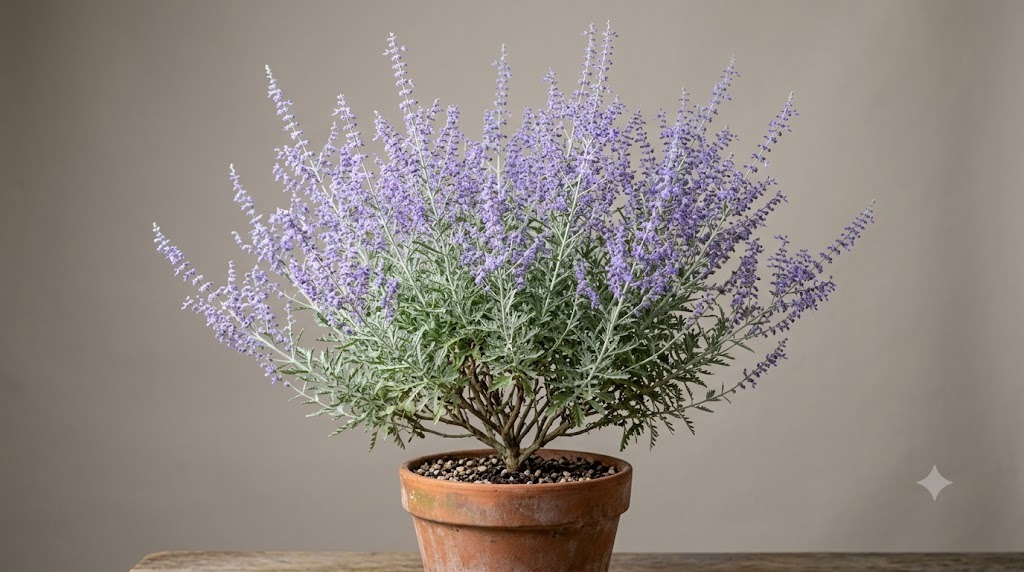
Russian sage forms an upright, airy, somewhat sprawling mound of woody-based stems clothed in finely divided, silvery-grey, aromatic leaves that release a sage-like scent when brushed. From midsummer onward the plant is topped by long, slender, branching spikes densely set with tiny tubular lavender-blue to violet flowers, held on pale silvery stems. The overall effect is a soft, smoky, see-through haze of blue and silver. Plants typically reach 0.9 to 1.2 m tall and about as wide, though there are more compact varieties. The combination of silver foliage and hovering blue flowers gives it a luminous, almost shimmering quality in the border.
Why People Grow It - Qualities & Benefits
- Exceptional drought tolerance: thrives in heat and dry soil once established.
- Long flowering season: airy blue spires from midsummer well into autumn.
- Silver aromatic foliage: attractive all season and pleasantly scented.
- Low maintenance: tough, undemanding, and largely pest- and disease-free.
- Pollinator magnet: alive with bees and butterflies for months.
- Structural and airy: adds height and a soft, see-through texture to borders.
Care
Light & Position
Russian sage demands full sun - the more, the better. It needs at least six hours of direct sun and flowers best and stands sturdiest in a hot, open, baking position. In shade it grows weak, flops badly, and flowers poorly. It is an excellent choice for the hottest, driest, most exposed spots in the garden where other plants struggle.
Soil
This plant insists on well-drained, even poor, soil. It thrives in lean, sandy, gritty, or stony ground and actively dislikes rich, heavy, or wet soil, which causes it to flop and rot. There is no need to improve the soil; in fact, overly fertile conditions produce weak, sprawling growth. Sharp drainage, especially in winter, is the single most important factor in keeping it healthy.
Watering
Russian sage is highly drought-tolerant once established and needs very little watering. Water new plants in their first season to help them root, then leave them largely to fend for themselves - established plants rarely need watering except in prolonged drought. Overwatering is far more dangerous than underwatering, leading to floppy growth and root rot.
Feeding
This is a plant that wants no feeding at all. It evolved in lean soils and performs best without fertilizer; feeding produces soft, weak, floppy growth and fewer flowers. Skip the feed and skip the rich mulch - poor, hungry soil is exactly what it wants.
Pruning
The key task is a hard prune in spring. Because it is a woody-based subshrub, cut the stems back hard in early spring, to about 15 to 30 cm above the ground, just as new growth appears at the base. This keeps the plant compact, sturdy, and full of fresh flowering stems rather than woody, bare, and sprawling. Do not cut it back in autumn; the dried stems provide winter structure and some protection to the crown.
Hardiness & Winter Care
Russian sage is very hardy and cold-tolerant, reliable to around USDA zone 4 or 5, in keeping with its origin in regions with cold winters. The main winter risk is not cold but wet: it can rot in heavy, waterlogged soil over winter. Ensure sharp drainage, leave the old stems standing until spring for protection, and it needs little other winter care in temperate gardens.
Planting & Propagation
Plant Russian sage in spring or early autumn in a hot, well-drained spot, taking care not to enrich the planting hole. Once settled it needs little attention. It can be propagated from softwood cuttings taken in late spring or early summer, which root readily, and established clumps sometimes produce suckers or rooted sideshoots that can be detached. It does not transplant or divide as cleanly as fibrous-rooted perennials, so cuttings are the most reliable way to make new plants.
Common Problems & Pests
- Flopping and sprawling: the most common complaint, almost always caused by too much shade, too-rich soil, overwatering, or skipping the spring prune.
- Root rot: in heavy, wet, or poorly drained soil, especially over winter - sharp drainage is the cure.
- Powdery mildew: occasionally in humid, crowded, or shaded conditions, but uncommon in its preferred sunny, airy spot.
- Few pests: the aromatic foliage is largely ignored by pests, and it is notably resistant to deer and rabbits.
Almost every problem traces back to conditions that are too rich, too wet, or too shady.
Toxicity & Safety
Generally considered non-toxic and low-risk to cats, dogs, and humans. Russian sage is not listed among the seriously poisonous garden plants and is widely grown in family and pet-friendly gardens. Its strongly aromatic foliage makes it unappealing to nibble, and it is rarely browsed by pets, deer, or rabbits. As with any ornamental, it is not intended for eating, and despite the name it is not the culinary sage used in cooking.
Pros & Cons
Pros
- Outstanding heat and drought tolerance.
- Very long flowering season of airy blue spires.
- Attractive silver, aromatic foliage.
- Extremely low maintenance and pest-resistant.
- A magnet for bees and butterflies; deer- and rabbit-resistant.
Cons
- Needs full sun and sharp drainage - no compromise.
- Flops in shade, rich soil, or if not pruned in spring.
- Dislikes wet winters and heavy soil.
- Can be slow to emerge in spring.
- May spread by suckers in ideal conditions.
Best Suited For
- Hot, dry, sunny borders and gravel gardens.
- Mediterranean-style and xeriscape (low-water) planting.
- Pollinator and wildlife gardens.
- Exposed, free-draining, poor-soil sites where little else thrives.
- Adding airy height and silver-blue color to mixed borders.
Not ideal for shady gardens, rich or heavy moist soils, or anyone wanting a tidy, non-sprawling plant without an annual prune.
FAQ
Why is my Russian sage flopping over? Flopping is the classic Russian sage problem, and it nearly always comes down to conditions that are too easy. Too much shade, soil that is too rich, too much water, or skipping the hard spring prune all cause weak, sprawling growth. Give it full sun, lean well-drained soil, little water, and a hard cut-back each spring, and it stands up sturdy.
Do I need to feed and water Russian sage? Almost never. This is a plant that thrives on neglect. It wants no fertilizer - feeding makes it floppy - and very little water once established. Water new plants their first season, then leave them be. Overfeeding and overwatering are the main ways people weaken it.
When and how do I prune Russian sage? Prune hard in early spring, not autumn. As new growth appears at the base, cut the woody stems back to about six inches to a foot above the ground. This keeps it compact and full of fresh flowering stems. Leave the old stems standing over winter for structure and crown protection.
Is Russian sage safe for pets? Yes, it is generally considered non-toxic and low-risk for cats and dogs, and its strongly aromatic foliage makes pets unlikely to eat it. It is also notably resistant to browsing by deer and rabbits. Despite the name, it is not the culinary sage used in cooking.
Does Russian sage really attract pollinators? Very much so. Its long season of airy lavender-blue flowers is alive with bees and butterflies for months, making it one of the best low-maintenance pollinator plants for a hot, sunny garden.