Star Jasmine (Trachelospermum jasminoides)
Star Jasmine is one of the most rewarding evergreen climbers you can grow - glossy, self-clinging foliage all year and a summer show of small, pure-white, pinwheel-shaped flowers that pump out an intense, sweet fragrance on warm evenings.
🗓️ Last reviewed: July 2026
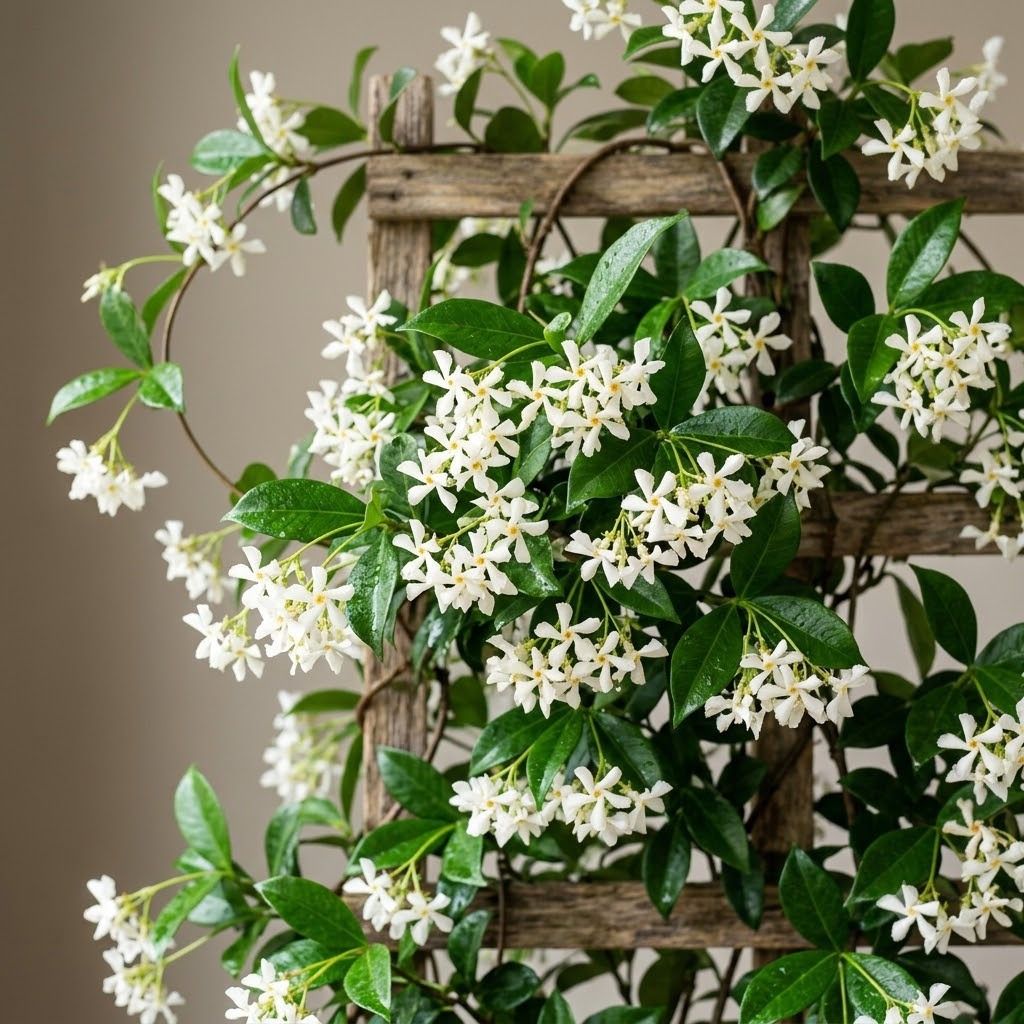
Overview
Star Jasmine is one of the most rewarding evergreen climbers you can grow - glossy, self-clinging foliage all year and a summer show of small, pure-white, pinwheel-shaped flowers that pump out an intense, sweet fragrance on warm evenings. Despite the name, it is not a true jasmine at all; it belongs to a different plant family, but it shares that same heady, romantic scent. Grown up a sunny sheltered wall, over an arch, or along a fence, it is neat, well-behaved, and long-lived. Give it warmth and shelter and it will perfume a whole patio or doorway through the height of summer.
Origin & Natural Habitat
Star Jasmine is native to eastern and southeastern Asia, including China, Japan, Korea, and Vietnam, where it scrambles through woodland edges, over rocks, and up trees and shrubs in warm-temperate to subtropical conditions. In the wild it is a twining, spreading evergreen that enjoys dappled sun and mild winters. Understanding this background explains its garden needs: it loves warmth and sun, appreciates a little shelter from harsh cold and drying wind, and, being naturally a climber of woodland margins, it tolerates some shade while flowering best in good light.
Appearance
Star Jasmine is a woody, twining evergreen climber, typically reaching around 3 to 6 metres over time, though it is easily kept smaller. The leaves are oval, leathery, and glossy deep green, often taking on bronze or reddish tints in cold weather, giving good structure all year. In mid to late summer it produces clusters of small white flowers, each with five petals arranged in a spiralling pinwheel or star shape - hence the common name. The scent is the real attraction: sweet, jasmine-like, and remarkably powerful, carrying well on warm still air. Stems exude a milky sap when cut. It climbs by twining rather than by tendrils, so it needs wires or a trellis to wrap around, especially when young.
Why People Grow It - Qualities & Benefits
- Intense fragrance: the summer scent is one of the strongest and sweetest of any garden climber.
- Evergreen cover: glossy foliage clothes a wall or fence all year, unlike deciduous climbers.
- Neat and manageable: less rampant than many climbers, easy to keep in bounds.
- Attractive flowers: clean white pinwheel blooms over a long summer season.
- Versatile: ideal for walls, fences, arches, pergolas, obelisks, and large containers.
- Long-lived: a well-sited plant becomes a permanent, low-fuss feature.
Care
Light & Position
Star Jasmine flowers best in full sun to light part shade. A warm, sheltered, sunny wall - especially one that catches the sun and holds warmth - is ideal, and it encourages the heaviest flowering and fragrance. Shelter from cold, drying winds is important, particularly in colder gardens, as this is a plant that appreciates a protected, mild spot.
Soil
It wants moist but well-drained soil, enriched with organic matter. It is not fussy about soil type as long as it does not sit waterlogged in winter, which it dislikes. In containers, use a good-quality, free-draining compost.
Watering
Water regularly while establishing, and during dry spells in summer, keeping the root zone from drying out completely. Once established in the ground it is reasonably drought-tolerant, but container-grown plants need steady watering as they dry out much faster.
Feeding
Feed in spring with a balanced fertiliser to support growth and flowering, and mulch the base with compost to conserve moisture and feed the soil. Container plants benefit from regular liquid feeding through the growing season.
Pruning
Prune lightly after flowering to tidy the plant, control size, and remove any weak, dead, or wayward stems. It responds well to trimming and can be kept neat against a wall. Tie in and guide young stems onto their support until the plant is well established and twining freely.
Hardiness & Winter Care
Star Jasmine is fairly hardy in mild and temperate gardens but is not reliably tough in very cold winters. In borderline areas, plant it in the most sheltered, warmest spot available, mulch the roots, and be prepared to protect it in hard frosts. In colder regions it is often grown in a large pot that can be moved to shelter, or against a warm wall for maximum protection.
Planting & Propagation
Plant in spring or early autumn so it can settle before extremes of heat or cold, positioning it against its support with wires or trellis in place. Space it away from the wall base slightly so rain reaches the roots. Propagate from semi-ripe cuttings taken in summer, which root fairly readily in a free-draining mix with warmth. Established plants can also be layered, pinning a low stem to the soil until it roots. Seed is possible but slow and less common for named forms.
Common Problems & Pests
- Poor flowering: usually caused by too much shade, cold exposure, or a very young plant still establishing - give it more sun and time.
- Cold damage: foliage may brown or drop in a harsh winter; often recovers with new spring growth if the roots survived.
- Yellowing leaves: can indicate waterlogged roots or a nutrient shortage.
- Scale insects and mealybugs: occasionally settle on stems and leaf joints, leaving sticky residue; wipe off or treat as needed.
- Aphids: may cluster on soft new growth; usually minor and controlled by predators.
Overall it is a healthy, trouble-free climber in a suitable spot.
Toxicity & Safety
Star Jasmine is considered mildly toxic. The stems and leaves contain a milky white sap that can cause skin irritation in sensitive people and mild stomach upset if plant parts are eaten, so it is sensible to wear gloves when pruning and to keep pets and small children from chewing the foliage. It is not among the most dangerous garden plants, but it is not edible and should not be eaten. Wash hands after handling cut stems.
Pros & Cons
Pros
- Intensely fragrant white summer flowers.
- Evergreen, glossy foliage all year round.
- Neat, manageable, and long-lived.
- Versatile on walls, arches, fences, and in pots.
- Reasonably drought-tolerant once established.
Cons
- Needs warmth and shelter; not reliably hardy in cold winters.
- Flowers best in sun - shy in deep shade.
- Milky sap is mildly irritant and it is not edible.
- Slow to get going in its first year or two.
- Needs a support to twine around.
Best Suited For
- Warm, sheltered, sunny walls and fences.
- Arches, pergolas, obelisks, and doorways where fragrance is enjoyed.
- Patios and seating areas that benefit from evening scent.
- Large containers in milder gardens or where it can be moved for winter.
- Evergreen screening on a trellis.
Not ideal for very cold, exposed gardens, or gardeners wanting an edible plant or a fast, instant screen.
FAQ
Is Star Jasmine a real jasmine? No. Despite the name and the similar sweet scent, it is not a true jasmine - it belongs to a different plant family entirely. It simply earned the common name because its white flowers smell so much like jasmine.
Why is my Star Jasmine not flowering? The most common reasons are too much shade, a cold or exposed position, or a young plant still establishing. Move it to a warmer, sunnier, sheltered spot if you can, feed it in spring, and give an establishing plant a couple of seasons to settle in.
Is Star Jasmine evergreen? Yes, in most gardens it keeps its glossy green leaves all year, often turning bronze or reddish in cold weather. In a very harsh winter it may drop some foliage but usually recovers in spring.
Is Star Jasmine safe around pets and children? It is only mildly toxic, but the milky sap can irritate skin and eating the leaves can cause mild stomach upset. Wear gloves when pruning and discourage pets and children from chewing it. It is not an edible plant.
How do I keep it under control? Prune lightly after flowering to shape it and control its size, and tie in young stems onto their support. It is far less rampant than many climbers and takes trimming well, so keeping it neat against a wall is straightforward.