Bay Bolete
The bay bolete (Imleria badia, long known as Boletus badius) is a prized wild edible found under conifers and beeches across the northern hemisphere.
🗓️ Last reviewed: July 2026
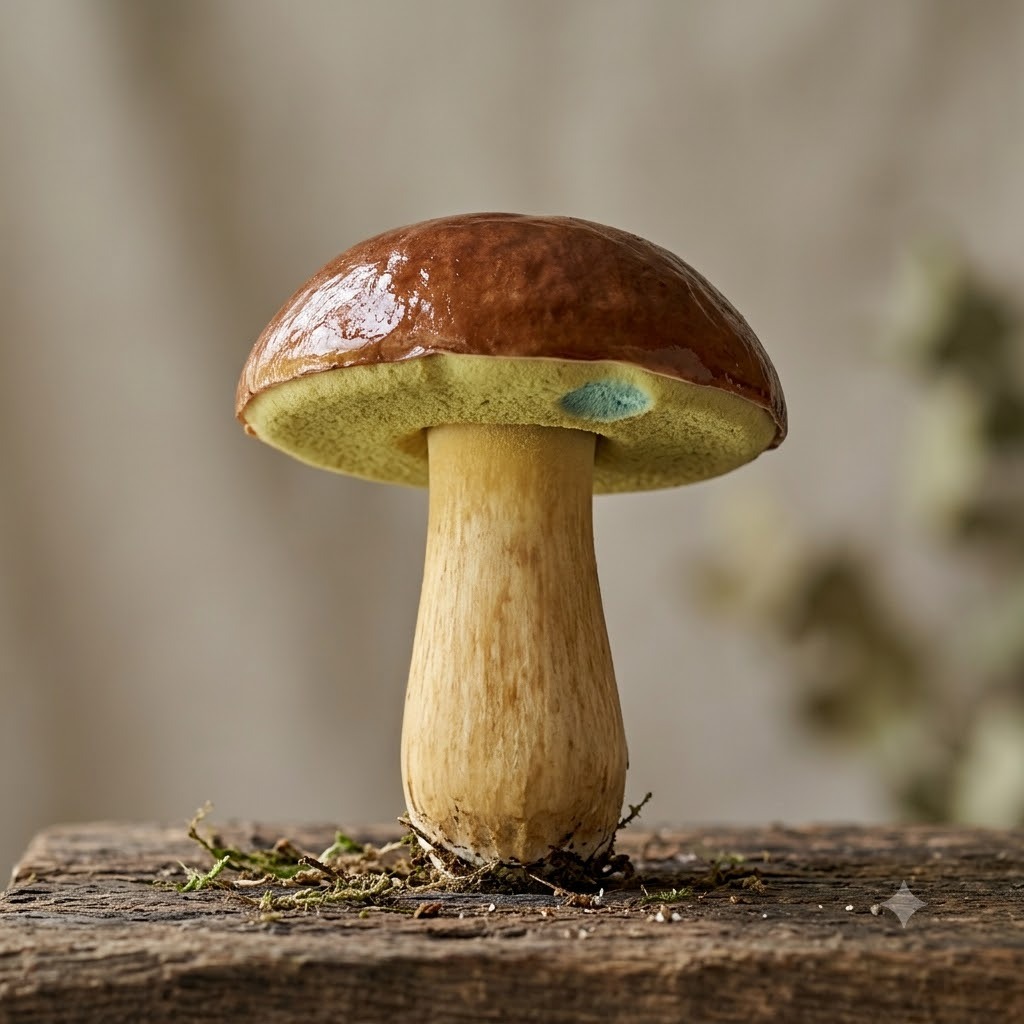
Overview
The bay bolete (Imleria badia, long known as Boletus badius) is a prized wild edible found under conifers and beeches across the northern hemisphere. It is a firm favourite among foragers because it is meaty, mild, and one of the safer boletes to learn - it has no dangerous poisonous twin in the classic sense, though it still demands the standard bolete safety checks. Its warm chestnut-brown cap and pale pores that flush blue-green when touched make it a satisfying find in autumn woods. This is a foraged mushroom, not a crop: it forms a living partnership with tree roots and cannot be grown in a kit or a bag.
Identification & Appearance
The cap is 4-15 cm across, chestnut to dark bay-brown, and slightly sticky when wet but dry and finely felted in dry weather. Underneath there are pores, not gills - they start pale cream to yellow and slowly age to dull olive. Press or bruise the pore surface and it stains a soft blue-green within seconds, then fades. The stem is slender, brownish, streaked with fine fibres, and lacks any ring or net - an important detail, since some other boletes carry a raised net pattern on the stem. The flesh is white to pale yellow and turns faintly bluish when cut. Spore print is olive-brown. Taken together, the chestnut cap, cream-to-olive pores that bruise slow blue-green, ringless fibrous stem, and mild taste form a consistent picture; no single feature confirms it alone.
Where It Grows
Bay boletes are mycorrhizal, meaning they wrap their threads around the roots of living trees and trade nutrients for sugars. They favour acidic soils under spruce, pine, and other conifers, and sometimes beech and oak. They appear from late summer through autumn, often on mossy banks, in needle litter, or on rotting stumps. They are widespread across Europe, northern Asia, and North America wherever suitable host trees grow. Because they will happily fruit on old, rotting conifer stumps as well as in the open forest floor, they are a reliable species to look for once you have found a productive patch - the same spots often produce year after year as long as the host trees remain healthy. They can appear singly or in loose scattered groups rather than tight clusters, so it pays to scan the ground carefully rather than expecting an obvious clump.
How to Grow at Home
This is the honest part: you cannot practically grow bay boletes at home. Like most boletes they are mycorrhizal and depend on a living, mature host tree - they will not fruit on straw, sawdust, or in a kit the way oyster or shiitake mushrooms do. Attempts to cultivate mycorrhizal boletes commercially have mostly failed. So the realistic path is foraging, not farming. Learn the host trees, walk the same conifer woods each autumn, and treat "growing" as encouraging habitat: protect mature conifer stands, tread lightly, and cut mushrooms rather than uprooting the soil so the underground network survives to fruit again.
Growing Conditions
Because bay boletes are wild and mycorrhizal, "growing conditions" means understanding the habitat rather than a windowsill setup.
Light
Irrelevant to the mushroom itself - the fungus lives in shade under the forest canopy. What matters is the mature host tree above it.
Watering
Bay boletes fruit after rain. A wet spell followed by mild, humid days is the classic trigger. In dry autumns they are scarce; after steady rain they can appear in numbers.
Temperature & Substrate
They favour cool, moist autumn conditions, roughly 8-18°C. The "substrate" is not something you provide - it is the acidic forest floor and the living roots of conifers or beech. No home substrate reproduces this.
Culinary Use
Bay boletes are excellent in the kitchen - firm, mild, and less prone to the sliminess of some relatives. Clean them dry with a brush, slice, and always cook thoroughly; never eat any wild mushroom raw. They fry well, hold their shape in stews and risottos, and dry beautifully for winter storage, concentrating a deep savoury flavour. Young, firm specimens are the best table mushrooms; older caps can be soft and are better dried or used for stock. When drying, slice thinly and use a warm airflow so they crisp rather than stew, then store them airtight away from light. A handful of dried bay boletes ground into powder makes a savoury seasoning for soups and sauces. The blue-green bruising is harmless and cooks away. Discard any specimen that is soft, waterlogged, or maggoty.
Health & Nutrition
Like most edible boletes, they are low in calories and a modest source of protein, fibre, B vitamins, and minerals such as selenium and potassium. They also carry beta-glucans studied for immune support. One point worth knowing is that boletes, including this one, can take up heavy metals and radioactive caesium from the soil in some regions, so it is sensible to gather from clean woodland away from industry and roadsides and not to eat huge quantities habitually. As with all wild mushrooms, eat them in moderation the first time to check personal tolerance, and always cook them fully to break down hard-to-digest compounds.
Common Problems
- Confusing it with a red-pored bolete - never eat a bolete with orange or red pores until you have expert confirmation; some are toxic. Bay bolete pores are cream to olive, never red.
- Maggot damage - boletes are magnets for insect larvae. Slice the stem to check for tunnels and discard riddled specimens.
- Waterlogged, slimy caps - past their best; they turn mushy when cooked.
- Misjudging bruising - a slow blue-green stain is normal for bay bolete, but colour changes alone never confirm edibility. Use the full set of features.
Pros & Cons
Pros
- Meaty, mild, versatile flavour.
- One of the more beginner-friendly boletes, with no deadly classic twin.
- Dries well for long storage.
- Widespread in autumn conifer woods.
Cons
- Cannot be cultivated at home - foraging only.
- Frequently maggot-infested.
- Still requires careful bolete ID and the standard safety checks.
- Seasonal and rain-dependent.
Best Suited For
- Foragers learning the bolete group in a relatively forgiving species.
- Cooks who want a firm, dryable wild mushroom.
- People with access to mature conifer or beech woodland.
Not ideal for anyone hoping to grow their own indoors, or beginners unwilling to learn rigorous mushroom identification.
FAQ
Can I grow bay boletes in a kit? No. They are mycorrhizal and need a living host tree. No kit or bag will fruit them. They are a foraged mushroom.
Is the blue-green bruising a sign of poison? No - for the bay bolete it is normal and harmless. But colour change alone never proves a mushroom is safe. Always use the full identification.
How do I avoid the poisonous boletes? Never eat a bolete with red or orange pores, or one whose flesh stains intensely dark blue and tastes bitter, without expert confirmation. When in doubt, leave it out.
Never eat a bay bolete without 100% expert identification. Even a relatively safe bolete demands certainty. If you cannot positively confirm the cap, pore colour, bruising, stem, and spore print, do not eat it.