Field Mushroom
The field mushroom (Agaricus campestris) is the wild cousin of the cultivated button mushroom and one of the most familiar edible fungi of open grassland.
🗓️ Last reviewed: July 2026
Overview
The field mushroom (Agaricus campestris) is the wild cousin of the cultivated button mushroom and one of the most familiar edible fungi of open grassland. It appears in meadows, pastures, and lawns after late-summer and autumn rain, often in large rings or troops, and carries the same clean, earthy, mushroomy smell and flavour that made its relative a supermarket staple. Yet the field mushroom is genuinely dangerous to gather carelessly, because it can be confused with deadly white Amanita species and with a toxic, yellow-staining Agaricus. This profile treats it as a foraging species and places its identification and its lethal look-alikes front and centre.
Identification & Appearance
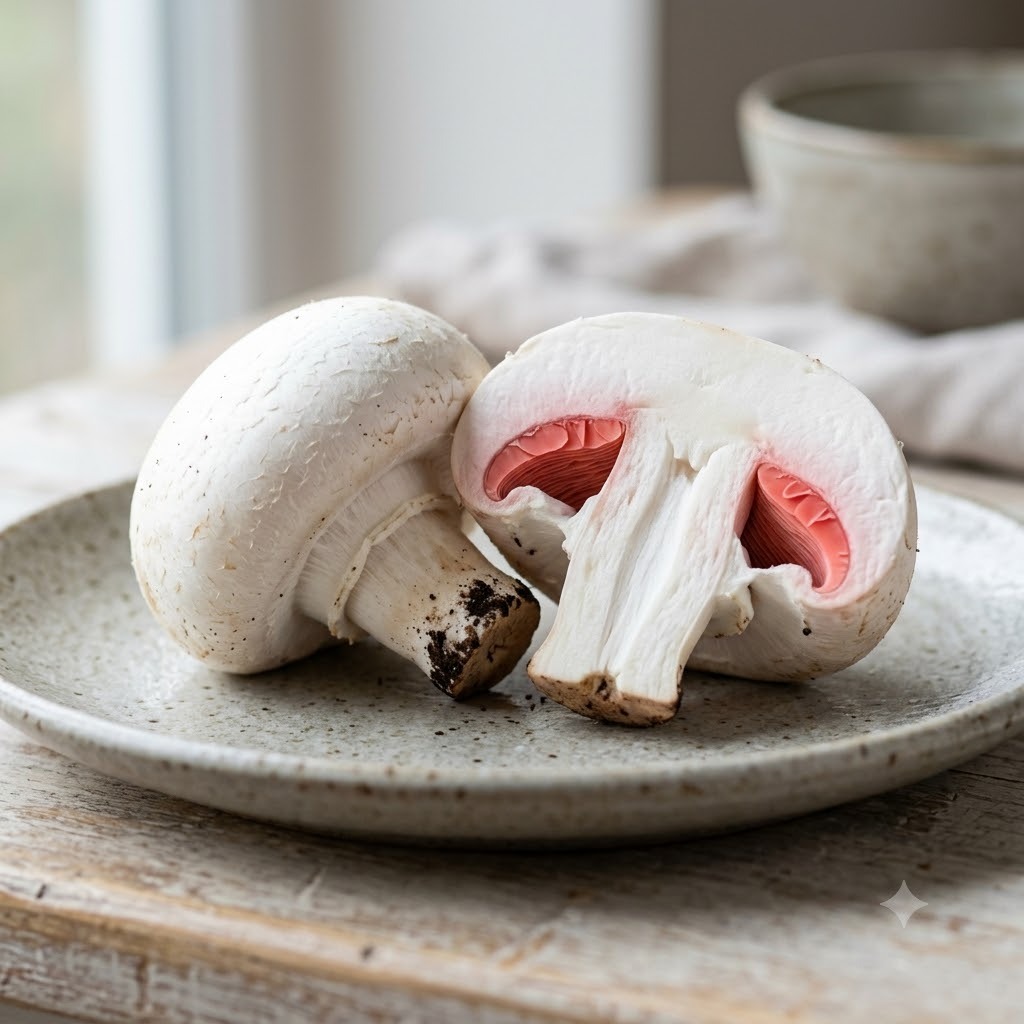
The field mushroom has a white to pale cream cap 3-10 cm across, dry and sometimes slightly scaly, rounded then flattening with age. The single most important safety feature is the gills: in a young field mushroom they are a clear bright pink, darkening through chocolate-brown to almost black as the mushroom matures - they are NEVER white. The stem is short, white, and usually tapers a little at the base, with a thin, often fragile ring that may disappear. There is no volva, no sac, and no bulb at the stem base. The flesh is white and may bruise very slightly pinkish but does NOT turn bright chrome-yellow. The spore print is dark brown. There is a pleasant mushroomy smell, never a chemical or ink-like odour.
Where It Grows
Field mushrooms grow in nutrient-rich, undisturbed grassland: old meadows, grazed pastures, lawns, playing fields, and roadside verges, often where livestock have manured the ground. They are widespread across temperate regions worldwide and fruit from late summer through autumn, especially after warm rain. They favour short, well-established turf and frequently appear in fairy rings or loose scattered groups. Crucially, they grow in the open, out on the grass, and away from trees - which is one habitat clue separating them from woodland Amanitas, although this alone is never enough to confirm identity.
How to Grow at Home
The field mushroom itself is a grassland species that is not practically cultivated at home; it does not take to bags of straw or sawdust the way oyster mushrooms do. If you want to grow this style of mushroom indoors, the sensible and far safer choice is its cultivated relative, the button or chestnut mushroom (Agaricus bisporus), which is sold as ready-made kits on composted, cased substrate. For the true field mushroom, the realistic route is foraging in clean grassland. Some enthusiasts scatter mature caps or spore slurry onto a manured lawn or pasture in the hope of encouraging future rings, but results are slow and unreliable, and anything that fruits still needs the full, rigorous identification before it is eaten. Never let a garden "sowing" tempt you into skipping the safety checks.
Growing Conditions
Light
As an open-grassland mushroom, the field mushroom fruits in full daylight out on the turf, unlike shade-loving woodland species. A garden-lawn attempt would sit in ordinary open light.
Watering
Field mushrooms flush after warm autumn rains soak the turf. A lawn encouraged with spore slurry should be kept naturally moist through the fruiting season, relying mainly on rainfall rather than heavy manual watering.
Temperature & Substrate
This is a late-summer-to-autumn mushroom, fruiting in mild conditions of roughly 10-20°C. Its natural substrate is rich, manured grassland soil in undisturbed pasture and lawn; the cultivated relative uses composted, cased manure-and-straw substrate instead.
Culinary Use
Field mushrooms are excellent cooked and taste much like a richer, more intense button mushroom. Fry them in butter, add them to breakfasts, soups, stews, and sauces, or grill the larger flat caps. They release plenty of dark, flavourful juice. Always cook them thoroughly and use them fresh, as they deteriorate quickly and can turn slimy within a day or two. Older specimens with darkening gills are still edible but stronger in flavour and more likely to harbour insects. Eat a modest portion the first time to check personal tolerance.
Health & Nutrition
Cooked field mushrooms are low in calories and supply protein, fibre, B vitamins, selenium, and potassium, along with beta-glucans. Nutritionally they resemble the cultivated button mushroom. As with every wild species, this is a footnote next to safety: the only mushroom worth eating is one you have identified with total confidence and cooked properly.
Common Problems
- Deadly Amanita confusion - the gravest risk. A young field mushroom with its cap still closed can resemble a young destroying angel (Amanita virosa) or death cap (Amanita phalloides), which are deadly. Amanitas have WHITE gills, a sac-like volva at the stem base, and often a white spore print. Field mushrooms have pink-to-brown gills, dark spores, and no volva. If the gills are white or there is any bulb or sac at the base, do NOT eat it.
- Yellow-stainer (Agaricus xanthodermus) - this toxic look-alike bruises bright chrome-yellow, especially at the stem base when cut, and smells of ink, phenol, or chemicals. It causes stomach cramps, vomiting, and diarrhoea. If the flesh stains bright yellow or the smell is chemical, discard it.
- Rapid spoilage - field mushrooms go slimy and maggoty fast; use them the day they are picked.
- Never picking button-stage specimens - because a closed young Amanita can mimic a young field mushroom, many experts advise avoiding tight buttons and picking only specimens open enough to show clearly pink or brown gills.
Pros & Cons
Pros
- Delicious, with a rich flavour like an intense button mushroom.
- Common and abundant in clean pasture and lawns in a good autumn.
- Versatile in the kitchen, from breakfasts to sauces.
- Grows in the open away from trees, giving one useful habitat clue.
Cons
- Can be confused with deadly white Amanita species - a lethal error.
- The toxic yellow-staining Agaricus xanthodermus is a common look-alike.
- Spoils very quickly after picking.
- Not practically cultivated; foraging carries real risk.
Best Suited For
- Experienced foragers confident in checking gill colour, base, and staining.
- People with access to clean, unsprayed pasture or lawn.
- Cooks who love the flavour of a rich, wild button mushroom.
Not ideal for beginners, anyone tempted to pick closed white buttons, or those who cannot rule out Amanita and yellow-staining Agaricus with certainty.
FAQ
How do I avoid confusing a field mushroom with a deadly Amanita? Check the gills, the base, and the spore print. Field mushrooms have pink-to-brown gills, a dark brown spore print, and no sac or bulb at the base. Deadly Amanitas have white gills, a white spore print, and a volva or sac at the stem base. White gills or a basal sac means do not eat it.
What is the yellow-stainer and how do I spot it? Agaricus xanthodermus is a toxic look-alike that bruises bright chrome-yellow, especially at the cut stem base, and smells of ink or chemicals. If it stains vivid yellow or smells chemical, discard it.
Can I grow field mushrooms indoors? Not really. For an indoor crop, grow the cultivated relative (button or chestnut mushroom) from a kit instead. The wild field mushroom is a foraging species.
Is the golden rule still absolute here? Absolutely. Never eat any wild mushroom unless a 100% confident expert has identified it. With deadly Amanita look-alikes in play, there is zero margin for a guess.