Matsutake
The matsutake (Tricholoma matsutake) is one of the most sought-after wild mushrooms in the world, famous in Japanese, Korean, and Chinese cuisine and commanding some of the highest prices of any foraged fungus.
🗓️ Last reviewed: July 2026
Overview
The matsutake (Tricholoma matsutake) is one of the most sought-after wild mushrooms in the world, famous in Japanese, Korean, and Chinese cuisine and commanding some of the highest prices of any foraged fungus. What sets it apart is its aroma - a heady, spicy blend often described as cinnamon crossed with hot pine and a touch of sweet socks. It grows in a tight partnership with pine and other conifers, pushing up through the needle duff in autumn. This is emphatically a foraged mushroom, not a crop, and it carries a serious warning: it has deadly white lookalikes. Learning matsutake means first learning what can kill you.
Identification & Appearance
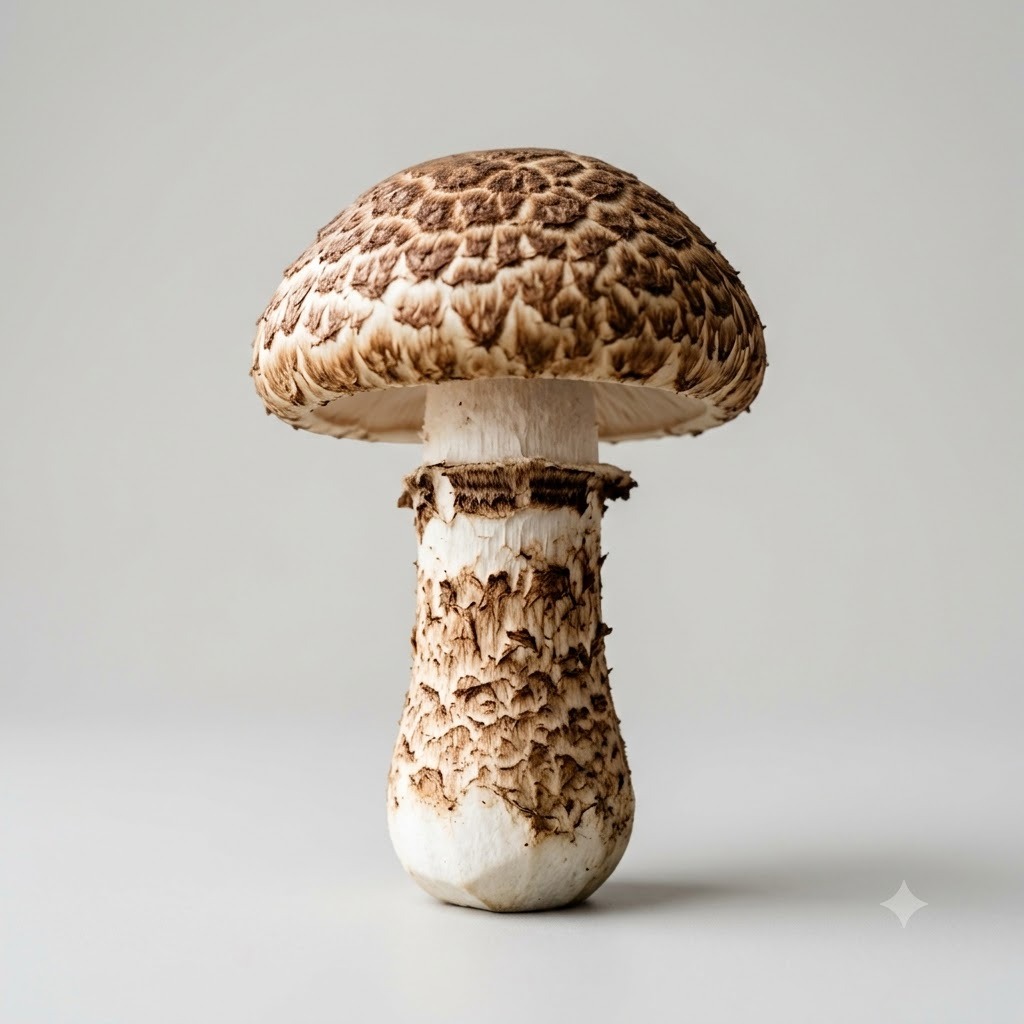
The cap is 6-20 cm across, firm and dense, white to buff and often overlaid with flat brown to reddish-brown fibrous scales that darken with age. The gills are white, crowded, and notched where they meet the stem. The stout stem is white above and scaly-brown below a distinct cottony ring, which is the remnant of a veil that once covered the young gills. The flesh is thick, white, and does not change colour dramatically. Spore print is white. Above all, the mature matsutake carries its unmistakable spicy-cinnamon-pine aroma - the single most reliable field character.
Where It Grows
Matsutake is mycorrhizal with pines and, depending on region, with spruce, fir, hemlock, or oak. It fruits in autumn (and sometimes spring) in nutrient-poor, well-drained soils, often on slopes under mature conifers. It frequently pushes up partly buried under needle litter, sometimes cracking the ground into a raised mound called a "shiro." Experienced hunters learn to read these subtle cracks and bulges in the duff rather than looking for an obvious cap, and they return to the same shiro year after year, since a productive ring can keep fruiting for decades. It is found across Japan, Korea, China, northern Europe (as the related T. nauseosum/caligatum group), and the Pacific Northwest of North America, where a busy commercial harvest supplies the Asian market each autumn.
How to Grow at Home
Here is the plain truth: matsutake cannot be cultivated at home, and it cannot be reliably farmed anywhere. It depends on a decades-old, undisturbed relationship with living pine roots and a very specific soil ecology that no one has managed to reproduce in a bag, a kit, or a garden bed. Every matsutake sold is wild-collected. So the realistic route is foraging under mature pines, and even that takes patience and local knowledge. Think of "growing" as stewardship: protect old pine stands, avoid raking or disturbing the shiro, and cut mushrooms cleanly so the underground network keeps producing year after year.
Growing Conditions
Because matsutake is wild and mycorrhizal, these notes describe its habitat, not a setup you can build.
Light
The mushroom lives in the shade of the forest floor; light is irrelevant to it. What matters is the mature pine or conifer host and undisturbed, poor, well-drained soil above the buried mycelium.
Watering
Matsutake fruits after autumn rains break a warm spell, when soil temperatures cool. A drop in temperature combined with moisture is the classic trigger. Drought years are lean; well-timed rain brings flushes.
Temperature & Substrate
Cool autumn conditions of roughly 10-18°C suit it, often after the first cold nights. The "substrate" is the living root zone of pines in mineral-poor, sandy or gritty soil - not something you provide at home.
Culinary Use
Matsutake is prized for aroma more than texture. Never wash it in water, which dulls the scent - wipe it clean with a damp cloth or scrape the dirty base, then slice thinly. It is traditionally grilled over charcoal, added to clear dashi soups (matsutake dobin mushi steamed in a little teapot), steamed with rice (matsutake gohan), or added at the very end of cooking so the perfume survives. The youngest, tightly closed buttons are the most prized and command the highest prices; fully opened caps are still good but milder. Always cook it; never eat wild mushrooms raw. Use it fresh and quickly, as the aroma fades within days - it does not store like a firm bolete, though it can be sliced and briefly preserved in dashi or gently dried by traditional methods.
Health & Nutrition
Low in calories, matsutake provides protein, fibre, B vitamins, copper, and selenium, along with beta-glucans studied for immune support. Its main value, though, is culinary and cultural rather than nutritional - in Japan a single fine specimen can be given as a prized autumn gift, and the season is celebrated much as truffle season is elsewhere. As with any wild mushroom, cook it fully and try a small amount the first time to check personal tolerance, and gather only from clean woodland away from roads and industry.
Common Problems
- Deadly white Amanita lookalikes - young matsutake can resemble the deadly Amanita smithiana and destroying-angel Amanitas (Amanita virosa and relatives). These can kill. Amanitas grow from a cup-like sac (volva) at the base, have a different veil structure, and crucially LACK the spicy-cinnamon-pine aroma. Always dig up the whole base and smell every mushroom.
- No aroma - if it does not smell strongly of spicy pine and cinnamon, do not treat it as matsutake. Aroma is the key living character.
- Maggot damage - older shiro mushrooms are often infested; slice to check.
- Buried, hard to spot - matsutake often hides under needles; hunt for the raised cracked mound rather than a full cap.
Pros & Cons
Pros
- One of the most aromatic and prized wild mushrooms on earth.
- Firm texture that holds up to grilling and soups.
- A rewarding, high-value foraging target.
Cons
- Cannot be cultivated - wild foraging only.
- Has DEADLY white Amanita lookalikes; a mistake can be fatal.
- Scarce, seasonal, and slow to find.
- Aroma fades fast after picking.
Best Suited For
- Experienced foragers who can rigorously separate it from Amanita.
- Cooks seeking a rare, aromatic wild delicacy.
- People with access to mature, undisturbed pine woodland.
Not ideal for beginners, anyone hoping to grow it indoors, or foragers who cannot confidently identify deadly white Amanitas.
FAQ
Can matsutake be grown at home? No. It is mycorrhizal, tied to living pine roots and a specific soil ecology, and has never been reliably cultivated. All matsutake is foraged.
How do I tell it from a deadly Amanita? Smell first - matsutake has a strong spicy-cinnamon-pine aroma; deadly Amanitas do not. Then check the base: Amanitas emerge from a cup-like volva. Dig up the whole mushroom and examine veil, ring, and base. When unsure, do not eat it.
Why does mine have no smell? Then treat it as suspect and do not eat it. Aroma is the defining, non-negotiable character of matsutake.
Never eat a matsutake without 100% expert identification. Its lookalikes can be fatal. If you cannot positively confirm the cap scales, ring, gill attachment, base, and above all the aroma, do not eat it. When in doubt, throw it out.