Parasol Mushroom
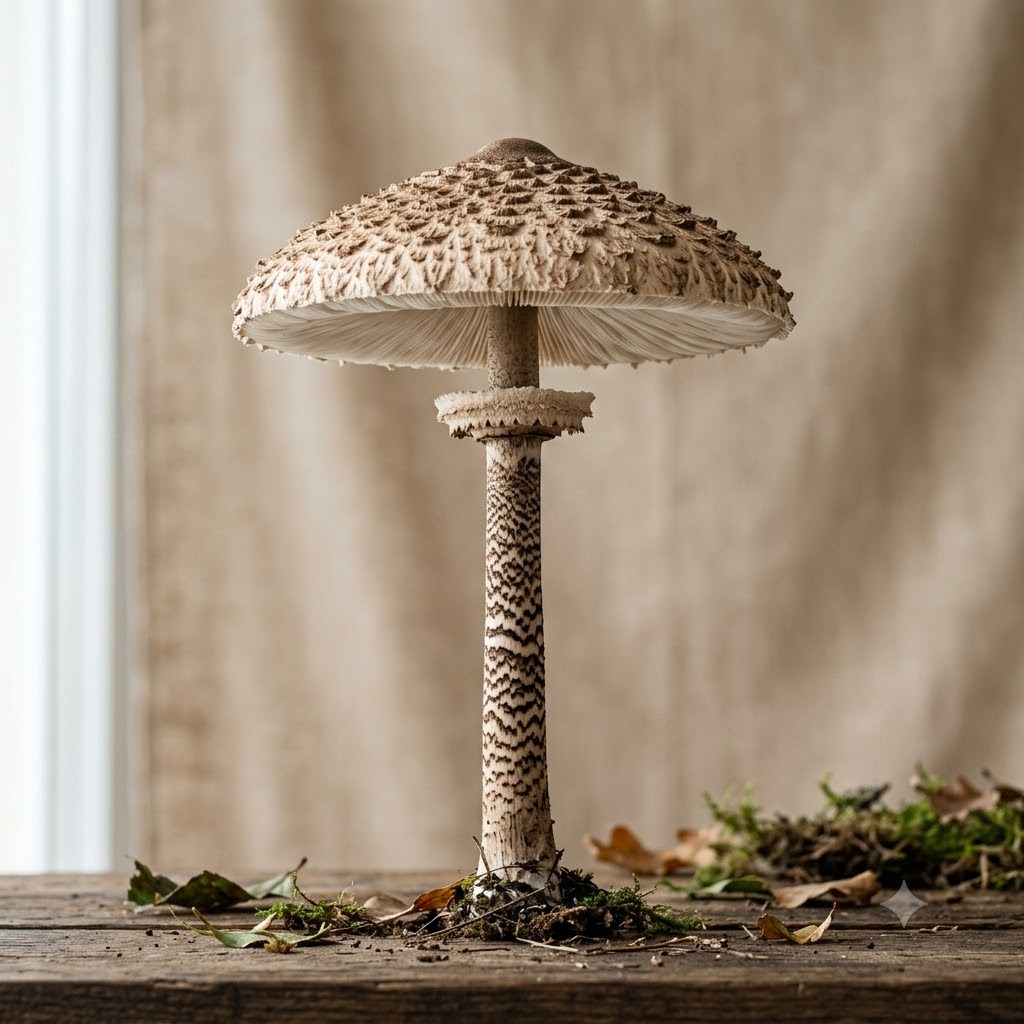
The parasol mushroom (Macrolepiota procera) is one of the most prized wild edibles in Europe - a tall, elegant fungus whose broad cap opens like a folded umbrella and whose flesh has a rich, nutty, almost popcorn-like flavour when fried.
🗓️ Last reviewed: July 2026
Overview
The parasol mushroom (Macrolepiota procera) is one of the most prized wild edibles in Europe - a tall, elegant fungus whose broad cap opens like a folded umbrella and whose flesh has a rich, nutty, almost popcorn-like flavour when fried. It is not a cultivated mushroom you can buy as a kit; it is a forager's find, appearing in grassy clearings, pastures, and woodland edges from late summer into autumn. Its size makes it striking and, in theory, easy to spot - but it also has toxic look-alikes that put it firmly in the "expert identification only" category. Treated with respect and correct knowledge, it is a spectacular seasonal treat.
Identification & Appearance
The parasol is large and distinctive. Mature caps reach 10-30 cm across, starting egg-shaped and expanding to a flat parasol with a raised central bump (an umbo). The cap surface is pale buff to greyish, broken into coarse brown scales, with a smoother darker centre. The gills are free (not touching the stem) and white to cream. The stem is tall and slender - often 15-40 cm - hollow, and marked with a distinctive brown snakeskin or "python" banding pattern. Near the top sits a thick, movable double ring that can be slid up and down the stem, a key feature. The flesh does not change colour dramatically when cut, and the spore print is white.
Where It Grows
Parasols favour open, well-drained ground: unimproved pastures, grassy woodland rides, road verges, dune grassland, and the edges of deciduous or mixed woodland. They are most common on nutrient-poor, sunny grassland across temperate Europe and parts of Asia and North America. Fruiting runs from midsummer through autumn, often after warm rain, and the mushrooms may appear singly, in scattered troops, or in loose rings.
How to Grow at Home
Be honest with yourself here: the parasol mushroom is not practically cultivated. It is a grassland fungus with complex, poorly understood relationships to soil and organic matter, and there is no reliable home-growing kit or substrate recipe that produces it. Unlike oyster or shiitake, you cannot buy spawn and expect a crop. This is a mushroom you forage, not farm. If you want parasols, the realistic path is learning to find and identify them in the field with an experienced mentor. Note the ground where you find them - the same clearings and pastures often fruit year after year, so responsible foragers return to known patches rather than trying to cultivate.
Growing Conditions
Light
Not applicable to home cultivation. In the wild, parasols favour open, sunlit grassland rather than deep shade - a clue to where to look when foraging.
Watering
Not applicable to home cultivation. Wild fruiting is triggered by warm, damp weather; a spell of rain after warm days in late summer is the classic prompt for a flush.
Temperature & Substrate
Not applicable to home cultivation. In nature the fungus lives in grassland soils rich in decaying organic matter, fruiting in the mild temperatures of late summer and autumn. There is no home substrate that reliably reproduces these conditions.
Culinary Use
The parasol is a genuine gourmet mushroom. The classic preparation uses only the caps of mature specimens: the tough, fibrous stems are usually discarded or used to flavour stock. Large flat caps are superb egg-and-breadcrumb coated and fried like a schnitzel, crisping at the edges with a nutty flavour. Younger caps can be sliced and sautéed in butter, added to risottos, or dried and powdered as a seasoning. Always cook parasols thoroughly - never eat them raw. Because of the look-alike risk, only cook specimens you have identified with complete confidence.
Health & Nutrition
Like most edible mushrooms, parasols are low in calories and fat, and provide protein, fibre, B vitamins, and minerals such as potassium and selenium. They contain beta-glucans, the fibres associated with immune and gut support. Their nutritional value is modest compared with the pleasure of eating them; they are enjoyed as a seasonal delicacy rather than a dietary staple. As with all wild mushrooms, eat only a small amount the first time to check for personal sensitivity.
Common Problems
- Misidentification - the single most serious risk. Toxic look-alikes exist (see Pros & Cons); never eat a parasol you are not 100% certain of.
- Maggots and insect damage - large caps are often colonised by larvae; check the flesh before cooking.
- Old, tough specimens - past-prime caps become leathery and can cause stomach upset; pick young, clean, fresh caps.
- Not cooking thoroughly - raw or undercooked parasols can cause digestive upset even when correctly identified.
Pros & Cons
Pros
- One of the finest-flavoured wild edibles - nutty and satisfying.
- Large size makes a single find worthwhile.
- Distinctive features (snakeskin stem, movable double ring) aid identification.
- Reappears reliably in the same grassland patches.
Cons
- Cannot be cultivated at home - forage only.
- Dangerous toxic look-alikes demand expert identification.
- Available only for a short season.
- Large caps are frequently maggot-ridden.
Best Suited For
- Experienced foragers with confident field identification skills.
- People with access to unimproved grassland and woodland edges.
- Cooks who enjoy a genuine seasonal wild delicacy.
Not ideal for beginners foraging alone, or anyone wanting a mushroom they can grow indoors.
Safety Warning - Dangerous Look-alikes
The parasol has serious toxic mimics, and you must never eat a wild mushroom without 100% expert identification. The most dangerous confusions are with poisonous Chlorophyllum species (such as Chlorophyllum molybdites, the green-spored parasol, which causes severe gastrointestinal poisoning) - these can look similar but typically bruise, lack the clean snakeskin stem pattern, and may give a greenish spore print. Crucially, never eat any small parasol-like mushroom: small dapperlings (Lepiota species) include deadly, amatoxin-containing fungi that can be fatal, and they resemble miniature parasols. As a rule, foragers accept only large specimens with the full set of features - the tall snakeskin-banded stem, the free white gills, the white spore print, and the thick movable double ring. If any single feature is missing or wrong, do not eat it. When in doubt, throw it out, and always learn from an experienced mentor before eating this species.
FAQ
Can I grow parasol mushrooms at home? No. They are not practically cultivated - there is no reliable kit or substrate. Parasols are a foraged wild mushroom, found in grassland and woodland edges.
What is the best way to tell a real parasol from a dangerous look-alike? Look for the combination of large size, a tall snakeskin-patterned stem, free white gills, a white spore print, and a thick ring that slides up and down. Never eat small parasol-like mushrooms, and always confirm identification with an expert.
Which part do I eat? Mainly the caps. The stems are fibrous and usually discarded; the flat mature caps are best, often fried in breadcrumbs.
Is it safe to eat parasols raw? No. Always cook wild parasols thoroughly, and only ever eat specimens you have identified with complete certainty.