Saffron Milk Cap
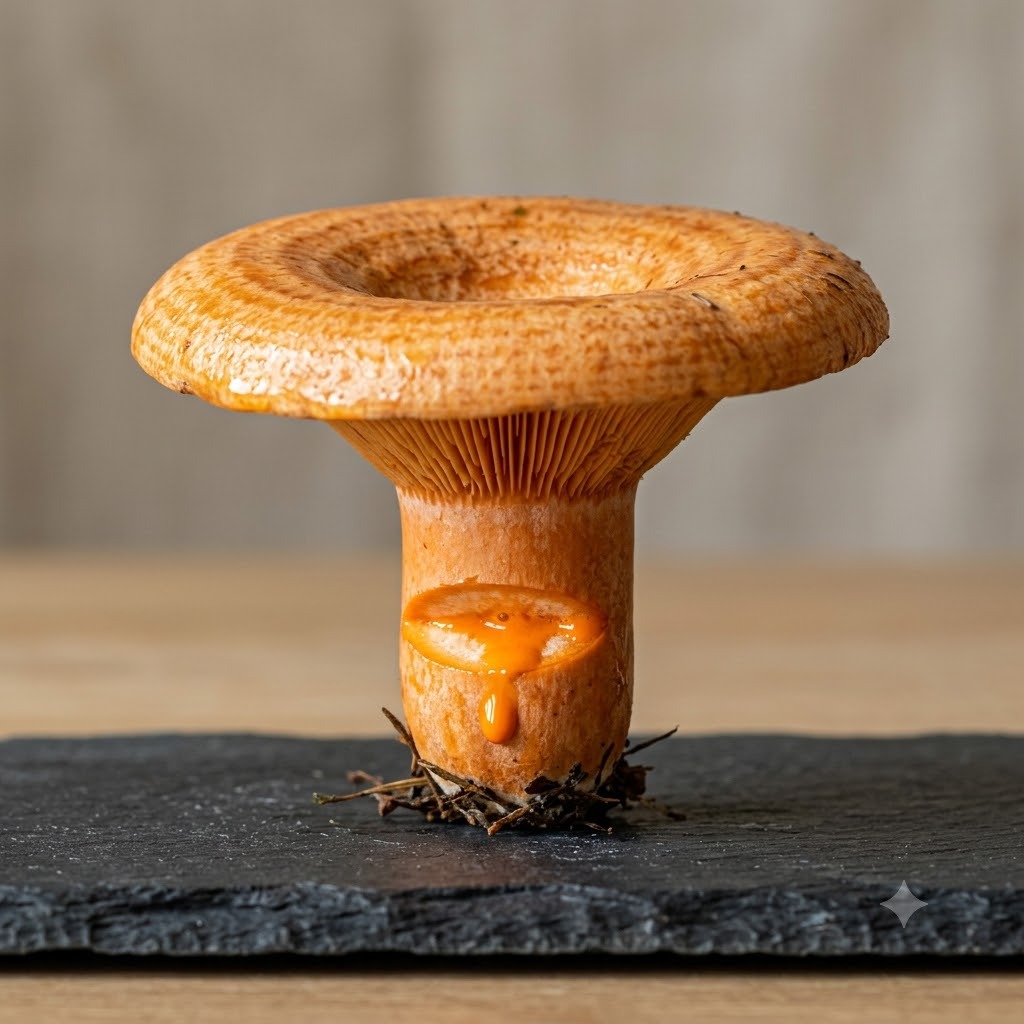
The saffron milk cap (Lactarius deliciosus) is one of the most celebrated wild edibles of the pine forest, famous for the bright orange-to-carrot-coloured latex, or "milk", that seeps from its flesh when cut.
🗓️ Last reviewed: July 2026
Overview
The saffron milk cap (Lactarius deliciosus) is one of the most celebrated wild edibles of the pine forest, famous for the bright orange-to-carrot-coloured latex, or "milk", that seeps from its flesh when cut. It is a mycorrhizal mushroom, meaning it grows in partnership with the roots of pine and other conifers and cannot be cultivated on a substrate in the ordinary way. Foragers across Europe, and especially in Spain, Catalonia, Poland, and the Mediterranean, treasure it for its firm, slightly crunchy texture and its mild, nutty flavour. This profile treats the saffron milk cap as a foraging species and stresses the safety checks that separate it from its look-alikes.
Identification & Appearance
The saffron milk cap has a convex-to-funnel-shaped cap 4-12 cm across, coloured orange with darker concentric rings or zones, often greening where bruised or aged. The gills run slightly down the stem and are orange, staining green with handling and time. The single most reliable feature is the latex: when you cut or scratch the flesh or gills, it bleeds a clear carrot-orange milk that does not turn white and slowly turns greenish. The stem is orange, often with small darker pits, and is hollow when mature. There is no ring and no volva. The spore print is pale ochre to pinkish-buff. The whole mushroom has a faint fruity or resinous smell of pine.
Where It Grows
Saffron milk caps are strictly associated with conifers, above all pines, and are found on sandy or acidic soils in pine plantations, mixed conifer woods, and dune forests. They are widespread across Europe, North Africa, and parts of Asia, and have been introduced with planted pines to other regions including Australia and the Americas. They fruit in autumn after rain, appearing scattered or in troops beneath the trees they partner with. Because they are mycorrhizal, they will only ever be found near living conifer roots, never on logs, compost, or dead wood.
How to Grow at Home
The saffron milk cap cannot be grown at home in any practical sense. It is a mycorrhizal fungus that lives in symbiosis with pine roots, so it needs a living host tree and years of established partnership to fruit - it cannot be raised on straw, sawdust, or compost like an oyster or button mushroom. The only realistic route is foraging, or, for the very patient, planting pine seedlings inoculated with saffron milk cap spores and waiting many years in the hope of an eventual harvest. That is a landscaping project, not a kitchen one. For everyone else, treat this as a mushroom to find, not to grow: study it with an expert, confirm the orange latex and pine association, and never eat one unless your identification is beyond doubt.
Growing Conditions
Light
As a woodland species found beneath conifers, it needs only the dim, filtered light of a pine canopy. There is no home-growing light requirement, since it cannot be cultivated indoors.
Watering
Saffron milk caps fruit after steady autumn rain has soaked the pine-forest floor. Moisture in the litter and soil, provided by natural rainfall, drives fruiting - there is nothing to water at home.
Temperature & Substrate
This is an autumn species, fruiting in cool, damp conditions typically between about 8 and 18°C. Its "substrate" is the living root system of pine and other conifers in acidic, sandy soil; it forms a mycorrhizal sheath around those roots and cannot use an artificial substrate.
Culinary Use
Saffron milk caps are firm and hold their shape well, making them ideal for grilling, frying, and roasting rather than for delicate sauces. In Catalonia they are famously grilled whole with olive oil, garlic, and parsley. They are best cooked simply and thoroughly; the texture stays pleasantly crunchy and the flavour is mild and nutty with a hint of pine. They can be slightly gritty, so clean them carefully. The orange colour mellows to a warm brown on cooking. As with all wild mushrooms, cook them fully and eat only a modest portion the first time you try them.
Health & Nutrition
Cooked saffron milk caps are low in calories and provide protein, fibre, B vitamins, and minerals, along with the beta-glucans common to edible mushrooms. Their orange pigment comes from carotenoid compounds. As always, nutrition is a minor point next to safety: the value of any mushroom is only realised when it is correctly identified and properly cooked. Eat a small amount first to check personal tolerance.
Common Problems
- Confusing the milk colour - the defining safety check is the latex. Saffron milk cap bleeds carrot-orange milk that slowly greens. Some related Lactarius species bleed white, acrid milk and can cause stomach upset; if the milk is white, it is not L. deliciosus.
- Look-alike milk caps - the false saffron milk cap (Lactarius deterrimus) is similar and edible but poorer, while other orange Lactarius vary in quality. When unsure of the exact species, do not eat it.
- Green staining alarms newcomers - greening of the flesh and gills is normal and not a sign of spoilage in this species.
- Grittiness - the pits in the stem and the sandy habitat trap grit; clean thoroughly.
Pros & Cons
Pros
- Distinctive and relatively easy to recognise thanks to its orange latex.
- Firm texture that grills and fries beautifully.
- Widespread in pine woods and often abundant in a good year.
- No deadly look-alikes when the orange-milk and pine checks are done properly.
Cons
- Cannot be cultivated - foraging is the only realistic option.
- Can be gritty and needs careful cleaning.
- Poorer or upsetting Lactarius look-alikes exist for the careless.
- Quality varies; some finds are bland or maggoty.
Best Suited For
- Foragers with access to pine and conifer woodland.
- Cooks who want a firm mushroom for grilling and roasting.
- Those learning to use latex colour as an identification tool.
Not ideal for anyone wanting a cultivated mushroom, or foragers who cannot reliably confirm the orange, slowly-greening milk and the conifer association.
FAQ
What makes the saffron milk cap easy to recognise? Cut the flesh or gills: true saffron milk cap bleeds a clear carrot-orange milk that slowly turns greenish, and it grows only near pines and other conifers. White milk or a non-conifer habitat rules it out.
Can I grow saffron milk caps at home? No. They are mycorrhizal and need a living conifer host, so they cannot be grown on a substrate. Only very long-term inoculated pine planting offers any hope of a harvest, over many years.
Is the green staining a bad sign? No. Greening of the flesh, gills, and cap is normal for this species and does not mean the mushroom has spoiled.
Do I still need expert confirmation? Yes, always. Never eat any wild mushroom unless a 100% confident expert has identified it. Even with the helpful orange-milk clue, confirm the species before eating.