Slippery Jack
The slippery jack (Suillus luteus) is a common, easily recognised bolete found under pines across the northern hemisphere and widely introduced wherever pines have been planted.
🗓️ Last reviewed: July 2026
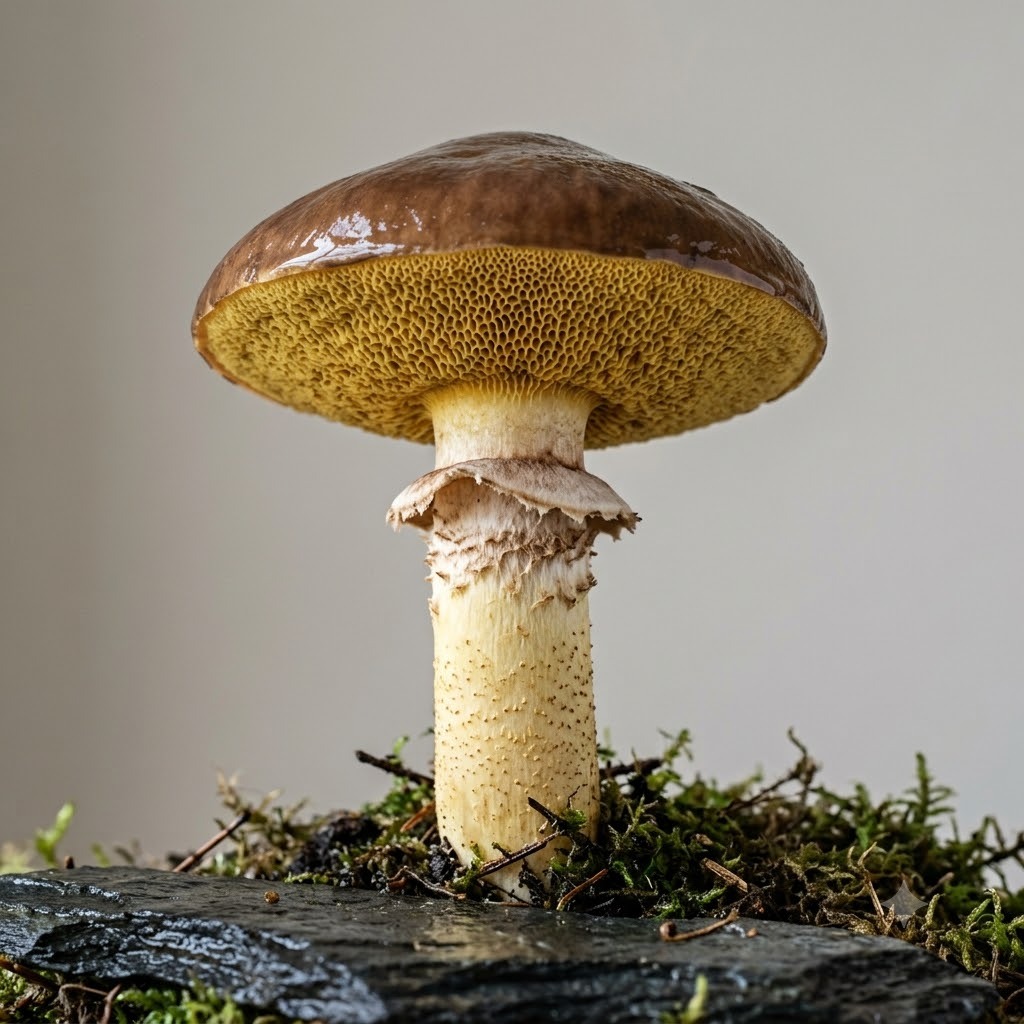
Overview
The slippery jack (Suillus luteus) is a common, easily recognised bolete found under pines across the northern hemisphere and widely introduced wherever pines have been planted. Its name comes from the glossy, slimy brown cap that feels like a wet toffee. It is a decent, mild edible enjoyed in many countries - especially popular in Eastern European and Baltic kitchens - but it comes with two practical catches: the slimy skin should be peeled off, and eaten in quantity or with the skin left on it can act as a laxative and upset sensitive stomachs. Like all boletes, it is a wild, mycorrhizal mushroom that cannot be grown at home.
Identification & Appearance
The cap is 4-12 cm across, chocolate to reddish-brown, and distinctly slimy or sticky, especially in wet weather. Underneath are pores, not gills - pale yellow, small, and fine, ageing to dull yellow-olive. A key feature is the stem: it carries a soft, membranous ring, purplish-brown to whitish, left behind by a partial veil that once covered the pores. Above the ring the stem is dotted with tiny glandular specks; below it is paler. The flesh is soft, whitish to pale yellow, and does not bruise blue - a useful check, since a strong blue stain points to a different bolete. Spore print is dull brown to cinnamon. Taken together, the slimy brown cap, fine yellow pores, ringed and dotted stem, and pine-wood habitat make it one of the more straightforward boletes to recognise.
Where It Grows
Slippery jack is mycorrhizal with pines, especially two-needle pines such as Scots pine, and is found in native pine woods and in planted pine stands, shelterbelts, and plantations worldwide - it has travelled with pine forestry to the southern hemisphere as well, appearing wherever pine seedlings were shipped with their fungal partners. It fruits from late summer into late autumn, often in groups, on sandy or well-drained soils, along forest tracks, and in young plantations. Younger plantations of ten to thirty years old are often especially productive. Because pines are so widely planted, it is one of the most accessible and abundant wild boletes, and for many foragers it is among the first they learn to gather in quantity.
How to Grow at Home
Honestly, you cannot grow slippery jack at home. It is mycorrhizal and needs living pine roots, so it will never fruit on straw, sawdust, or in a kit like oyster or shiitake mushrooms. There is no home-cultivation route. The realistic path is foraging in pine woods and plantations. If you want to encourage it, the only real lever is habitat: healthy pine stands on sandy soil. Otherwise, treat "growing" as learning where and when it appears each autumn, and harvest by cutting or gently twisting so the underground network survives to fruit again.
Growing Conditions
As a wild, mycorrhizal species these notes describe habitat, not an indoor setup.
Light
Irrelevant to the mushroom, which lives in the shade of the pine canopy. The living pine host and well-drained soil are what matter.
Watering
Slippery jack fruits after rain in warm-to-mild autumn weather. A wet spell followed by humid days brings flushes; dry spells leave the woods bare.
Temperature & Substrate
It favours mild autumn conditions, roughly 10-20°C. The "substrate" is the sandy, well-drained root zone of living pines - not something you can provide at home.
Culinary Use
Slippery jack is a mild, pleasant edible, but preparation matters. Peel off the slimy skin from the cap before cooking - it is easy to pull away, starting from the cap edge, and removes the sliminess and much of the laxative tendency. Many cooks also scrape off the spongy pore layer in older specimens, since it turns slippery and unpleasant once cooked. Then slice and cook thoroughly; never eat it raw. It suits soups, sautes, stews, and pickling, and is particularly popular pickled in vinegar and spices in Eastern European kitchens, where jars of preserved slippery jacks are a traditional autumn store. It also dries well once peeled. Eat modest portions the first time, as some people find even peeled ones mildly laxative.
Health & Nutrition
Low in calories, it offers protein, fibre, B vitamins, and minerals. Its beta-glucans, like those of other boletes, are studied for immune support. The main caution is digestive: the slimy cuticle can loosen the bowels, so peeling and moderation are wise. Like other boletes it can also take up trace metals and, in some regions, radioactive caesium from the soil, so gather from clean woodland away from roads and industry and do not eat very large amounts habitually. Always cook it fully and start with a small amount to check personal tolerance.
Common Problems
- Laxative effect / stomach upset - most often from leaving the slimy skin on or eating large amounts. Peel the cap and eat modest portions.
- Slimy, hard-to-handle caps - normal for the species; peeling solves it. In dry weather the cap is less sticky.
- Maggot damage - common in older specimens; slice the stem to check and discard riddled ones.
- Confusing Suillus species - several similar slippery boletes grow under conifers. Most are edible with the same peeling advice, but always confirm before eating.
Pros & Cons
Pros
- Common, widespread, and easy to recognise by its slimy cap and ringed stem.
- Mild, pleasant flavour good for soups and pickling.
- Accessible thanks to widely planted pines.
- Can be dried for storage.
Cons
- Cannot be cultivated at home - foraging only.
- Slimy skin must be peeled; can be laxative if eaten with skin or in quantity.
- Often maggot-infested when older.
- Not a strong-flavoured gourmet mushroom.
Best Suited For
- Foragers with easy access to pine woods or plantations.
- Cooks who want a mild mushroom for soups, stews, or pickling.
- Beginners learning an easy-to-recognise bolete - with proper ID.
Not ideal for anyone hoping to grow it indoors, people with sensitive stomachs who skip the peeling step, or those wanting a bold gourmet flavour.
FAQ
Can I grow slippery jack in a kit? No. It is mycorrhizal and needs living pine roots. No kit or bag will fruit it - it is a foraged mushroom.
Why do I need to peel it? The slimy cap cuticle is the main cause of its laxative reputation and is unpleasant in texture. Peeling it away, and scraping old pores, makes the mushroom much more agreeable.
Is it safe to eat? For most people, yes, when peeled, cooked, and eaten in moderation - but some still find it mildly laxative. Try a small portion first and never eat it raw.
Never eat a slippery jack without 100% expert identification. Confirm the slimy brown cap, yellow pores, ringed stem with glandular dots, and brown spore print. If you cannot positively identify it, do not eat it. When in doubt, leave it out.