Velvet Shank
The velvet shank (Flammulina velutipes) is the wild ancestor of the cultivated enoki mushroom - but in nature it looks nothing like the pale, spindly enoki of the supermarket.
🗓️ Last reviewed: July 2026
Overview
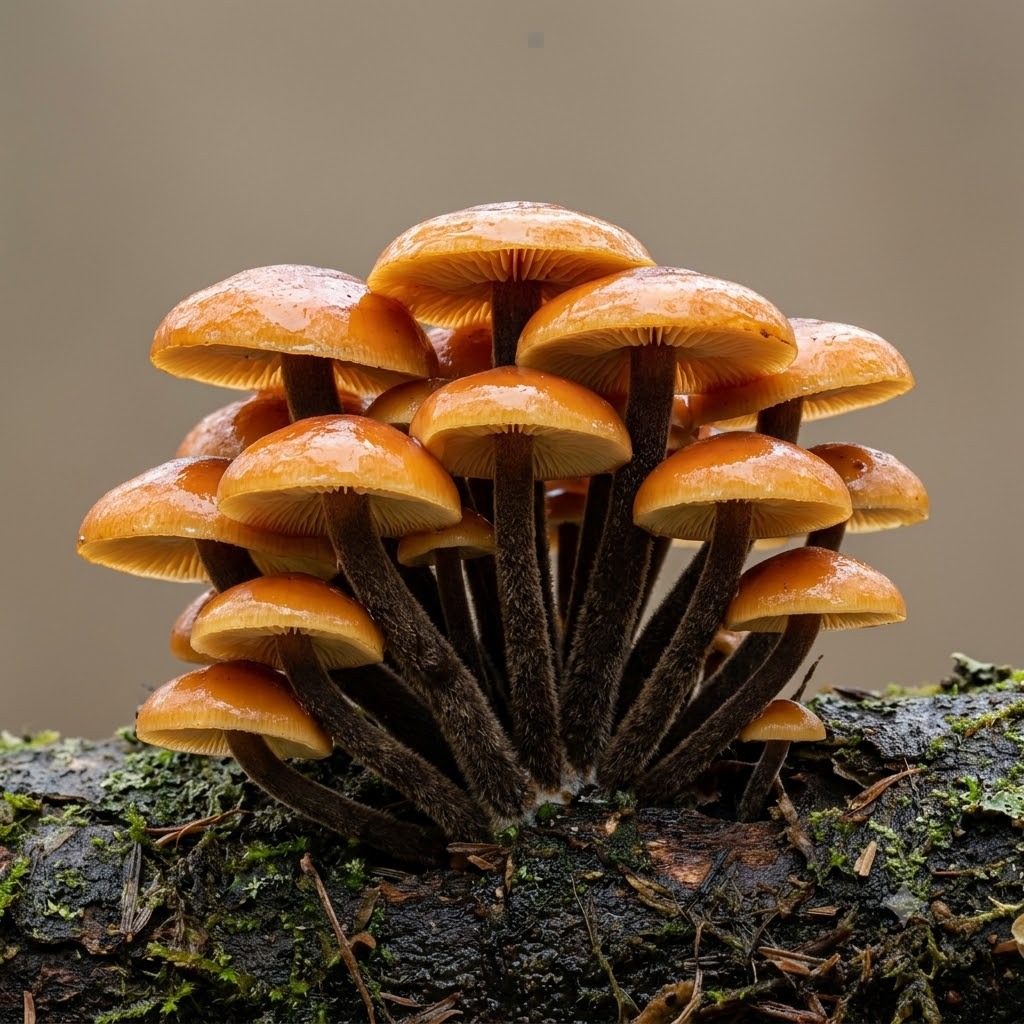
The velvet shank (Flammulina velutipes) is the wild ancestor of the cultivated enoki mushroom - but in nature it looks nothing like the pale, spindly enoki of the supermarket. In the wild it is a bright orange-brown, glossy-capped mushroom with a distinctive dark, velvety stem, and it has the remarkable habit of fruiting in the depths of winter, even pushing through frost and snow. This makes it a rare treat for cold-season foragers when almost nothing else is fruiting. It is a genuinely good edible, but it carries one of the most important safety warnings in this entire book, because it has a deadly poisonous look-alike.
Identification & Appearance
The wild velvet shank has a smooth, sticky, shiny cap 2-10 cm across, coloured warm orange to tawny brown, often darker in the centre and paler at the margin. The gills are pale - white to yellowish - and fairly well spaced. The most diagnostic feature is the stem: tough, and covered in a fine dark brown to blackish velvety coating, especially towards the base, giving the mushroom its name. The stem is usually paler at the very top near the gills and darkens downward. The flesh is thin and the spore print is white. Velvet shanks grow in tufted clusters on wood, often in large numbers from the same log or stump.
Where It Grows
Velvet shank is a wood-decaying fungus of dead and dying hardwoods, especially elm, beech, willow, poplar, and ash. It fruits on dead trunks, fallen logs, stumps, and wounds on living trees, in deciduous and mixed woodland, parks, and hedgerows across temperate regions. Its defining feature is timing: it fruits from late autumn through winter into early spring, often during frosty spells, when its cold tolerance lets it flush while other fungi are dormant. Clusters may reappear on the same wood over several winters.
How to Grow at Home
An honest note: while the cultivated white enoki form of this species is grown commercially in controlled, high-carbon-dioxide conditions to produce those long pale stems, that is an industrial process, not a home project. The wild velvet shank as you would find and identify it is not something you practically cultivate at home from a simple kit; the wild-type mushroom is a foraged find on dead hardwood. If you want wild velvet shanks, the realistic path is winter foraging: learn its habitat, its cold-season timing, and above all how to separate it from its deadly look-alike, ideally with an experienced mentor. Note the logs and stumps where you find it, as they often fruit again in later winters.
Growing Conditions
Light
Not applicable to home cultivation of the wild mushroom. In the wild it grows on wood in woodland and hedgerow, in the low light of the winter months - a habitat clue when foraging.
Watering
Not applicable to home cultivation. Wild fruiting is triggered by cold, damp late-autumn and winter conditions; the mushroom tolerates frost and can even continue after freezing.
Temperature & Substrate
Not applicable to home cultivation of the wild form. In nature it lives on dead hardwood and fruits at low temperatures, from just above freezing up through the cool of late autumn and early spring. No simple home substrate reproduces the wild mushroom.
Culinary Use
Velvet shanks are a good winter edible with a mild, slightly fruity flavour and a pleasant slippery-firm texture. The stems are tough and are usually trimmed away or discarded; the caps are the choice part. Remove the sticky layer if you prefer, then cook thoroughly - never eat them raw. They are excellent in soups, stews, stir-fries, and Asian-style broths, where their texture shines, and they pair well with winter vegetables and noodle dishes. Because they fruit when little else is available, they are especially valued for hearty cold-weather cooking. Always cook only specimens you have identified with absolute certainty.
Health & Nutrition
Like other edible mushrooms, velvet shanks are low in calories and fat and provide protein, fibre, and B vitamins. As a Flammulina species, they contain beta-glucans and other compounds studied for immune and general health support. Their main value to a forager, though, is seasonal: a fresh source of wild mushrooms in the middle of winter. As always with wild mushrooms, eat only a small amount the first time to check for personal sensitivity, and cook them fully.
Common Problems
- Deadly look-alike confusion - the most serious risk of any mushroom in this book (see the safety section); never eat one without certainty.
- Tough stems - trim away the fibrous velvety stems and keep the caps.
- Sticky caps trapping debris - the glutinous surface catches dirt and leaves; clean carefully.
- Undercooking - always cook thoroughly; never sample raw.
Pros & Cons
Pros
- Fruits in winter when almost nothing else does.
- Mild, pleasant flavour and good texture for broths and stir-fries.
- Grows in generous clusters on dead wood.
- Reappears on the same logs over several winters.
Cons
- Cannot be practically cultivated at home in its wild form - forage only.
- Has a deadly poisonous look-alike, making expert ID essential.
- Tough stems must be discarded.
- Sticky caps need careful cleaning.
Best Suited For
- Confident winter foragers who know their local dead hardwoods.
- Cooks wanting a wild mushroom for cold-season soups and broths.
- People able to reliably separate it from its dangerous look-alike.
Not ideal for beginners, unsupervised foragers, or anyone unsure of the deadly look-alike.
Safety Warning - Dangerous Look-alikes
This is the most important warning for this mushroom, and it must not be taken lightly: never eat a wild velvet shank without 100% expert identification. The velvet shank has a deadly poisonous look-alike, the funeral bell (Galerina marginata), which contains the same lethal amatoxins as the death cap and can be fatal. Galerina also grows in clusters on wood, sometimes in cool weather, and can appear superficially similar to an inexperienced eye. The critical differences: velvet shank has a white spore print, pale gills, and a dark velvety stem with no ring, whereas Galerina marginata has a rusty-brown spore print, browner gills, and typically a ring or ring-zone on the stem. Because the consequences of a mistake are potentially fatal, a beginner should never eat a velvet shank on their own judgement. Always take a spore print, check every feature, and confirm your identification with an experienced expert before eating. When in any doubt at all, do not eat it.
FAQ
Is wild velvet shank the same as enoki? They are the same species, but the wild mushroom looks completely different from cultivated white enoki - it has an orange-brown sticky cap and a dark velvety stem rather than long pale stems.
Can I grow it at home? Not the wild form practically. Commercial white enoki is grown industrially in controlled conditions; the wild velvet shank is a foraged winter mushroom on dead hardwood.
What is the biggest safety risk? Its deadly look-alike, the funeral bell (Galerina marginata), which contains lethal amatoxins. Never eat a velvet shank without expert identification and a white spore print.
When and where do I find it? On dead hardwoods such as elm, beech, and willow, mainly from late autumn through winter, often during frosty spells when little else is fruiting.